



Finding Harmony with the Hōlua
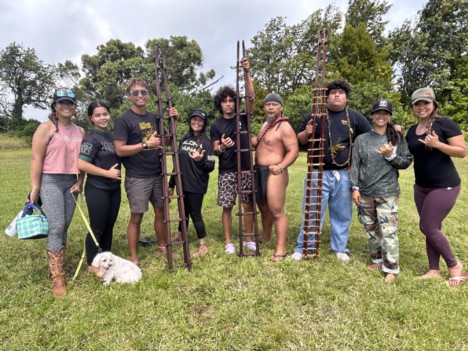
Hōlua workshop participants included Ho’akā Mana’s Kanoelani Davis, Kamahina Kahalewai, Azriel Mendoza, Steph Kaplan, Ka’ohu Stone, Makaio Villanueva, Brayden Lawelawe, Aulani Herrod-Perkins, and Anuhea Beair. Photos by Dayanti Karunaratne
By Dayanti Karunaratne | Editor
Some stood back, unsure if they would take a turn, while others were keen to throw themselves on the Hōlua and ride down the grassy hill. A few stood upright, but most lay their chest on the smooth wooden crossbars, their hands gripping the frame of the traditional Hawaiian sled. Some accelerated, others stumbled off, but everyone seemed to come up smiling.
“I think the most beautiful part of this experience was how some of them hesitated at the beginning, and by the end, they gave it a try,” workshop organizer Kanoelani Davis of Hoʻaka Mana said. “I was really proud of them, and they were so excited that they did it. And they were successful, and were courageous.”
The riding of the Hōlua was the culmination of a workshop organized by Hoʻaka Mana, a Native Hawaiian organization that focuses on mental health and well-being. About ten people spent two days exploring heʻe Hōlua, or Hawaiian sledding, as well as kaula, traditional Hawaiian cordage.
Hoʻaka Manaʻs mission is to “inspire healthier families with a connection to Native Hawaiian practices focusing on emotional and mental well-being by establishing indigenous identity foundations through experience and education.”
For Davis, a connection to Native Hawaiian practices means integrating many teachings. “We can take what we know about the island, what we know about our culture, what we know about traditional healing, and harmonize it, so it doesn’t look separate,” she said.
“What happened to us a long time ago is, everything was separated in order for it to be controlled. Our history was separated, our culture was separated, in order for it to be controlled,” Davis said. “So if you could separate the language and the culture and the land, it was a way to control and, for lack of a better word, colonize us,” Davis said. “So what I wanted to do with this program was harmonize.”
As a cultural practitioner who works throughout the state to promote traditional healing practices, Davis hosts Hōlua workshops like this as a way to teach harmony — and much more.
Beyond teaching people how to ride the Hōlua, the workshop explored many aspects of the practice to help people connect with its teachings.
The workshop began on June 23 with opening protocols that included specific oli for the dayʻs planned activities. Inside the Ho’aka Mana office in Kaunakakai, the group got a close look at three Hōlua, touching their smooth wooden pieces and admiring the tight lashings. For most in the group, it was the closest they had ever been to Hōlua. Then, participants made their own miniature versions using chopsticks and metal twine. Mini-Hōlua racing was on the agenda for the workshop, so competitive jokes arose. The craft not only taught the basic parts of the sled — kama’alo (runners) and crossspieces and handrails — it also offered a lesson in patience with oneself, as the tiny pieces were quick to slip out.
Soon the group was off to Hālawa. In the river bed, they gathered ʻUle hala — the aerial root of the Pū Hala plant — and learned how to make it into kaula, or cordage. Once gathered, the fibre had to be processed on the river rocks until it became pliable, then further prepared on the shore using traditional techniques of milo (to twist) and kāwili (to twine).
Along the way, they learned the meaning of the ahupuaʻa Kamiloloa. Davis says that many people think itʻs a general reference to milo trees; she said itʻs actually a reference to a traditional cordage-making term: milo (to twist) and loa (long).
“In this [trip] they learned how to make cordage, they learned about a place on Molokai, and that doing this process in the river is also cleansing, it’s also healing,” Davis said. “They also learned a chant that preserves the place name and practice of Kamiloloa. And some of them actually found their calling.”
Brayden Lawelawe was so successful in preparing cordage that he began helping others.
“I was actually doubtful,” Lawelawe said. “I was like ʻIʻm done, I canʻt do this anymoreʻ. And then I just started doing it, out of nowhere. Now I feel like I got it down. It was a good, fun experience. And I feel like it’s one of my favorite ways to make leis now.”
On the second day, participants completed their mini-Hōlua and worked more with kaula and knotting techniques at the Kaunakakai office before heading out to ride the Hōlua.
With lunch and snacks and even an adventure dog along for the trip, the group set off to Kalaʻe and the Molokai Museum and Culture Center. Following a history lesson about Rudolph Meyer, Kalaupapa and genealogy with Monique Campo, the group headed to the hill behind the museum for the long-awaited Hōlua riding.
After oiling the Hōlua runners and eyeing up the slopes, participants began to ride. Eventually, pushes were given, as the thrill seekers found the steepest slopes and lined up races.
“Once I let this little spark of fear go, I didnʻt want to stop. I want to master it,” said Steph Kaplan, a project manager with conservation group Koʻiʻula, who came from Maui for the workshop. “It is pure adrenaline.”
“To see their faces light up, was beautiful to me,” said Davis about the Hōlua riding experience. “That courage, I believe, thatʻs inside of them, allowed them to see life a little bit differently.”

 Add your comment


Don't have a Molokai Dispatch ID?
Sign up is easy. Sign up now
You must login to post a comment.
Lost Password