


Standoff at Kalaupapa Trailhead
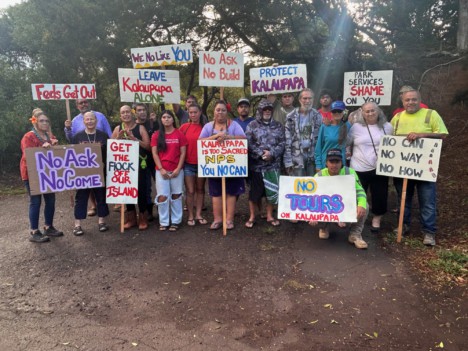
On July 9, about 20 protesters met to voice concerns about the first National Parks tour of the Kalaupapa settlement. Photos by Dayanti Karunaratne
By Dayanti Karunaratne
Two groups gathered near the end of Kala’e Highway on the morning of July 9 when the first National Parks-led tour of Kalaupapa National Historic Site was scheduled to depart. Ten hikers, plus their guides, met at the National Park Service (NPS) parking lot. Up the road, closer to the trailhead, a group of about 20 protesters were holding hand-painted placards with messages like “Kalaupapa is too sacred — NPS You no can” and “No ask, no come.”
“If the government doesn’t follow the rules, the people have to step up,” Maui County Councilmember Keani Rawlins-Fernandez told the protesters around 7 a.m. as they waited for the tour departure.
She said the tour breaks a number of rules, including trespassing and the rights of Native Hawaiian people to operate the tour to Kalaupapa, the former community for people with Hansen’s Disease.
Last month, the NPS announced the July 9 launch of its hiking tours, scheduled on Thursdays and Saturdays from the trail connected to the Kala’e Highway. The announcement came after the death this spring of Meli Watanuki, who lived at Kalaupapa and operated bus tours of the settlement. After the NPS tours were announced, park staff set up booths in Kaunakakai and Kualapu’u to field questions about the new tour.
On Thursday, when the 10 hikers who had reserved a spot in the tour began to move toward the trailhead, tensions mounted. Then, before the hikers could pass through the gate, Rawlins-Fernandez moved swiftly to put a firm grip on the metal frame, keeping it closed.
Long-time Molokai resident Lori Buchanan was quick to stand by the councilmember’s side and explain the protester’s perspective. She pointed to a sign on the gate that read: “Entry by Permit Only — R.W. Meyer Ltd.” She said Meyer family members, including people who sit on the board of the Meyer family estate, are among the protesters.
“Right now, we consider this trespassing,” Buchanan told the Maui County Police Department officer who stood at the gate. The officer said he could help file a complaint of tresspassing, but for the moment they were going to allow the hikers to pass through the gate and do the tour.
Turning to address both hikers and protesters, Buchanan said the tours are not only trespassing on Meyer land but “they are also going to traverse over the Department of Hawaiian Homelands’ land, which I am a beneficiary, so I own the land that they are going to be traversing on. That’s also trespassing as far as I’m concerned because I have not been consulted.”
Rawlins-Fernandez said she only heard about the tours through a press release on June 24. She said she was shocked and called Department of Hawaiian Homelands Chairperson Kali Watson. According to Rawlins-Fernandez, Watson said the announcement came as a surprise to him as well.
According to the Department of Health, which is responsible for the care and treatment of the Hansen’s Disease Registry patients, DHHL owns 1,247 acres of land within Kalawao County including the area of Kalaupapa Settlement. DHHL delegates site control to the U.S. National Park Service (NPS) as part of Kalaupapa National Historical Park, per a General Lease.
However, a letter sent to state representative Mahina Poepoe on July 10 from DHHL Chairperson Watson states: “With respect to consultation and notice, the subject of restarting visitor tours at Kalaupapa was not wholly unknown to DHHL.”
“According to information available to the Department, NPS discussed its intent to resume tours during regularly conducted NPS–State agency team conferences attended by DHHL line staff,” continued the letter, which DHHL shared with The Dispatch.
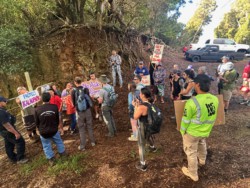
When the hikers and their guides moved toward the trail, Maui County councilmember Keani Rawlins-Fernandez blocked the gate, briefly pausing the tour while the protesters explained their position. Photos by Dayanti Karunaratne.
Regarding the Parks’ right to operate tours, Rawlins-Fernandez pointed out that legislation around Kalaupapa gives patient residents first right of refusal for tour operations. After that, she said, priority is to be given to Kānaka Maoli, i.e. Native Hawaiians.
During an interview about the tours in June, NPS Superintendent Nancy Holman told The Dispatch that this secondary priority for Native Hawaiians is common knowledge, and that is why they have been working in partnership with DHHL for years.
As for community consultation, Holman says that is contained in the general management plan.
“That plan was, depending on how you look at it, created with 10 to 14 years of public consultation about a future vision of the park,” Holman explained.
That general management planning document doesn’t affect the view of Rawlins-Fernandez, who said she doesn’t want NPS in charge after the patients are gone.
“I don’t trust them as an institution,” she told The Dispatch, pointing out that having Molokai residents on staff at the park was a comfort, but there are fewer locals working there now, and that she is seeing indications in federal hiring policies that suggest they will no longer be given priority.
After the hikers had gone through the gate, longtime activist Walter Ritte addressed the group of protesters. He thanked everyone for coming out, and insisted that the issue is not over.
“You guys know it’s not going to be solved in one step,” Ritte said. “As we take more and more steps, we got to get more and more people.”
“We’ve been semi-successful at keeping tourism out,” he continued. “Things like this threaten all the work we have done to control tourism.”
Ritte said he would continue to protest the tours and invited everyone to join him.
On Saturday morning, the group of protesters, who are calling themselves Kūnou iā Kalaupapa, convened at the trailhead to await the second planned tour, but Rawlins-Fernandez met them instead with a letter from Holman, which she read to the group.
“The NPS provided its first public tour of Kalaupapa National Historical Park on July 9, 2026. This NPS tour was a limited, non-commercial offering. Protesters were present. The NPS is temporarily pausing future public tours while it reassesses the feasibility of visitor access. More information will be shared as it becomes available.”
As of press time on Monday, no updates on the tours were available.

 Add your comment


Don't have a Molokai Dispatch ID?
Sign up is easy. Sign up now
You must login to post a comment.
Lost Password