



What’s Next for Kalaupapa?
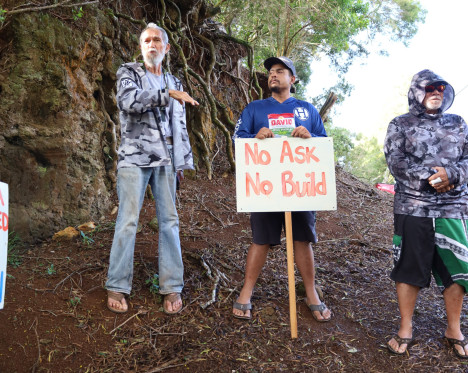
Walter Ritte speaks to people at the Kalaupapa trailhead on July 9. Photo by Dayanti Karunaratne
By Dayanti Karunaratne | Editor
The National Park Service tours to the Kalaupapa Peninsula are now on hold, but there is still much work to be done in order to clarify a vision for the area. After all, before it was a colony for people with Hansen’s Disease, it was a community with farms and families. The area has been managed by a long list of agencies for years, but there are few patients remaining, and that means changes are coming. So, what’s next for Kalaupapa?
Following the launch of the tours on July 9, and the announcement the following day that they would be paused, U.S. House Representative Jill Tokuda met with NPS Superintendent Nancy Holman to discuss whether the agency would continue its twice-weekly hiking tours.
“I expressed to her that I wanted a personal call, because without any kind of real community engagement and involvement in the process of tourism, I thought it was grossly premature to even be talking about restarting tours at that particular point,” Tokuda told The Dispatch.
She described the meeting as productive, but said there is a lot of follow-up to be done. She said she requested documentation from NPS that indicates they can circumvent the priority that Native Hawaiians be given second right of refusal for tour operations.
Federal legislation gives first priority for operating tours to patient residents of the Kalaupapa settlement. If none are interested, as Holman says is the case now, Native Hawaiians are to be given a second right of refusal — a step that seems to have been skipped, Tokuda said.
Tokuda also echoed what protesters have been saying since the first tour on July 9: There needs to be community consultation. She said meetings with representatives from department heads is not enough.
“I asked [Holman] specifically: ‘Why wasn’t a listening session done with the community? With folks from up top, with existing patients or their families? If they had done an actual listening session before all of this happened, we could have avoided a lot of these conflicts.”
Prior to this conversation, Holman has said that over 10 years was spent on public consultations. It’s contained in their General Management Plan, and, consequently, it’s guiding the organization as it begins leading tours.
Tokuda disagrees.
“Community engagement is not something you do once and walk away,” she said, referring to past meetings. “I think it’s very disappointing if community engagement comes down to being a checkbox.”
Walter Ritte, one of the protesters who was at the inaugural tour, participated in community consultations in 2011, 2015 and again in 2021.
“It was a long process,” he said. “We participated. There are pages of testimony. We thought we had input. And then, nothing happened. The plan got shelved.”
While Ritte called the consultations “frustrating,” he said that he would participate again.
“I don’t have any trust or faith, especially with this crazy [U.S.] President, but we’re not going to stop making ourselves heard,” he said.
Ritte welcomed the news that Tokuda was getting involved, saying he has not felt support at the federal level. But he wants to talk about the past, too.
“I think it’s important for us to realize what this place was, and that the government stepped in and used it … to keep people away from people,” the long-time activist told The Dispatch.
“The main point is, there was a thriving community with three valleys and water in the valleys and a peninsula that can grow food,” said Ritte.
Ritte said that when he first applied for homestead land, he expressed interest in living and farming in Kalaupapa but was told it was not ready for applicants. He said that a year after that, he attended a meeting at which U.S. House Rep. Daniel Akaka was explaining that the property owned by the Department of Hawaiian Home Lands would become part of federal government jurisdiction.
“[Akaka] mentioned that one of the reasons they are allowing the federal government to have it was because no homesteaders wanted to use it,” Ritte explained. For him, the comment set off alarm bells, as it went against what he had been told earlier.
Tokuda said it’s important to be “fiercely protective” of Kalaupapa. She said that recent changes to National Parks and other conservation areas should serve as a cautionary tale.
“I think what happened in Utah is a cautionary tale to every community that we have got to be vigilant in protecting the spaces that are important to us,” Tokuda said, noting that two parks in that state were drastically reduced in size. “We’re in a world where lots of things can change with the drafting of an executive order, so it requires vigilance.”

 Add your comment


Don't have a Molokai Dispatch ID?
Sign up is easy. Sign up now
You must login to post a comment.
Lost Password