



Molokai Kōnane Tournament
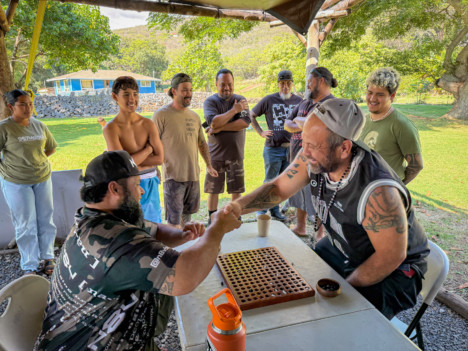
Photo by Léo Azambuja
By Léo Azambuja
There was a lot at stake at the Molokai Kōnane Tournament at Keawanui Fishpond last Saturday: paid travel expenses and accommodations for the top-two players to attend a kōnane tournament in Honolulu next month, plus the prospect of playing the final match on an ancient board that hasn’t been played on for well over a century.
After an entire morning of rounds to reach the finals, Hanohano Naehu beat Kenny Adachi in a hard-fought grand final match that lasted almost an hour.
The board game is unique to Hawaii, and its origins date back hundreds of years. Kapena Baptista, a kōnane player and enthusiast who came to Molokai from Oahu to help organize the tournament, believes it is one the greatest abstract games of humanity.
“Kōnane is a very old game. It’s in fact so old that we don’t know how old it is. We cannot properly date it, but we know that kōnane exists within moʻolelo, or stories of our chiefs, that existed some 600 years ago. So, it’s at least that old,” Baptista said.
Kōnane’s rules may be simple, but it is a game of endless strategies, critical thinking and resource management. Each turn, the players must jump their pieces over the other player’s pieces to remove them from the game. But the winner is not necessarily the player who removes the most pieces from his opponent; it is the one who sets up his opponent in a manner that he cannot move any piece.
“On the surface, what you’re doing here is really quite simple, but over time, the more you play, the more you’ll realize that you can find yourself in certain situations where suddenly you can’t move anymore,” Baptista said.
Altogether, there were 16 players in the Molokai Kōnane Tournament. Fourteen-year-old Kapuawehiwa Puaʻa-Kahoʻokano seemed unstoppable, and was the only female and teenager to reach the semifinals. All the other semifinalists were males in their mid-to-late forties.
Puaʻa-Kahoʻokano was eventually beat by the more-experienced Naehu in the semifinals. But she still won the third-place match by beating Jr. Dudoit, who had lost to Adachi in the other semifinal game.
Leading up to the final, the tournament was played on small boards in a best-of-three format. But the final was a single match played on a larger board.
Naehu and Adachi will now compete in a tournament at the Bernice Pauahi Bishop Museum in Honolulu Feb. 13. Their travel expenses and accommodations will be paid by the museum. The tournament will be live streamed on local TV, and will also have two competitors for each of the following islands; Oahu, Big Island and Kauai. Fans unable to attend in person can watch the matches online via IPTV Sonix, bringing the excitement of the tournament directly to viewers at home.
Kōnane can be played on a wooden board or on a carved lava rock board. Because wood tends to decay with age, there aren’t many wooden boards that survived since a coup overthrew the Hawaiian Kingdom in 1893.
Baptista said the Bishop Museum has in its collection three of the six known wooden papamū, or kōnane boards, remaining from the Hawaii Monarchy. Those boards were never displayed in an exhibit. One of them, he said, is in a state beyond repair. The other two are still usable, with a board named Kupuna Papamū being in the best condition.
Baptista played kōnane as a child, but really got into it only five or six years ago. He was the one who asked the Bishop Museum to hold a statewide tournament. The final match of the tournament will be played on the Kupuna Papamū, which once belonged to Queen Kapiʻolani’s collection, making it at least 130 years old. It was gifted to the museum in 1923 by Princess Kahanu, Prince Kūhiō’s wife.
“There is actually a replica of that board being made right now,” Baptista said. “The winner of the overall grand championship tournament, they donʻt get to keep the original board, but they get an exact copy.”
The Molokai Kōnane Tournament was organized by the nonprofit organization Hui o Kuapā in a partnership with the Bishop Museum, Ka Hale Hoaka and ʻĀina Momona.
“Kapena reached out to us to help facilitate and organize the tournament on Molokai because Molokai is known throughout Hawaii for really embracing Makahiki,” Hui o Kuapā program director Maile Naehu said.
Hui o Kuapā restored four fishponds on Molokai and is currently working to restore a fifth fishpond, she said. Besides restoring fishponds, they help to organize a lot of different community events and opportunities.
“Hui o Kuapā has been the lead in Makahiki games for many, many years,” Maile Naehu said.
Visit www.huiokuapa.org to donate or for information on the nonprofit’s events, including volunteer opportunities. Visit www.bishopmuseum.org/konane2026/ for more information on the Bishop Museum’s upcoming kōnane tournament.

 Add your comment


