



Planting the Seeds of Sustainability
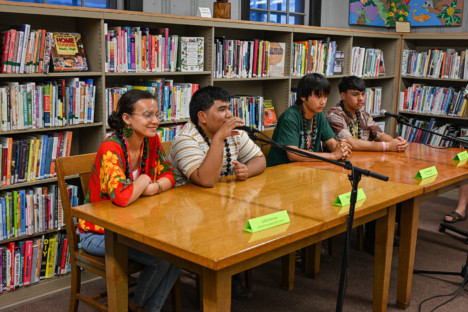
High school students, left to right, Leila Pereira, Mark Ragonton, Max Sakamoto and Kilohana Meyer shared their view on sustainability at Molokai Library last month. Photo by Léo Azambuja
By Léo Azambuja
Four high-school students recently discussed challenges in Molokai’s food system at an informal meeting at Molokai Public Library. They stressed the importance of local food production, self-sufficiency and educational programs.
Kilohana Meyer emphasized sustainable farming practices. Max Sakamoto highlighted entrepreneurial efforts using local produce. Mark Ragonton discussed culinary initiatives. Leila Pereira talked about farming entrepreneurship and waste diversion from the landfill.
They also noted the need for grants, mentorship and community support to foster young farmers and entrepreneurs at the forum hosted by the Molokai Baháʻí Community in collaboration with the library Nov. 19.
“I’d like to see Molokai completely independent (from off-island food suppliers),” Pereira said. “I’d like for everybody to have free access to food.”
A member of the Molokai Homestead Youth Council — which regularly promotes recycling at events — Pereira added she would like to see Molokai residents being able to increase recycling and reuse more plastic products.
Piggybacking on Pereira’s thoughts, Meyer said his biggest vision for Molokai is to see the island working together to create a more sustainable future for everyone, and for the island to use less single-use plastics.
“Our landfill is just growing bigger each and every day, and that is a big problem to me,” said Meyer, a member of the Future Farmers of America, a group that teaches and promotes sustainable farming practices, covering produce and livestock.
Sakamoto, of the Molokai High School Youth Entrepreneurs, also agreed that Molokai should be more self-sufficient on food, step-up recycling and reuse more plastics. His group explores turning Molokai’s available resources, such as coconut, into value-added products.
Ragonton, a member of the Hui Meaʻai Culinary Club, liked his fellow panelists’ ideas, but wished there were more opportunities for students to learn about growing their own produce. He too wants residents to be more conscious about plastic use and recycling.
Pereira also shared insights on her family’s practice of raising rabbits for personal consumption. If they were doing it on a commercial scale, she said, they would need a lot more resources and a proper facility.
“Since we do it mostly just for family, we don’t really go through those processes. But definitely, if we were selling professionally, we would need a lot more help,” she said.
Pereira said you can raise livestock, but when you think about what you are feeding them, you are still relying on imports.
“I know people in our group have been talking about creating their own pellets for their own animals,” Pereira said.
To Sakamoto, it’s vital to educate people on the importance of food sustainability, and they could produce food for themselves. He said the chickens his family raise feed on food leftovers plus bugs and worms that come out of it.
“Our chickens eat our rotten vegetables, like tomatoes and everything like that, all the vegetables we don’t use,” he said, adding the food scraps are placed in simple composting bins inside the chicken coops.
“It’s just a few pieces of wood screwed together, and they just dump old vegetables and stuff inside, and then the fruit flies and stuff will lay eggs, and the worms and stuff will crawl out,” Sakamoto said.
Pereira said she feels there is a big financial gap. Growing up as a farmer, she said, it wasn’t a career option for her, “it’s just sort of something off to the side.” It’s a lot of hard work and there isn’t a lot of money in it, she said.
Securing grants rather than just USDA loans would be “really helpful” to start a food production business, she said. Finding mentorships would also be beneficial, because many people don’t have the knowledge on how to start a business.
“I think just the biggest way to be sustainable on Molokai is just to grow your own food or support the local businesses that are growing (food),” Meyer said. He added the biggest challenge in farming is getting started, but if you learn and are really passionate about it, “you could definitely be able to do it.”
All the panelists were involved with farming, not just through school or youth programs, but also at home. But none of them had plans of pursuing farming as a professional career. Still, their plans were somehow still connected with farming.
Pereira wants to become a livestock veterinarian. Rangonton said he could use farming as an additional resource for his cooking. Sakamoto plans to leave Molokai, but said he enjoyed cooking with locally grown produce. Meyer said his first career choice is in firefighting but could get back into agriculture later in life.
Paul Hanley mediated the event, bringing a set of pre-formulated questions and also entertaining questions from the audience.
The event was part of the Global Citizenship Speaker Series created by Molokai Baháʻí Community for the community to listen, learn from, and share their views with local or international speakers about a variety of topics important to the island.

 Add your comment


Don't have a Molokai Dispatch ID?
Sign up is easy. Sign up now
You must login to post a comment.
Lost Password