



The Power of Seagrass
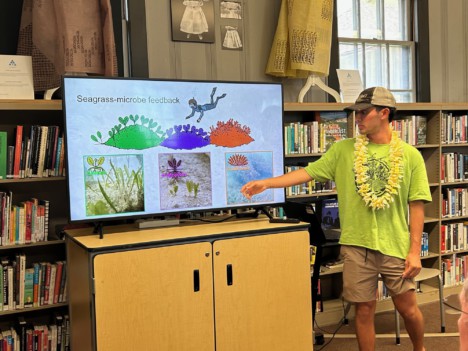
UH Manoa Marine Biologist Iker Yturralde speaks at the Molokai Public Library on June 1. Photo by Dayanti Karunaratne
By Dayanti Karunaratne | Editor
Most people avoid beaches that have a lot of underwater vegetation. There’s an ‘ick factor’ when we feel plants between our toes or see it floating on the surface of the water. But Marine Biologist Iker Yturralde knows that it’s an important part of our ecosystem. So when he visited Molokai in early June, he went searching for seagrass.
“Coastal vegetation is disappearing due to a host of different reasons, whether it be natural disasters or man-made events,” Yturralde of the University of Hawaiʻi at Manoa said at a presentation at the Molokai Public Library. “Seagrass protects against the damages of rising sea levels and increased storm events.”
He added that seagrass stores carbon, generates oxygen and provides food for the Hawaiian turtle and native snails.
Yturralde said he wasnʻt sure if he would find native seagrass (Halophila hawaiiana). Repeated missions to Maui had been unsuccessful. Plus, the Kona Low storms this spring, which caused massive disturbances in coastal areas, may have also destroyed native seagrass, according to Yturralde.
On his first dip, just off the south shore about two miles east of Kaunakakai, he found an abundant meadow of native seagrass, which is recognizable by its rigid blades. (Its cousin Halophila decipiens, or Caribbean seagrass, has floppy blades.) His team collected more samples at a site farther east.
His excitement about his discovery of the native seagrass was palpable when he shared his findings on June 1.
“We found that tiny organisms living inside the plants are shaping their health,” Yturralde said. He said that the presence of certain organisms explains why some plants are diseased while others thrive. It’s an overlooked idea, he added, that can help conservation efforts.
Efforts to conserve seagrass meadows usually involve pulling out invasive species such as gorilla ogo. However, Yturralde said this doesn’t consider how different plants change soil composition. He compared the situation to crop rotation. Since every plant affects the soil differently, future plants grown on a plot will feel those effects. Keep growing the same plant on the same plot and eventually the output suffers. In other words, plant diversity is important to the soil, which is beneficial to native seagrass.
As native seagrass mingles with the non-native species, Yturralde said he wonders if there is a new hybrid type emerging. To find out, he took samples to his lab on Oahu. Looking at the plants on a microscopic level will also tell him if they are absorbing beneficial microbes, which will strengthen them against disease.
“We are going to see more saltwater entering our wetlands,” Yturralde said, explaining that changing sea levels means changing salt levels. He said that if plants can adapt to these changes, that’s a sign of hope in the effort to conserve coastlines.
Eventually, seagrass might be planted in areas that need protection against erosion.
During his presentation, many in the audience were keen to know how they could help: Can seagrass be grown in a fish tank? Is there anything people can do to the coastlines they care for in order to support seagrass growth? These were some of the questions posed to Yturralde.
He responded by saying it’s too early to know the best way forward, but with his success finding native seagrass in Molokai waters, he will be back, and he’s keen to continue sharing his findings with the community.
Visit www.soest.hawaii.edu/soestwp for more information.

 Add your comment


Don't have a Molokai Dispatch ID?
Sign up is easy. Sign up now
You must login to post a comment.
Lost Password