in

Search Results for: <

Aloha Saint Damien: Following in His Footsteps

Sunday, November 1st, 2009

Aloha Saint Damien: Following in His Footsteps

This is an ongoing blog about Father Damien by Molokai Dispatch reporter Megan Stephenson.

Saint Damien’s relic venerated across Molokai

After weeks of waiting, Molokai residents finally were able to celebrate the momentary return of Saint Damien de Veuster, last Friday evening. Over one hundred worshipers of all faiths on Molokai gathered with 13 bishops and religious delegates from Hawaii, California and Belgium for a special inter-faith Mass at Kaunakakai Ball Field.

Carried by two alter boys of St. Damien Parish, Travine and Ralph Johnson, the relic was followed by bishops from California and the Cardinal Godfried Danneels of Belgium from St. Sophia’s. Several Belgian people had also come to follow the relic tour, including the provincial of the Sacred Hearts congregation in Belgium, Frans Gorissen. He said since the first Belgian priest was sent to Hawaii in 1825, there has been an “indefinable connection” between Belgium and Hawaii.

The crowd stood quietly as the group entered the makeshift aisle on the ball field, heading towards an alter decorated with ti leaves and various tropical flower arrangements. The bishops all wore different colored leis with their standard black clergy shirt, while the Hawaiian delegation wore white cassocks.

Honolulu’s Bishop Larry Silva,leader of the Diocese of Honolulu, led the hour-long service, punctuated by song, prayers from community members, and the Ricky Grorospe’s winning student performance of ‘Damien,’ a play by Aldyth Morris.

“It was wonderful, especially to see the youth. It’s important to see the youth involved in our faith,” said Bishop Silva.

Early the next morning, as the sun rose along the cliffs, a small group of Molokai and Oahu faithful carried the relic down the pali trail to an evocative celebration in Saint Damien’s home of Kalawao on the Kalaupapa peninsula. Rev. Clyde Guerrero, Travine and Ralph Johnson, and Kamalani Bicoy, all of St. Damien Parish on Molokai, as well as two seniors from Damien Memorial High School in Oahu, Jerick Sablan and Jonathan Padron, hiked down the trail with the relic protected in a backpack that the boys shared.

Once at the bottom, the rest of the delegation from the previous night greeted them; they had flown down earlier that morning. After a brief service, the group continued on to the recently renovated St. Philomena’s, Father Damien’s church in Kalawao.

The relic has now been returned to Honolulu, where it will remain in the Cathedral of Our Lady of Peace – the same cathedral were Saint Damien was ordained a priest nearly 150 years ago.

Policies and Employment

Sunday, November 1st, 2009

As we all know employment is very crucial to find here on Moloka'i.  As for me I've been looking for employment and I'm sure of myself that everyone else is.  Some employment places didn't consider my Resume although experience is very high in the employment task.  I also applied at another opening to which I have very well experience in and they also didn't hire because I'm related to a worker there. I think being that I have a relative that I'll be working under wouldn't affect me because I will try even harder to impress my "BOSS", so that they wouldn't think that I would be reducing my ability to work.

Live Video: Senate Discusses Alternatives to Furloughs

Friday, October 30th, 2009

Watch live as the Senate discuess alternatives so Furlough Fridays via the Honolulu Advertiser courtesy of 'Olelo Community Television:

http://www.honoluluadvertiser.com/article/99999999/MOGULUS02/399990001&template=mogulus

Help Wanted

Thursday, October 29th, 2009

PUC allows three interveners in water rate increase case.

Hawaii’s Public Utilities Commission (PUC) decided earlier this month that the stack of issues surrounding possible water rate increases on Molokai was too much for them to sort through. The County of Maui, West Molokai Association and Stand For Water were all named as interveners in the case.

Off the Bottle

Wednesday, October 28th, 2009
Meeting to discuss how to combat underage drinking.

Neighborhood Place of Wailuku News Release

Maui County is one of hundreds of communities nationwide that will conduct town hall meetings to discuss and raise awareness of the problem of underage drinking. Parents, teachers, officials, youth and other community members will be educated about the impact that underage drinking has on the community, and they will develop possible ways to address this issue. The Neighborhood Place of Wailuku (NPW), County of Maui – Department Housing & Human Concerns, and the Maui Police Department, in collaboration with the State Alcohol & Drug Abuse Division (ADAD) is sponsoring these meetings.

Save Our Birds

Wednesday, October 28th, 2009

Save Our Birds

Public invited to view conservation plan for wildlife refuge.

U.S. Fish and Wildlife Service News Release

The U.S. Fish and Wildlife Service is initiating development of a comprehensive conservation plan for Kealia Pond on Maui and Kakahai`a National Wildlife Refuge on Molokai that will guide their management for the next 15 years. A public meeting is planned for both islands to explain the planning process and seek the public’s input in the projects.

The open house is scheduled on Molokai for Nov. 4 from 6:30 to 8:30 p.m. at the  Mitchell Pauole Center-Conference Room in Kaunakakai.

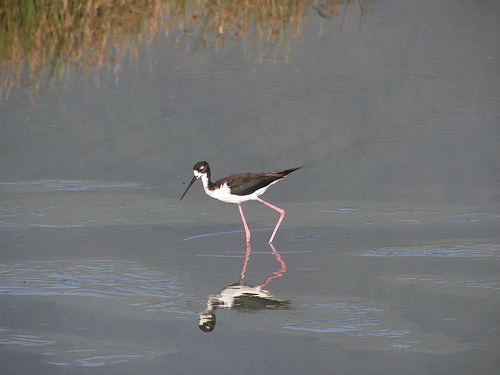
Kealia Pond and Kakahai`a National Wildlife Refuges are part of the Maui National Wildlife Refuge Complex. Kakahai`a National Wildlife Refuge is located on the southeastern coast of Molokai. Habitats found in this refuge include open water, freshwater marsh, mudflat, grassland, and scrubland. An inland Hawaiian fishpond is also located on the refuge. The refuge provides important breeding, feeding, and resting areas for endangered water birds, a variety of migratory waterfowl, shorebirds, and other wetland birds. Some of the more common migrants are Northern pintail and Pacific golden plover. Kakahai`a is closed to the general public. However, volunteers occasionally conduct wetland education programs.

The Service invites public comments on the conservation plan. For more information, including the first planning update for this project, see the Service's website at: www.fws.gov/pacific/planning.

To receive a paper copy of the planning update and comment form, or to submit comments, contact: Glynnis Nakai, Project Leader, Maui National Wildlife Refuge Complex, P.O. Box 1042, Kihei, Hawai‘i 96753, phone: (808) 875-1582, fax: (808) 875-2945.

Comments can also be e-mailed to us using the following address: FW1PlanningComments@fws.gov. Please include “Kealia Pond or Kakahai`a” in the subject line. Comments will be accepted until November 20.

Molokai’s Saint Damien

Wednesday, October 28th, 2009

Molokai’s Saint Damien

Thousands watch live as Damien is canonized in Rome.


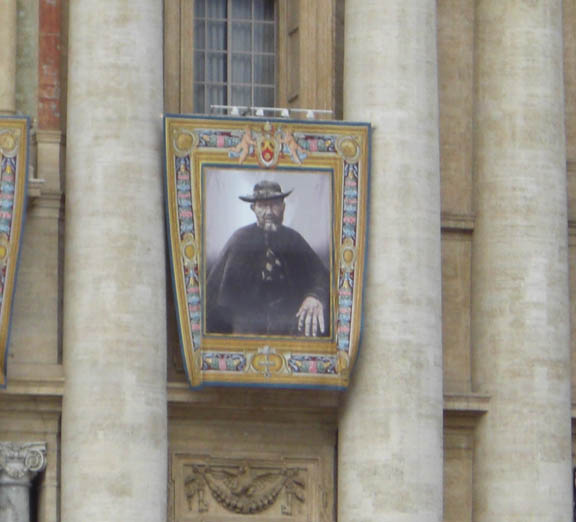
It began with song. The prayers and chanting of exhilarated voices filled the packed St. Peter’s Basilica in Rome. Thousands of pilgrims sat or stood, inside and outside the Basilica to watch, straining their ears to hear the words that many had waited years to hear. Bishops in their pink robes and cardinals in red hats swayed down the aisle, followed by the Holy Father, Pope Benedict XVI, during the opening service. While five would be canonized there that day, the focus for many was on Father Damien.

n on Molokai – the first is Catholics that don’t practice.

He and Father Felix Vandebroek of St. Francis in Kalaupapa are members of the same order as Father Damien. Guerreiro said he identified with Damien’s solidarity. Before arriving in Hawaii, Damien thought of the native Hawaiians like others of his position as savages and pagans.

But he soon changed his tune, Guerreiro said. “He became absolutely one with them.”

Damien’s journey was certainly unforeseen by many of the people in his life – a peasant farm boy who entered his congregation at a remarkably young age, barely knowing French and no Latin at all. Damien’s enthusiasm, resolve, and unlimited devoutness endeared him to his people, the forgotten of Molokai, and has now captivated the modern world. His commitment and sacrifice has earned him the highest honor attainable for a Catholic priest, and one of the highest distinctions in the world.

When in Rome

Wednesday, October 28th, 2009

When in Rome

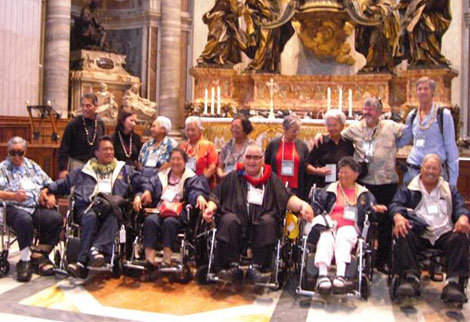
The morning of Father Damien’s canonization dawned cold, dark and rainy in Rome. Eighty thousand people from around the world packed into St. Peter’s Square, jockeying for a chance to get inside of the famous Basilica. A small group from a tiny island in the middle of the Pacific pushed through the crowds to reach a special side entrance before taking their reserved seats a few feet away from the alter. They were VIPs.

Those VIPs, 11 Hansen’s disease patients from Kalaupapa and Hale Mohalu hospital in Honolulu, were treated as celebrities for the entirety of their two-week trip to Europe. They were part of a Hawaiian tour group of over 500 people that traveled to Belgium and Italy to celebrate the life of Hawaii’s first saint.

“It was first class everywhere we went,” said Kalaupapa patient Clarence “Boogie” Kahilihiwa. “At every event we were always given the highest priority.”

is about two flights of stairs beneath the church,” explained Kahilihiwa. “It’s so silent in there, but when you get down there you really feel like Damien is there to greet you – gives you chicken skin.”

The first-class treatment and once in a lifetime experiences continued as the group moved on to Italy for the second week of their trip. Mary Igarta, another Molokai resident who made the pilgrimage, said seeing all of the holy sites in Rome and being present for the canonization was a very spiritual event.

“It reminded me how proud I was to be a catholic from Molokai and so close to Father Damien. Having over 500 Hawaiians people present at the canonization was amazing,” she said.

While in Rome the patients had two audiences with the pope and were specially invited to visit the U.S. Embassy.

Presidential Recognition
At the embassy, the group met with cardinals from around the world, Hawaiian Senator Daniel Akaka, Congressman Donald Payne and Honolulu Bishop Larry Silva. The American dignitaries were part of a four-man group selected by President Obama to represent the United States at Damien’s canonization. The fourth member was Kalaupapa’s own Steve Prokop.

Prokop, the National Park Service Superintendent at Kalaupapa, received a phone call from the White House asking him to represent the country during his trip to Europe.

“Getting a call from the White House was completely out of nowhere. I wasn’t expecting to be named to the delegation, but it was a great honor,” Prokop said.

As part of the delegation, Prokop received a behind-the-scenes tour of the Vatican, attended special receptions in Rome and met the King and Queen of Belgium.

“We rode around with police escorts wherever we went. It was certainly one of the personal and professional highlights of my life,” Prokop said.

He said that the most exciting part of the trip for him was seeing how well the patients were treated throughout the entire trip. After being treated so poorly in the past, he was happy to see all of his Kalaupapa neighbors getting the respect they deserve.

The patients were not looking for fame, but they were also happy about the treatment they received overseas.

“Everybody felt real, real good about it,” Palea said. “I wouldn’t say we were celebrities. People just wanted to talk to us to get closer to Father Damien.”

The irony of being in the spotlight after generations of Kalaupapa residents were marginalized by society wasn’t lost on the patients.

“A hundred years ago they would’ve said, ‘What are these lepers doing here?’ and now we are meeting ambassadors and every place we went we were the first ones to go,” Kahilihiwa said with a laugh.

KP2 Declared Blind

Wednesday, October 28th, 2009

KP2 Declared Blind

Molokai seal not to be released into the wild.

After a medical exam at Waikiki Aquarium last week, KP2, the young Hawaiian monk seal that had made Kaunakakai Wharf his home, was found to have cataracts. Veterinarians declared the seal to be 80 percent blind; with such limited eyesight, biologists say he’s unlikely to survive in the wild.

NOAA officials removed KP2 from Molokai waters two weeks ago. He was taken to Waikiki Aquarium for a thorough health inspection before a planned release into waters around Niihau. But after learning of the seal’s eye condition, NOAA has cancelled KP2’s release and are instead discussing relocation to either Sea Life Park on Oahu or a mainland aquarium.

Some Molokai residents want KP2 returned to the island.  They are outraged that NOAA removed the seal with very little public notice.  Activist Walter Ritte led about a dozen residents to Oahu Wednesday to protest at Waikiki Aquarium. The group wants NOAA to build a sanctuary for the seal on Molokai. But officials say the idea is not logistically plausible. 

Dr. Carmen Colitz, a veterinary specialist flown to Hawaii to examine KP2, said she believes KP2 developed cataracts so young because of a nutritional deficiency from never from his mother. KP2 was abaondonned by his mother at 24 hours old and raised by NOAA specialists for eight months. He is the first considered the first hand-reared Hawaiian monk seal.

KP2 was released in Kalaupapa last November and a few months later, appeared at the Kaunakakai Wharf. He became friendly with humans, playing with children in the water. In June, NOAA transported him back to Kalaupapa, hoping he would socialize with other young seals and “stay wild.” However, in just two days, KP2 was back at the wharf and socializing with the only friends he knows -- people.

NOAA specialists say KP2 was relocated from Molokai for safety reasons. They worried that as he reached sexual maturity, his play would become rougher and potentially dangerous. Incidents of nipping people and holding them under water were already reported.

KP2 is currently under quarantine at Waikiki Aquarium until plans are made for his future.

Home on the Range(r)

Wednesday, October 28th, 2009

Home on the Range(r)

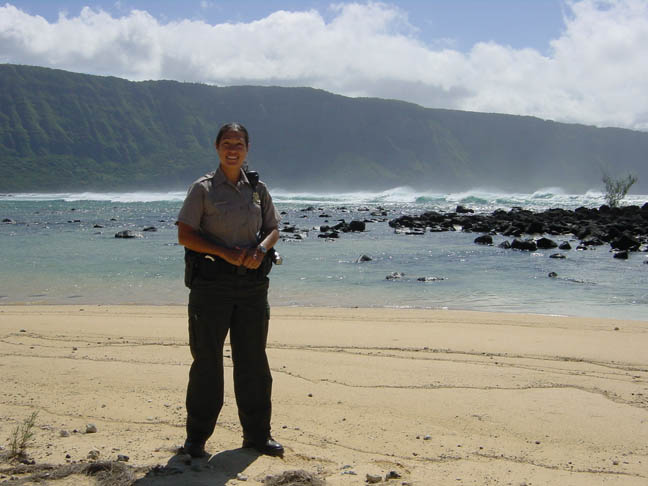
First Molokai woman protects Kalaupapa.


Even though she is one of just six female park rangers in all of Hawaii, Amy Sakurada doesn’t feel special. After a tomboy childhood on Molokai, growing up with three older brothers, and playing four sports in high school, roughing it has always come naturally. Sakurada is now the first female park ranger and the second law enforcement ranger from Molokai serving at Kalaupapa National Park since 2006.

Growing up, Sakurada said she wanted to go into law enforcement, but it wasn’t until she attended the University of Hawaii at Hilo that her interest in natural and cultural resource protection was sparked. Born and raised on Molokai, she said she was already familiar with the cultural richness of Hawaii.

is a program to preserve for future generations.”

All in a Day’s Work

The duties of a Kalaupapa Park Ranger include law enforcement, structural fire and wildland fire inspection and response, emergency medical services, and search and rescue. Chief Ranger Tim Trainer said there are usually a couple of rescues a year on the pali trail due to injuries.

Sakurada said she is challenged on a daily basis to keep up with proper physical fitness. She hikes the Kalaupapa pali trail four days a week, plus additional treks on the ranger’s safety checks.

“We have to be in top shape. We put our lives on the line every day,” she said.

Even for someone in as good a shape as Sakurada, she said the trail can be overcoming at times. “It forces us to keep in shape. But after a long day at work, it’s exhausting.”

Sakurada said her biggest challenges are staying on top of new laws and regulations as well as the physical fitness. Jurisdictional authority is also challenging, between the different agencies: the National Park Service, the Department of Health, and the Department of Hawaiian Home Lands.

Sakurada attended the Federal Law Enforcement Training Center in Georgia last March, where Trainer, Sakurada’s supervisor, said she was one of the top performers. She learned such skills as fitness, sharp shooting, defensive driving skills, federal law, preservation of a crime scene, court testimony, archaeological resource protection, firearms qualifications and emergency vehicle operations.

Rangers go through many training sessions every year, from physical fitness to law “refreshers.” Twice a year rangers take a physical fitness test – a mile-and-a-half run, weigh lifting, and agility tests. Rangers also have an additional water pack test, wearing a 45-pound pack and walking three miles in 45 minutes.

A Long Journey

It hasn’t been a short or easy road for Sakurada to get where she is today. She began her career in the park service while in college, when a roommate helped her get a seasonal job at Volcano National Park on the Big Island. She had learned about well-known national parks like the Grand Canyon, but said she wasn’t familiar with Hawaii’s until her first parks job. After she graduated college in 1998, she continued to work for the park service as a supervisory visitor use assistant.

In 2004, she decided she wanted to be a ranger, to protect the environmental and cultural resources she found so beautiful as a teenager. She paid for her own initial training in Santa Rose, California, and received a seasonal commission – the entry level credentials for park rangers. Training is similar to a basic police academy, she said. There is firearms training, federal law regulation for national parks, archaeological and environmental law, and interviewing techniques for court.

After her training, she began working at Pu’ukohola Heiau on Hawaii Island, one of the last major temples built in the Hawaiian Islands, constructed by Kamehameha the Great,.

She was offered the position at Kalaupapa in 2006.

“It was an easy choice to make. She’s qualified at the top, high recommendations from her supervisors. And the fact that she’s from Molokai is even better,” said Trainer.

Sakurada has participated in a few career days at the high school and community outreach events to discuss her job. She said not many people know what a ranger does, and she’d like to see more people, especially young girls, take an interest in law enforcement in general.

“I can help young girls, and be a role model for the community,” she explained.