in

Search Results for: <

Arbor Party

Wednesday, November 18th, 2009

Arbor Party

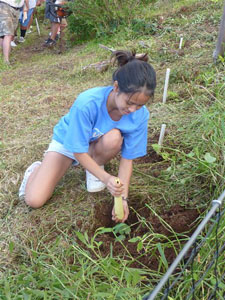
Hawaii’s Arbor Day came and went last Friday without many people on Molokai noticing. But that wasn’t the case for Bill Garnett and some of Molokai’s dedicated students. They spent the entire day preserving native Hawaiian plants along the Kalaupapa trailhead.

Garnett is a rare Hawaiian plants specialist who works for the University of Hawaii and has spearheaded environmental projects across the state.

“Arbor Day is pretty much my Christmas,” he said. “I love it because today I get a lot of people to come out and plant with me.”

For the fifth year in a row, Garnett celebrated his favorite day of the year by inviting the public to join him in planting native Hawaiian species at the top of the Pali Trail leading down to Kalaupapa. Garnett said volunteers have planted hundreds of native plants and helped to eradicate invasive species during the annual event.

This year, most of Garnett’s assistants were local students. Sixth graders from Kaunakakai School spent their morning learning about the environment and getting their hands dirty while planting. After school, the Molokai Environmental Protection Organization (MEPO) took over.

MEPO is an after-school environmental club at Molokai High School that was started as a student project over 30 years ago.

“We basically just do environmental projects and try to make the kids aware of their environment and what they can do to help save it,” said club advisor and high school teacher Robert Bento.

The club, which meets almost every Friday afternoon, has grown over the years and now has over 30 members. Almost 20 of them were on hand last Friday to help with the planting.

“It’s a really fun way to come out and do community service and other stuff that will help with getting into college,” said Molokai High junior Denichel Ruiz. Ruiz said she chose to volunteer with MEPO because it is a good way to get outdoors and experience her environment.

This year Ruiz and her classmates spent the afternoon planting two endangered Hawaiian plants. The `awikiwiki vine and the Kokio kaokao (white hibiscus) are two plants that grown only on the northern coast of Molokai.

Garnett took time during the planting to teach the students about the plants, why they are important and how to protect them.

Garnett said he is always happy when the high school students give up their time to help. He hopes that these types of events will encourage the students to find careers as environmentalists.

“It’s important to point out that these kids are giving up their own time on a Friday afternoon to come out and help. That’s a really good commitment,” Garnett said.

MEPO does similar projects throughout the school year at different locations on the island such as the rainforest and Pu’u O Hoku Ranch. Bento said they are also planning a long weekend to work in Kalaupapa this year and have gone to Kaho`olawe in the past as well.

“I just want to thank all of our volunteers who came out to help,” Garnett said.  “I also want to especially thank the Meyer family who owns this property for giving us access and helping to preserve an important part of the culture.”

Scoreboard

Monday, November 16th, 2009

Scoreboard


Last Week’s Scores

Island Youth Football League
Molokai Peewees       6
Ewa Beach               34

Molokai Termites     12
Ewa Beach               44

Molokai Youth Baseball

LVBA Fall Desert Classic
Molokai 12, Las Vegas 2
Molokai 17, Arizona Devils 2
Molokai 23, Las Vegas Lightning 2
Molokai 17, Las Vegas Titans 5
Molokai 6, Utah Bandits 2
Molokai 16, California Diamond Dogs 4
Molokai 4, Lamorinda Diablos 3

Coming up…

Girls’ High School Basketball
11/27 Molokai v. King Kekaulike 7 p.m. @ The Barn
11/28 Molokai v. King Kekaulike 10 a.m. @ The Barn

State takes first step towards possible undersea power cable

Monday, November 16th, 2009


State of Hawaii News Release

The State of Hawai‘i today issued a request for proposal (RFP) from companies and other interested organizations to conduct an environmental impact statement (EIS) for an undersea power cable connecting the islands of Lāna‘i, Moloka‘i, O‘ahu, and Maui.  

The undersea cable, which would connect the islands into one electrical grid to allow the integration of renewable wind power generated in Maui County for transmission to O‘ahu is part of a comprehensive energy agreement signed one year ago between the State of Hawai‘i and Hawaiian Electric companies to move the state away from its dependence on fossil fuels for electricity and ground transportation.

Discovering the Depths

Monday, November 16th, 2009

Discovering the Depths

By Malia Lee
Twenty-nine Molokai High School students and six of their teachers got a rare opportunity at the beginning of the month. They boarded the Hi`ialakai for an educational cruise around Kaunakakai Harbor. The cruise was sponsored by The Hawaiian Islands Humpback Whale National Marine Sanctuary. 

The Hi‘ialakai, Hawaiian for "embracing pathways to the sea," conducts coral reef ecosystem mapping, bio-analysis assessments, coral reef health and fish stock studies.  The Hi’ialakai carries out most of its dive intensive operations in the Northwest Hawaiian Islands. 

Students were selected to spend one day at sea participating in activities such as plankton tows, bottom sediment studies, water quality tests, and navigation lessons.  This was a great opportunity for them to participate in “real-time” marine science.  They also got to meet Deck Utilityman F. Gaetano Maurizio who was born and raised on Molokai, who has been with the ship since it was acquired from the U.S. Coast Guard in October 2001.

Molokai Harvest

Monday, November 16th, 2009

Molokai Harvest

Attendees of this year’s Food and Business Expo sampled sirloin medallions rubbed with Molokai coffee, sweet prawns marinated with fresh Molokai herbs, spicy tuna adorned by Molokai sweet potato chips, and candied Molokai pumpkin and papaya salad along side cheesecake.

The seventh annual event featured many Molokai products – a first for some of the featured chefs. Michael Gallagher, former executive chef of Na Pili Kai Resort on Maui, has been a contributing chef at the expo for the past five years.

“I love the people here,” he said. “Its fun, laid back, and a relaxed place to come to.”

Gallagher said he especially liked being able to promote local farmers.

“Chefs have a bond with farmers and fishermen,” he explained.

Emanuela Vinciguerra, better known as Manu, is the sales and marketing director for Kumu Farms, which donated produce to the Expo for the first time this year.

“I think it’s a great opportunity for Molokai to be known for produce in the islands,” Vinciguerra said. She said the Expo is an opportunity to promote the culture of Molokai as well as its produce. Businesses like Kumu Farms and Pu`u O Hoku Ranch keep jobs on Molokai by providing produce for the island.

The same produce used by the chefs in their displays was sold at the new Country Store, a booth featuring Molokai-grown produce, along side the vendors. Local arts and crafts businesses, entrepreneurs and a fundraising booth for Molokai High school were among other vendors that participated.

Ameron-John K. Madela, shell jeweler of Lohikai O Molokai, normally participates in the Saturday Farmer’s Market, and decided to try out the Expo for the first time. Every booth has to have a demonstration, he explained, as he showed off wooden bowls full of different colored shells.

One bowl was full of rocks and broken shells to show how difficult it is to find his specific shells. He said many people were surprised to see the bowls were full of naturally-colored shells, in pink, red and beige, and were not artificially stained beads.

Robert Stephenson, president of the Molokai Chamber of Commerce, which hosts the annual event, said this year’s event was the most highly attended in the Expo’s history.

“The goal of the event is to promote and enhance a better quality of life for the people of Molokai as well as keeping in mind its unique lifestyle and diverse cultures,” he said via email.

Residents and visitors to the island were also entertained by Moana’s hula halau, musical group Sixpac and demonstrations by the chefs throughout the day.

Get Up, Stand Up

Monday, November 16th, 2009

Get Up, Stand Up

Standup paddling is one of the fastest growing sports in the world today – “faster than anything we’ve ever seen in the water sports industry – ever,” said Jim Hayes, owner of Tropical Blends, a custom surfboard shop in Honolulu.

Standup paddling is known by many names – in Hawaiian, ‘Ku Hoe He`e Nalu,’ meaning to stand, to paddle, to surf a wave; in the industry, the acronym SUP (for Stand Up Paddling); and in the 1960s, the fathers of standup paddling were known as the Beach Boys of Waikiki, and why it became known as Beach Boy surfing. This multi-skilled sport is a combination of paddling and surfing, whose ancient beginnings are Polynesian and have gained attraction within the last five years.

“Really all it takes is some enthusiasm for the water, and some balance skill,” Hayes said.

Many paddle for exercise, which may explain its popularity, Hayes added.. Easier than surfing and more fun that working out in a gym, standup paddling is a whole body workout. A SUP’er can paddle long or short distances, or can just try a new way to surf.

Shane Adolpho, a Molokai local and standup paddling enthusiast, said he has been standup paddling for years, after he saw a co-worker try it. He now standup paddles distance runs with several other devotees of the sport.

Adolpho said he owns so many boards because they’re used for different conditions – the shorter boards, in the nine-foot range, are for wave surfing, while the longer boards, 12 to 14-feet, are for downwind paddling.

“If there’s surf, I’d rather [standup paddle] surf. It keeps me in shape for when I do long distance [paddling],” he said.

Standup paddle boards are different from surfboards in that they are thicker and sturdier. Hayes began manufacturing standup boards with the help of a friend in the wind surfing industry. The more experienced paddler can also use a surfboard to standup paddle surf, Hayes said.

“The first time I caught a wave [while paddling], it was a thrill starting over for something new and fresh,” he said. “It gave me refreshed enthusiasm.”

Who paddles?
Standup paddling has been reported in some unorthodox places. Earlier this year, “Stand Up Paddle Surf Magazine” reported that veteran surfer, Archie Kalepa of Maui, SUP’ed a record 187 miles through the Colorado River.

Paddlers have formed clubs on the east and west coasts of the U.S., in Japan, Australia, Brazil, Tahiti, and the UK.

“Lakes, rivers, streams – it’s everywhere,” Hayes said. There are also competitive racing circuits starting up.

Ekolu Kalama, Molokai born and raised, is the world’s first professional standup paddle surfer. Soon after he went pro in 2008, Kalama became the first person to paddle surf from Spain to Morocco, across the Straight of Gibraltar. Earlier this year he won the Rainbow Sandals Molokai to Oahu Stand Up Paddle division race.

For standup paddlers who want to get started locally, Adolpho said the best conditions to downwind paddle on Molokai can be found on the south side of the island because of tradewinds – starting in areas like Kawela and traveling downwind to convenient destinations like Hotel Molokai and Kaunakakai Wharf.

“For guys who’ve never surfed before, [they] get a workout, see the ocean, see the reef, fishes – it’s a pretty cool deal,” he said.


Lego My Robot

Monday, November 16th, 2009

Lego My Robot

For many, robots conjure up images of the Space Age, the Jetson family cartoon, Japanese inventions and one day, the hope of a robotic servant. They are iconic machines, often featured in film as highly complex machinery or bio-mechanical hybrids. In reality, robots can be constructed by anyone – including students on Molokai.

“A good robot design has to have something to keep it stable…and does the same thing over and over again,” said Kylee Bush, a fifth grader at Kaunakakai Elementary school.

build lots of things, but it’s cool to build robots instead of Lego cities,” Svetin said.

Heidi Jenkins, the group’s leader and third/fourth teacher at Kaunakakai Elementary, was instrumental in bringing the program to Molokai. She attended a Teachers’ Space Camp about five years ago, where she was exposed to the Lego robotic program.

“I thought it was great for the kids to get this real world application,” she said.

Jenkins and fifth grader teacher Kawika Gonzales started a group last January to get their kids interested in robotic technology. They even held a mock tournament for the students. This year they were able to take their students to a real tournament, thanks to grants from the Maui Economic Development Board (MEDB), the Air Force, and 21st Century, a federal grant given to rural and inner-city schools for after-school programs.
Kylee Bush was in the initial group last school year.

“On TV I always hear about Harvard, and it’s a good school. I want to be an inventor, and this will add to a better chance to getting into Harvard,” she said.

The MEDB provided $5,000 from their Women in Technology division. The group’s goal is to see equality in STEM (science, technology, engineering and math)-related fields for women, as well as native Hawaiians.

Since one of Molokai’s teams was made of all girls, and about half of all the participants from Molokai are of native Hawaiian ancestry, Jenkins said the Board was excited to support them. All together, Jenkins estimated the program received $7,000 in grants for the tournament.

After December 19, the best Hawaii teams are eligible to compete in the International First Lego League robotics competition in Atlanta, in May 2010.

“I was very proud of them,” Jenkins said of the girls. “You never know as first year teams what to expect, but I was very impressed how the girls handled themselves.”

Jenkins said their next step is to “polish what we have,” as well as figure out how to get to Honolulu financially.


Aloha from Iowa

Monday, November 16th, 2009

Aloha from Iowa

Although he has lived in Iowa since he was four years old, Chris Keahi has often felt homesick for what he feels is his real home: Hawaii. His father, Leonard Keahi, was born and raised on Molokai, and his mother a native Iowan. To deal with the homesickness of his fatherland , and to keep the aloha spirit alive among other relocated Hawaiians in Iowa, Keahi’s efforts won him the Governor’s Volunteer Award back in July.

heard it was there, they started gravitating,” Keahi said.

Keahi also met another Molokai local, Chef Ephraim Malag, the executive chef of Oak View Restaurant at the Tournament Club of Iowa in Polk City. Malag started a monthly luau, complete with kalua pig, Hawaiian music and hula dancers.

Soon after the hui became active, Kahookele was diagnosed with breast cancer, but did not have insurance. Keahi was asked to spearhead a fundraiser for her. Hawaiians from around the state came together for a luau, where authentic Hawaiian cuisine was served, such as huli huli chicken, kalua pig and guava cake. The fundraiser brought in $10,000 for Kahookele.

In her gratitude, she and Young-Dunn decided to nominate Keahi for the Governor’s Volunteer Award for his fundraising effort as well as networking volunteer work.

Keahi won the Governor’s Volunteer Award under the Des Moines Iowa Department of Human Rights, Asian-Pacific Islander Division. Those nominated are honored and thanked for their commitment and service for the benefit of others with a ceremony.

“I don’t feel like I’ve done anything extraordinary,” he said. “I’ll continue to keep doing those things regardless of if I’m recognized for it.”

His Aunt Martha Nakagawa, who lives in Ho`olehua, said she remembers Keahi visiting his family in Molokai while he was growing up.

“He’s a real neat kid. His heart is in Hawaii,” she said. “I think my brother had a lot to do with it.”

Keahi agreed that his dad was a “constant example of a humble servant.”

“When you’re in Hawaii, you grow up taught to give without expecting to get anything in return,” Keahi said.

Keahi now works as the public affairs coordinator for the Iowa Donor Network, the state’s only organ procurement organization, as well as the primary contact for organ, tissue and eye donations.

Keahi looked into moving back to his home island a few years ago, but found the current economy and cost of living to difficult at that moment. However, he still lives in Hawaiian values.

“One of the things I appreciate most about being in Hawaii, especially Molokai, so many people have so little materially, but have so much of generosity,” he said.

Price of Admission

Thursday, November 12th, 2009

Price of Admission
DLNR planning to raise prices across the state

The price of parking your boat in harbors across Hawaii may rise by as much as 100 percent in the near future. The Department of Land and Natural Resources (DLNR) has proposed raising prices of mooring rentals to help pay for much needed repairs and maintenance across the state as a part of their “Plan B” to revitalize state parks.

Trespassers and Property Damage Rampant on West End

Wednesday, November 11th, 2009

By Ed Misaki

The Nature Conservancy, Molokai Ranch, Molokai Land Trust and Hui Malama O Mo`omomi have been experiencing unprecedented trespassing and property damage.  Fences are being cut, gates broken, and trespassing has become a norm. Residents, land owners, law enforcement officers and community leaders alike have taken note and gathered to raise awareness and bring an end to the problem.

Homesteader Mac Poepoe of Hui Malama O Mo`omomi says concerned citizens have asked the Molokai Police Department to become involved.

“We have got to do something,” explained Poepoe. “People have loss their values of malama `aina and respect.”