in

Search Results for: <

Molokai musicians invade the mainland

Friday, November 20th, 2009

Molokai musicians Eddie Tanaka and Rick Schonely are currently in California at the mid-way point of a week long tour of the west coast. Tanaka and Schonely, who regularly play around the island, will play two more shows this weekend before returning to Hawaii.

Earlier this week The Eddie Tanaka Band opened for the world famous Makaha Sons at the Aladdin Theatre in Portland, Ore. Schonely said they had a great time at the Aladdin and received great reviews across the board.The duo then took a few days off to enjoy Portland by catching a Trailblazers game and a KISS concert.

Playing Games in Naiwa – Part 2

Friday, November 20th, 2009

Playing Games in Naiwa – Part 2

In our last episode, our hero has forgotten about home, and most likely his woman, after arriving in Kalae at the makahiki playing field. With all its ceremony, games and betting, there is indeed much excitement. 

In the evenings during makahiki time, the chiefs wait with their court for the master of ceremony to announce activities, name dancers, and give other details.  The emcee in this story, who is tall and thin with red hair, is named Kalaeloa.  It is said that Kalae is named after him. 

Kalaeloa walks among the crowd gathered looking to crown with a lei po`o the male and female athletes who will lead the games of the evening. He decides upon a beautiful woman with red hair and announces that four men will also be chosen, whether they are commoners or chief, to play in the night’s games.

Although the translation I am using was done by Mary Kewena Pukui, I was surprised when I read the original Hawaiian that some of the place names were changed.  In this chant, Haena is substituted for Ka`ana.  Haena is a place on Kauai which at one point was considered one of the origins of the hula.  Ka`ana is believed to be the birth place of hula by the people of Molokai.  The chant below as Kalaeloa uses it to praise the beauty of the girl he has chosen to wear the lei.

You have to keep the punctuation of the actual chant.  You can arrange the translation anyway you like but keep the original punctuation..
Hulili maopu ka la, wela Maunaloa - The glaring sun heats Maunaloa
Halialia na lehua o Kaana - The lehua blossoms of Haena dream of it,
Holoi mapu i ka wai mapu a ke kupa-e! - Their fragrance fills the streams for the native sons!
Aia la iluna o Luahinehaele, - There on the top of Luahinehaele
Ka elele pa makani a ka Ikioe mailalo - Comes the messenger, the Ikioe wind from below.
A popo, a uka o Kawaeku, - Coming in a gust to the upland of Kawaeku,
Kuehuehu I ka uka o Kalaeloa - And scattering dust up on Kalaeloa
Inoino aku la Kaolohia i ka makani - Kaiolohia suffers a wind storm.

Shouting and cheering, the crowd approves of the woman who is chosen.  She partners with a number of other girls and begins the game of puhenehene, or the game of hidden stones. 

The woman introduces herself as Koa`ekea and then chants:

Ola  Kaluakoi i ka ua naulu. - Kaluakoi is given life by the naulu rains.
Hehihehi keiki o Keonelele. - That pelt the natives sons of Keonelele.

Fun-draising

Friday, November 20th, 2009

Fun-draising

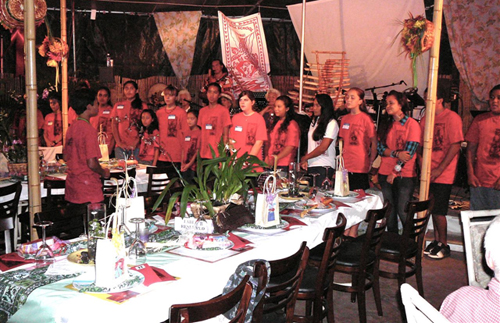
Aka`ula School held its annual auction and dinner event last weekend.

A butchered steer, a year of bliss and a Caribbean living room are just a few of the many prizes that were up for bidding last weekend at Aka`ula School’s biggest fundraiser of the year. The event, Ku Ka Lau Lama, was held at Paddler’s Inn and featured a full buffet meal along with silent and live auctions.

As one of Molokai’s only private schools, making ends meet is always a challenge for Aka`ula and the annual dinner auction provides a huge help to the school and the community.

“This event will probably take care of a month to two months of operating expenses. It’s a big chunk; it’s not the only chunk, but it’s a huge chunk,” said head of school Vicki Newberry.

Guests mingled around tables of silent auction items, bid on larger rewards like an electric bike, massage packages, and vacation get-aways during a live auction, and enjoyed a buffet style dinner.

Newberry credited the students’ parents for their determination and hard work that make the event possible. This was the sixth year for the event, which returned to its original location at Paddler’s.

The students themselves also pitched in a helping hand by serving food and doing other jobs during the event. Seventh-grader Alex Gilliland, who acted as a part time emcee for the silent auction, said she was happy to help out because it was an important night.

“This event helps us a lot with our fundraising,” Gilliland said. “It allows a lot of us to come to school here that wouldn’t otherwise be able to pay the full way.”

Each of the event’s 200 attendees received a personal note at dinner from one of the school’s students thanking them for their support and explaining why Aka`ula was important.

The school is made up of roughly 60 students in fifth through eighth grades. They were originally located in Kaunakakai at what is now Molokai Pizza Café until last December when they relocated to Kualapuu Center.

“I like going to school here because we meet new friends from all over. It’s fun because the older students hang with younger students and everyone gets along,” eighth-grader Heather Place said.

Newberry said having a peaceful campus has been one of their biggest principles since the school started. The students appreciate the welcoming atmosphere which gives them more opportunities to do the things they love.

“I think we get more chances to do interesting things than other schools,” said Pono Chow, an eigth-grader and the song conductor for the school’s choir. He and his classmates led off last weekend’s fundraiser with a few songs.

They were followed by jazz artists Mehana Suza and Starbird as well as Hawaiian music performers Na Ohana Hoaloha. Na Ohana, a local band, used the event to release their first ever DVD which was on sale throughout the night.

Newberry said she did not yet know how much money was raised by the event, but was certain that the school surpassed its goals for the night and will be able to operate for the next few months based on the money they made last weekend.

Seal Send Off

Thursday, November 19th, 2009

Seal Send Off

Concerned residents and cultural ambassadors from Molokai led the blessing of KP2 yesterday, Molokai’s favorite monk seal that lived most of his two years around the island and was discovered to have cataracts a few weeks ago. The blessing took place at Waikiki Aquarium and was led by Reverand David Kaupu. Aquarium staff and National Oceanic and Atmospheric Administration (NOAA) officials were also on hand.

also represents us as Hawaiian people and culture being as endangered as he.”

David Schofield, NOAA marine animal coordinator, said blessings like these have been done before when whales or dolphins have been found on beaches.
“We try to be as respectful as we can with Hawaiian culture. We invite practitioners so their protocols were followed as well as ours,” he said.

Celebration of Arts

Thursday, November 19th, 2009

Celebration of Arts


This acrylic painting, done by Molokai artist Linda Johnston, captures the Molokai band Na Ohana Hoaloha during one of their weekly performances at Coffees of Hawaii. Johnston first decided to paint the musicians of Molokai ten years ago. This particular painting took three weeks to complete the actual painting. The original three foot by two foot painting is currently on display at Coffees and Na Ohana used the image as a cover for their recently released debut DVD titled “Pretty Old for Our First Time,” produced by Aka`ula School. Johnston’s work can be found for sale at the Molokai Artist’s and Crafter’s Guild in Kaunakakai and on her websites  www.molokai-art-hawaii.com and www.stdamienofmolokai.net.

Playing Games in Naiwa – Part 1

Thursday, November 19th, 2009

Playing Games in Naiwa – Part 1

This story about Naiwa was originally written in 1921 in the Hawaiian language newspaper, Kuokua in three increments. In 1952 an English version of the story showed up in the newspaper Ka Leo O Molokai, written by Molly Reppun. Another version can be found in the private collections of Marsha Camera. It tells us a lot about the makahiki, the places and some of the customs from a time period right before Kamehameha’s wars.

The story begins in Waikolu. Our main character lives there with his extended family and his wahine. A grandfather begins to tell all the residents to get ready for the upcoming games to be played in Kalae. He says, he still has strength in his old bones and if friends and family bet on his skills, they will have many “goods” to carry home on their backs. Our hero decides to stay home with his “Niihau basket,” or woman, rather than to travel with the group. When the group returns, they are laden with wealth from the games.

The next time the grandfather gathers the men together, our hero decides to join them. But some of the women are sly in their comments about how dressed up some of the men are. This creates some anxiety in our hero who reassures everyone that he has only one woman in his heart. The men talk among themselves about creating a delay in their trip which they believe will stress out our hero. They agree to stay at a house an extra night in Kalaupapa to gather a bigger group before going up the pali to Kalae.

In the prelude to the games, the story’s details of the people, the place names and metaphors are amazing. The area of Kalae was ruled by two “good” chiefs. What made them good? They did not engage in war and burden the people with it. Instead, these two got along quite well and as a result hosted the games. The author tells us that story takes place during the time of “our grandfathers” and before foreign food, “Kahaolekaukau”.

This time the grandfather gives his walking stick to another and instructs the group to remember to carry the god with them when they travel. They gather from Waikolu, Wailau, Pelekunu and Halawa before climbing the cliffs. Others travel from as far away as Kaana with its lehua. The iwa birds soar above as they reach their destination. The famous and well known chant, “Aia Molokai Kuuiwa” first appears in this tale.

Before the games, there is ceremony and speeches. And the master of ceremonies invites the young men to enjoy the dancing of the young women. He highlights who is considered the best dancer for that season. And our hero forgets completely about home in all the excitement of the festivities. Which is exactly what the men in their mischief had planned when they tarried an extra night in Kalaupapa.

As a new day dawns, the crowds begin to compete with riches being exchanged while betting on different champions. Our hero's group, like others, wins and looses throughout the day. There is so much betting that items go from group to group occasionally returning to their original owners.


In our next episode we will learn more about the two weeks our hero remains away from home in Kalae.

Keiki Kanes Capture Crown

Thursday, November 19th, 2009

Keiki Kanes Capture Crown

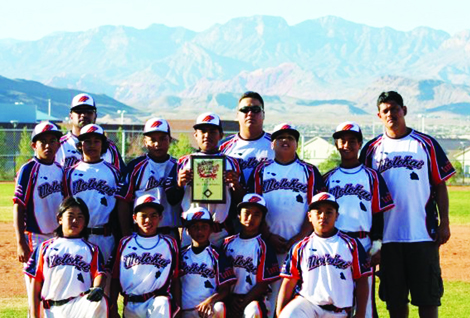
were eight years old and we had a goal to provide them with a life long experience,” he said. “When we got this chance to go to the mainland we knew it was what we were working for since day one.”

The team started with 13 boys and has remained mostly intact over the past few years. 11 players traveled to Las Vegas for the tournament and Hooper said that every one of them played a big role in bringing the championship trophy back to Molokai.

“Pretty much everybody put their paws into it. There was no one or two kids that took over the game,” he said.

The team is currently competing in a Cal Ripken, Jr. league with teams from Honolulu. They make one trip a month to Oahu and are currently 4-4 with four games remaining in the league’s regular season.


Island to Island

Wednesday, November 18th, 2009

Island to Island

With a flourish of feathers and face paint, a Pacific cultural group called Ariw Poenipan performed for the Molokai community last week. The group hails from the Torres Strait Islands between Australia and Papua New Guinea. Known for their authentic cultural performances, theirs is an oral culture preserved through passing on stories, traditions, music and dance. Molokai got to see a glimpse of this in front of the Public Library. Pictured above, dancers display the elaborate, hand-made headdresses and “dance machines” they are famous for. The props are not only cultural significant, but assist the dancer keep rhythm as they manipulate the moving parts, creating sound effects.


To illustrate that the challenges they face in the Torres Strait are similar to those encountered globally, leader Jeff Aniba-Waia explained that because of global warming, many of their low-lying islands are in danger from rising water levels. The group’s name, Ariw Poenipan, refers to the electrifying lightening that pierces the rain, and the echoing thunder of the monsoon season.

Bombs to Beauty

Wednesday, November 18th, 2009

Bombs to Beauty

Ilio Point on Molokai’s northwestern tip has seen its share of earth shattering events – literally. Acquired by the U.S. Navy in 1940 as an aerial bombing range, the area still has so many unexploded ordinances that access is prohibited. Ilio Point, despite the devastation, is rich in rare plants and animals, cultural sites and archeological specimens. Because of that, the Department of Land and Natural Resources (DLNR) Natural Area Reserves (NARS) Commission has recommended the area for designation as a Natural Area Reserve.

The proposed area consists of 261 acres of state land that is not designated to any specific department. The state’s deed on the land currently prohibits access because of the unexploded ordinances, and the NARS designation would not change that, or affect native gathering rights, according to Emma Yuen, NARS Enhancement Coordinator.  However, part of the goal of the NARS designation is to remove safety hazards from the area.

Ilio Point is home to seabird species, the endangered Hawaiian monk seal and many native and rare plants. Fossilized goose bones and snail shells of now-extinct species have also been found in the area.

If designated, the land would be preserved in perpetuity, according to Bill Evanson, District Natural Area Program Manager. Final approval of the NARS designation is up to the Governor.

“It needs to be protected,” said Molokai resident and Hawaiian plants specialist Bill Garnett. “It’s one little place on Molokai where it still is what it used to be.”

Garnett and others testified at a public hearing about the proposed Ilio Point reserve held on Molokai last week.

Resident Halona Kaopuiki explained his family’s history in the area and the cultural important of preserving access to Ilio. 

“We’re talking about access. We have burials out there,” he said.

Yama Kaholoaa, Sr. expressed apprehension about the plan because it is not community initiated. He testified about the knowledge and resources of Molokai residents that are left unused, and said he hoped a plan for Ilio Point would be developed in close communication with the community.

“It should be the native Hawaiians that take care of the native species,” Kaholoaa said.

There are two other Natural Area Reserves on Molokai already – Pu`u Ali`i and Oloku`i on the island’s north central shore. The last NAR in the state was designated in 1991.

Another public hearing will be this Wednesday, Nov.. 18 from 6-8 p.m. at the Mitchell Pauole Center.


KP2 Heads to Temporary Home in California

Wednesday, November 18th, 2009

KP2 Heads to Temporary Home in California

NOAA News Release

NOAA Fisheries Service announced plans to move KP2, the monk seal abandoned at birth, to a temporary facility at the University of California at Santa Cruz some time next week.  During a recent medical examination, it was discovered that KP2 has cataracts that prevent him from being released back into the wild.  He will undergo bilateral cataract surgery while in California.  NOAA Fisheries Service plans to return KP2 back to Hawaii as soon as a permanent facility can be built for him and perhaps other unreleasable seals in Hawaii.

Since the day he was born, KP2 has been an ambassador for monk seals and has brought attention to the critically endangered monk seal population.  NOAA Fisheries and the Waikiki Aquarium are facilitating a private native Hawaiian blessing to send KP2 on his way.  KP2 has touched the hearts of many and we look forward to his return to Hawaii as soon as possible.

A native Hawaiian blessing will be conducted on Wednesday, November 18 at 12:15 p.m. on the front lawn of Waikiki Aquarium. David Schofield, NOAA official, Dr. Andrew Rossiter, Waikiki Aquarium, Walter Ritte, Molokai resident, and other cultural representatives from Molokai will be on hand for the blessing.

Due to quarantine concerns, the native Hawaiian blessing will be held in private.