in

Search Results for: <

Lions Roar

Wednesday, December 2nd, 2009

Lions Roar

Molokai Lions Club News Release

The Molokai Lions Club will hold its first ever giant garage sale Molokai Community Service Center across from the old telephone company in Kaunakakai on Dec. 5th from 8 a.m. to 2 p.m.

This is a fundraiser for the activities that the Molokai Lions Club bring to the community such as the two $500 Service Awards for graduating MHS seniors, the Halloween Costume contest, the Easter Egg hunt and contest, the Retina Screening Project Van, the Sight Is Beautiful poster contest, and vision screening for the public and private elementary and middle schools. The garage sale will feature new and used household items inc. small appliances, clothing, plants, etc.

For more information call Lion Carol Connatty at 553-3859.

Fridays are for Fish

Wednesday, December 2nd, 2009

Fridays are for Fish


By Walter Ritte
The Hawaiian Learning Center (HLC) has opened its doors to help parents and to educate students on Furlough Fridays. HLC has been providing free "learn by doing" cultural land stewardship opportunities at the Keawanui fishpond.

Lessons for the students include traditional ahupua`a land management and how things you do mauka affect the shoreline, reefs and ocean. An introduction to life forms found in traditional fishponds as well as the invasive limu, which are now in our ponds is included in this cultural education, as well as how the fishponds work. Math and science become hands-on lessons that help to keep our animals alive, improve the water quality, and keep records of the size, weight, and numbers of animals in the pond.

Parents interested in details of this program can call 558-0111 or 6580406.

Water Shortage Continues

Wednesday, December 2nd, 2009

Water Shortage Continues

By the County of Maui

The Department of Hawaiian Homelands (DHHL) is asking residents of Ho`olehua and surrounding areas to continue conserving water. Repairs to two DHHL water pumps at the Kalae water well that began in early November are not finished. Residents and businesses in the area are reminded to continue necessary water conservation efforts by restricting lawn watering, avoiding washing cars and taking shorter showers. Non-essential water use should be limited.

In order to maintain safe levels in the water reservoir, a temporary four-inch emergency water line was installed. %he line is smaller than normal, so a lesser amount of water is being pumped to residents in the Ho`olehua and Kalamaula areas. As a result, DHHL asked the residents to reduce their usage by 50 percent on Nov. 10 to help lessen the risk of running out of water while the repairs are being completed.

The County of Maui’s water system is helping to supply water to DHHL’s system during repairs. Earlier this year, when the County’s system underwent emergency repairs, DHHL provided water to the County to assist Kaunakakai residents.

Fire Department Captain Travis Tancayo headed a county-wide effort to ensure that there is enough water in the event of a fire for both the impacted Ho`olehua area and the surrounding areas currently sharing their water. Tancayo credits the work of many in helping to prevent a dangerously low water supply situation from worsening.

“With the guidance of Pacific Electro’s Marty Johnston, the group was able to collaborate and resolve how to get needed water to the reservoir while DHHL’s pumps were under repair,” Tancayo said.

“Everyone involved worked weekends and nights to develop the response plan, get materials and lay pipes so that people could have water available. We're very grateful for Kualapuu Ranch and ranch owner Kevin Komkowich's assistance. The pipes were laid on the ranch's property and their support and understanding of the urgency were instrumental.

“We were then faced with needing to cut the road to lay the temporary water line and Pedro Ranch stepped forward with heavy equipment to help get this done. By having many people and agencies work together we were able to respond rapidly and help our community and that also includes our residents and businesses that took steps to immediately conserve water. The public’s help is always crucial and appreciated”

Anita Wong, DHHL’s deputy director, gave special recognition to Molokai Properties (also known as Molokai Ranch). The company reactivated its Well 17 in order to provide a needed water source for the Kalae Reservoir. “Molokai Properties’ help with Well 17 was essential,” Wong said. “Rex Kamakana and the water department personnel worked tirelessly to make it happen and we appreciate their hard work these past few weeks.” Wong also commended Monsanto for the company’s help with providing 2,700 feet of a high density four-inch water pipe needed for water to flow to the reservoir from Well 17.

“Monsanto not only provided the needed pipe material, the company also made available a large crew of workers to install the pipe over a 3-day period using specialized tools,” she said.

The County of Maui is providing water to the Kalamaula area and will continue to assist DHHL until repairs to its two pumps are completed.
Repairs are expected to be completed sometime in the first week of December. Impacted residents and businesses in Ho`olehua and Kalamaula are asked to continue conservation efforts until the repairs are completed.

Hanging Tough

Wednesday, December 2nd, 2009

Hanging Tough

Life in Maunaloa has not been easy for the past couple years.  The unexpected closure of Molokai Ranch was followed by the boarding up of many of the town’s biggest businesses. Now, Maunaloa’s community members are digging in their heels to try to save their most important remaining resource – their school.

“Our school is the heartbeat of our community,” said sixth grade teacher Wendy Espaniola. “[Losing it] would make a major impact on our community, it would shut us down.”

Espaniola is one of 10 community members and educators who were selected to be on the Maunaloa Consolidation Task Force. The task force was formed to evaluate the future of Maunaloa Elementary School. Their job is to present the Board of Education (BOE) with a detailed report of the school and also recommend whether or not it should remain open.

Maunaloa Elementary School is one of approximately 20 schools across the state that is being considered for consolidation by the BOE. The state is threatening to Muanaloa students to another school on Molokai and closing the building. Randy Moore, the Department of Education’s assistant superintendent, said there is a list of criteria that the BOE uses to determine if a school should be considered for consolidation.

According to Moore, schools are required to go through with a consolidation study if: one-third of classroom space is in excess of what the school needs, more than one-third of school facilities do not meet current standards or the school is in danger of becoming so small that it will not offer the range of educational opportunities available at other schools. Maunaloa’s facilities are up to par, but with only roughly 60 students, the school’s small size raised red flags for the BOE.

These rules have been on the books for several years. However, the recent state budget cut has pushed the Board to move much more quickly on the consolidation studies. One school, located in Wailupe, Oahu, has already been consolidated and four other locations (including Maunaloa) are in the beginning stages of the investigation.

“The state financial crisis has certainly accelerated the process,” Moore said. “To operate a school like Maunaloa is probably more than double the cost per student of the average school.”

Just Getting Started
Last week the task force met for the second time at the school’s cafeteria. They presented data about the school and accepted public testimony from community members. The data and testimonies will eventually be used in their report to the BOE, which will be delivered this spring.

The task force will hold its final meeting Feb. 16, 2010 to make a recommendation about the school. Complex superintendent Lindsey Ball and state Superintendent Patricia Hamamoto will also review the task force’s report and make recommendations to the BOE. Based on all of that information, the BOE will make a decision about the school.

According to Moore, the process for Oahu’s Wailupe School took approximately five months to finish. He said the Maunaloa decision is more complicated because of its broader implications to the community, and he expects it to take much longer.

Save Our School
Maunaloa made it on to the BOE’s consolidation list because of its small student body, but in the eyes of the community the school’s size is its greatest asset. 

The school averages 10.5 students per teacher. While budget cuts have led to combining grades for certain subjects and a lack of counselors, parents say that small ratio provides an invaluable relationship between the teacher and students.

“My kids love the school because it is small and they learn more than they would in a bigger school,” said Etty Angst, parent of two children at the school.

Maka Alameida graduated from Maunaloa three years ago and said the personal attention he got from teachers made him a better student.

“You get choke one-on-one time with teachers, so if you fall behind they catch you up quickly,” he said.

Other Molokai residents are concerned about the strain closing the school would put on students and their families with the daily commute to one of the island’s other schools. Most students would have to take the MEO bus to and from school, which means leaving home before 7 a.m. and not returning until late in the evening. The long ride and bus schedule would make it very difficult for any of the students to participate in after-school activities or extra help sessions.

“Logistically it’s a tremendous strain on our youth, I can’t see a first or second grade student having to put in those kind of hours to go to school,” said Molokai High teacher Art Buchalter.

More Than a School
While losing any school can be tough on its students, closing Maunaloa may have even larger implications.

“The community makes this school unique. The kids have a lot of pride in this school, because it is theirs,” said Molokai resident Dart Bicoy.

Over 60 percent of the school’s employees live in the community and would probably have to move to find new work. Espaniola said she was also worried that families would relocate to make the commute easier.

“I think parents would have to move, the value of our homes would go down, whatever businesses we have here would leave too,” Espaniola said.

She and her brother, Danny Espaniola, are both members of the Consolidation Task Force that has to evaluate the school. Danny Espaniola, the current vice principal at the high school and former graduate of Maunaloa School, said he believes this is just another obstacle in the very bumpy road that goes along with living in Maunaloa.

“This community has gone through so much since the plantation era, but it has always bounced back from adversity,” he said. “This is just another hurdle in our challenge – another bump in the road.”


Cruising with Cruz

Wednesday, December 2nd, 2009

Cruising with Cruz


Sitting with a glass of red wine or perhaps a beer, audience members took in the John Cruz concert last Friday night with a mellow attitude. While there was plenty of applause at the end of each song, listeners kept conversations to a minimum, hanging on to each of Cruz’s soulful melodies.

John Cruz has pockets of fans throughout the country, and has played at some big venues, like the famous South by Southwest music festival in Texas. But in the past few years, the popular Hawaiian musician and Grammy Award-winner has been touring the mainland a lot – and some of his loyal home-based fans began asking him: when was he going to return and play in Hawaii?

John Cruz returned to his roots this month, when he started a state-wide tour, including one show on Molokai. Cruz played at Paddlers Inn last Friday night, in a freelanced acoustical solo performance. His manager, Leslie Truglio, said Cruz never plans his solo shows, and just plays whatever comes to him.

“When playing real small intimate places [like Paddlers], you can get really introspective,” Cruz said. “When playing for little bit bigger crowd, need to be really inclusive. Invite people in with open arms rather than close up and talk about how alone you are.”

Earlier this year, he played at the Sust-`AINA-bility conference on Molokai with his cousin and fellow Grammy-winning musician, Amy Hanaiali`i.

“It reminded me how rare it is for me to come to Molokai,” Cruz said, adding this is where he is able to go fly-fishing and enjoy some rare solitude.

Cruz said he likes to bring his Hawaiian vibe to his mainland audiences, many of whom have not had much exposure to Hawaiian music. But when he returns home, he likes to bring different influences from the mainland – Irish music, African music –  more than just acoustic soul.

He is currently working on his third album, due out sometime next summer. He said producing a recorded album depends on how much inspiration comes to him.

“As time goes on, more things happen in your life, you have more and more things to deal with in your head,” he said. “So it’s hard to have that time free where your heads open, your hearts open and things can come through.”

Cruz is headed to play concerts next on Oahu and Maui.

“When playing live, it’s all about the energy and connecting, and communicating with people live,” Cruz said.

For more information, check out Cruz’s official webpage, www.johncruz.com.

Food for the Forsaken

Wednesday, December 2nd, 2009

Food for the Forsaken

Loaded up in coolers and boxes, then into trucks and cars, 500 meals full of Thanksgiving food and well-wishes were given out to those spending the holiday alone by St. Damien Parish on Thanksgiving Day.

Over 50 volunteers gave up their time to package cornbread, peas, mashed potatoes, and of course, turkey, that were given to the homeless, the women’s shelter, and Home Pumehana – the first large-scale Thanksgiving food drive.

It was a collaborative effort between Leoda and Mike Shizuma; Leoda is the coordinator for the social ministry of the St. Damien Parish, and Mike owns a catering company. He said he had done a similar event several years ago, and felt in a position to give back.

“[We] just wanted to bless a family” with this food, she said.

Luke Santiago, who attends Aka`ula School, said he and his family have been helping with Mike’s catering business for a while.

“It’s good to give to needy and other people,” he said.

The Thanksgiving food drive started last Monday, when the parish received boxes of canned food from Honolulu. She said the donations came from the Catholic churches there, after Bishop Larry Silva made a “plea” to help the people of Molokai who had lost their jobs after Molokai Ranch closed in 2008.

Leoda Shizuma intended to give the boxes away until Wednesday. They ran out on Tuesday.

“People just kept walking in, off the streets,” she said. “It got around by word of mouth.”

Molokai residents made monetary donations as well, to help purchase food for the Thanksgiving meal.

Carol and Jim Gartland, owners of the Kualapu`u Center, said it was a quiet day for them with no other family on the island, and they thought it was the right thing to do to volunteer their time driving the food to its destinations.

In such a close community, but without a food pantry or a soup kitchen, Leoda Shizuma said this is a small start to help the “homebound.”

“I think some people have no sense that [homelessness] can happen,” she said. “This [event] is a model to others to join the effort.”

Fruits of Their Labor

Wednesday, December 2nd, 2009

Fruits of Their Labor

If you have ever tasted the generic Pinesol-tasting lemon tea found in hotel rooms, a new tea to Molokai will leave you feeling spoiled.

Coffees of Hawaii has created their first original tea, made from the fruit of their coffee plants and blended with flowers and herbs. This kind of tea is called a tisane (pronounced ti-zane), an herbal fusion of different flowers and herbs. This particular infusion is only produced on Molokai, and uses only Hawaiian-grown products – most of which is found on Friendly Isle.

“Tisane: Molokai style,” reduces the company’s waste by reusing the pulp as a profitable product, and adds another, more mellow dimension to the company, said Ford. Since coffee is a highly “amped” drink, there is another market that Coffees wished to reach with a less caffeinated product.

“Mocha Mamas keep us in business,” Holmes said. “But this is a better choice, a healthy alternative, for the kupuna and those that don’t drink coffee.”

The tea blends were also chosen for their specific health benefits.

“This community to me seems to be increasingly more active and health conscious. This is an excellent way to support any dietary or lifestyle change,” Ford said.

The original tisane and its five blends is already available to order through their website,  http://www.coffeesofhawaii.com/, will be hitting Coffees’ retail shelves around the holidays and will soon be sold in other shops around the island.

Molokai’s Tisane Choices
Cherry ambrosia: a completely new interpretation of coffee. Several times the antioxidant power of blueberries.

Jasmine Blossom Green Tea: coffee cherry, jasmine blossoms (strong antibacterial, antiviral, and anti-tumor properties), green tea (boosts metabolism).

Lavender Tisane: coffee cherry, lavender blossoms (antiseptic, anti-bacterial, anti-fungal, anti-inflammatory, anti-convulsive, and anti-depressant properties).

Lemongrass Tisane: coffee cherry, lemongrass (relieves fever, flu, headaches, intestinal irritations; detoxifies liver and the digestive tract).

Mamaki Ginger Tisane: coffee cherry, mamaki leaf (reduces cholesterol, cleanses toxins from the blood), ginger root (cold remedy, also used by native Hawaiians; promotes energy circulation and increases metabolic rate, relieves cold skin, hands & feet).

Papaya Leaf Vanilla Tisane: coffee cherry, papaya leaf (relieves heartburn, indigestion; wheat gluten (good for people with Celiac disease), vanilla bean (aromatherapeutic: reduces stress, helps headaches, improves mood, relieves depression; calming to queasy stomach).

(Except for green tea from Japan, all ingredients are Molokai- or Hawaii-grown.)

Footsteps For Football

Friday, November 27th, 2009

Footsteps For Football

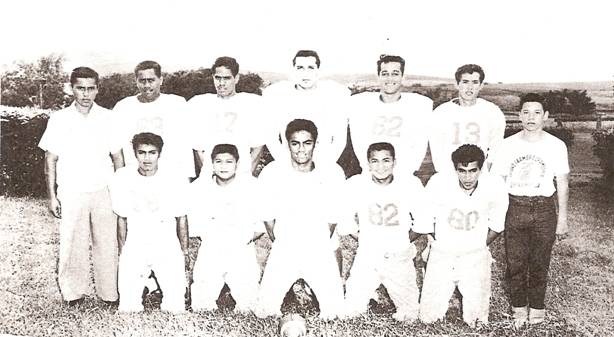
There hasn’t been a high school football game on Molokai since 1961, but the possibility of ending that streak took a small leap towards reality last month. Mike Kahale, a physical education teacher at Kualapu`u School, recently received a $2,000 grant to purchase football equipment.

Kahale, who has been working to create a high school football team since moving to Molokai five years ago, said the grant from USA Football was a step in the right direction.

“It’s a huge step,” he said. “Getting the equipment was one of our biggest obstacles and the fact that we got it from a nationally recognized organization shows we are willing to look to outside sources to get this done.”

Kahale and his wife, Nichol Helm Kahale, presented a strategic five-year plan to bring football back to Molokai to High School Athletic Director Cami Kimball last year.

“We sat down at the beginning of the year last year and talked about possibly bringing it back to the school,” Kimball said. “It’s on our backburner, but I don’t want to give the impression that we will have a team next year.”

The cost of high school football is exponentially higher than most other sports and a good deal of money would still need to be raised to help pay for travel costs, field maintenance and additional equipment.

Starting a football program seems even more daunting as it comes on the coattails of major budget cuts for high school sports across the state. Supporters of the program will be looking to other outside businesses and organizations to help with funding.

Kahale said Molokai’s most famous football player, Kimo “Scooby” Von Oelhoffen, has offered to help fund the program, but the two have yet to discuss actual dollars and cents. Von Oelhoffen played football at University of Hawaii and Boise State before starting a 15-year NFL career, despite never getting the chance to play in high school.

Crazy Eights
The $100,000-plus price tag that comes with a traditional football team is a stretch at this point, but that doesn’t mean the sport can’t exist at all. In the past year, some of the Maui Interscholastic League’s (MIL) smaller schools have started to look into an eight-man football league.

Eight-man football – rather than traditional 11-man teams -- is played in many rural regions on the mainland and allows small schools with small budgets a chance to play football. MIL Executive Director Joe Balangitao and St. Anthony’s High School Athletic Director Charlie Pico have been working to develop such a league for Maui County’s smaller schools.

“An eight player league is way more suitable for us,” Kimball said. “There is no way we can do a regular league. For us to send that many players every will is just not a possibility.”

Kahale said they still hope to establish a full team in the future, but see the possibility of an eight-man team as good progress.

“It’s not exactly what we wanted, but right now it’s either eight-man or nothing and it is definitely better than nothing,” he said.

Moving Forward

Kahale said the next step is to inform other possible contributors and Balangitao about the new grant. The MIL requires commitments from only three schools to sanction a league.

“We just have to let everyone know we are headed in the right direction and get our plan into the hands of people who can help us raise the money we need,” Kahale said. “We should be afforded every opportunity that every other high school has in Maui County.  Our kids deserve it.”

Winter Sports Preview

Friday, November 27th, 2009

Winter Sports Preview

The rains are starting to fall, turkeys are in the oven and Christmas decorations are not far away, which means that it is almost time for Molokai High School to kickoff its winter sports seasons. This year the Farmers will compete in seven winter sports and all of the teams are entering their season with high hopes.

Basketball
The Lady Farmers come into the new season with high expectations after capturing last year’s Div. II state championship. Molokai returns nine of its ten players from the championship squad and appears poised to make another long postseason run.

Seven players on this year’s team put in serious minutes on the court last year and are expected to do the same with another year of experience under their belt.

, and I intend to build on those,” she said.

Megan Stephenson also contributed to this story.

Time Well-Served

Wednesday, November 25th, 2009

Community contributed

Provided by Gwen McGwin

Lieutenant Commander Rudy McGwin grew up on the Hawaiian islands of O`ahu and Moloka`i. His father, Donald McGwin, a decorated Air Force Chief Warrant Officer, exposed him to life in the military at an early age. Rudy enlisted in the Coast Guard in January 1980 to “see the world.” After graduating from Radioman “A” school in Petaluma, California the summer of that year, he received his first set of orders to (ta-da!) – COMMSTA Honolulu. So much for seeing the world!