in

Search Results for: <

Tutu’s Corner

Wednesday, September 21st, 2011

Community contributed by Tutu and Me Traveling Preschool

Self-esteem is one’s regard for self. It is how we value ourselves. Most of the feelings about ourselves were established when we were children. Many people suffer from a low self-esteem, which leads to many other problems in their lives. Low self-esteem could, for example, lead to depression and even a life of oppression and crime as one strives to feel good about oneself. Therefore, it is very important, as caregivers of young children, that we help children to develop a healthy self esteem while they are young.

Farmers Football Dominates

Tuesday, September 20th, 2011


Created with Admarket's flickrSLiDR.

Hundreds of fans cheered a mean, green touchdown-scoring machine last Saturday, as the Molokai High School (MHS) club football team blanked visiting Seabury Hall in the first matchup of the season.

“It felt good – it was an exciting game,” said sophomore Noah Caparida. “We’re looking like a real team.”

Kalaupapa Courage Recognized

Monday, September 19th, 2011

Kalaupapa Courage Recognized

In the face of great injustice, they lived exemplary lives – and for that, the patient-residents of Kalaupapa were individually honored last week with certificates from Hawaii’s state legislature. Mounted on plaques, the certificates honored the patients’ lives and apologized for their mistreatment.

An estimated 8,000 Hansen’s disease patients were abruptly taken from their families to live on the peninsula in forced isolation from 1866 to 1969. They were nevertheless “remarkably resilient and have responded to their plight with kindness, generosity, and forgiveness rather than anger, bitterness, and despair,” the plaques read in part.

House Representatives John Mizuno and Faye Hanohano spearheaded the resolution to individually honor the patient-residents and conducted the ceremony at McVeigh Hall last Tuesday. A total of 17 former patients in the state received plaques, including those currently living outside Kalaupapa.

“Thank you very much,” patient-resident Gloria Marks told them when she received her plaque. She was one of five Kalaupapa patient-residents who accepted her plaque in person on Tuesday.

Clarence “Boogie” Kahilihiwa, also expressed his appreciation of the honoring.

“It’s nice to get recognized,” he said after the ceremony.

The certificates also recognized Senate Concurrent Resolution No. 208. The resolution was passed in 2008 as the government’s first official apology to the residents of Kalaupapa for their exile. They made note, too, of Saint Damien de Veuster, who spent his life in the settlement.

The patient-residents are “living remnants of the history of Kalaupapa,” Mizuno said after the ceremony. He and Hanohano began discussing ways to acknowledge their lives individually around March, he said.

“This may be the last opportunity to thank them and apologize,” Mizuno said. “It’s very important as we’re getting to the end of a chapter.”

Mark Miller, the Department of Health administrator for the Kalaupapa settlement, said he found out about the representatives’ visit about two days before they arrived. He and the patients were unsure what was to be presented until the meeting actually happened, he said.

“It was getting time we recognized the circumstances surrounding the patients’ involvement with having to stay here,” he said of the plaques. “It’s a good thing.”

Surviving the Fall

Monday, September 19th, 2011

Surviving the Fall

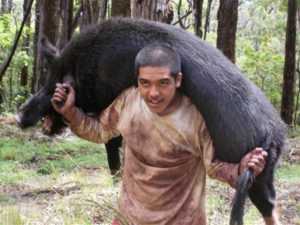
“No dog is worth your life,” says Kaimana He, sitting in front of his house. Small scratches are faintly visible on his face; in the sun, the remnants of bruises are fading around his ribs.

His mother, Tina He-Lindsey, agrees.

“Even with the most experienced people, accidents still happen,” she says.

The pair knows what they’re talking about. It was only weeks earlier that He-Lindsey came home to a jolting phone call from family friend Dolphin Pawn: While trying to retrieve his dogs on a hunting trip with friends through Waialeia Valley that morning, Kaimana had fallen off a ledge more than 40 feet. He had a large gash on his forehead; the full extent of his injuries was unknown. Pawn, who was hunting with a separate party, stumbled across the boys and used his dogs’ GPS collars to pinpoint Kaimana’s location.

Sore and bloody, the 17-year-old would need to be airlifted to a hospital.

“It was a terrible day, our worst nightmare,” He-Lindsey says. “The first thing I did was pray to God to keep him safe, to comfort him and ask my grandfather to watch over him. … When you’re completely helpless to your own child, that’s reason enough to panic.”

The Accident
Kaimana and his friends left Kaunakakai about 4 a.m. on Sept. 3, planning to trek into the Molokai Forest Reserve to hunt boar. For Kaimana, pig-hunting is

,” he says. “The mountains may be beautiful but they can take your life.”

Paddling Pailolo

Monday, September 19th, 2011

Paddling Pailolo

The 26-mile Pailolo Channel is one of the windiest but best courses in the state, according to its paddlers. Last Saturday, 70 teams assembled for the fifth annual six-person outrigger race from Maui to Molokai known as the Pailolo Challenge. Molokai’s Wa`akapaumua men completed the race in 4th place overall with a time of 2:59.48. The club also paddled a women’s crew, finishing 10th in the open women’s division.

Maui’s team Primo won the race with a time of 2:42.59. For Primo paddler Kekoa Cramer, the toughest part of the race is “leaving Molokai.”

Molokai’s Clint Labrador said the course held five to six foot swells on race day. “The finish was intense as we were battling with Hawaiian Canoe Club's first crew from about One Alii Park for 3rd place,” he said. “They got us by a half canoe length at the very end, but we managed to give them a run for their money.”

Molokai Teaches with Heart

Monday, September 19th, 2011

Submitted by Diane Abraham

Each month, kumu from a different school island-wide are featured in articles written completely by the keiki to share their experiences with their most beloved teachers.  Below are the submissions from seventh grade Molokai Middle School students and fourth grade Kualapu`u School Hawaiian immersion students. Mahalo to Kumu Loke Han of Kualapu`u and Iolani Kuoha of Molokai Middle for gathering the students’ contributions.

Kualapu`u School
Kumu Henohea Linker
`O ka`u kumu punahele `o Kumu Henohea Linker no ka mea
Ho`omake`aka `o ia a hana `o ia i na mea maika`i, na mea le`ale`a
e like me na kemu hana lima. `Olu`olu o Kumu Henohea a a`o

Veteran’s Corner

Monday, September 19th, 2011

Veteran’s Corner

Column by Jesse Church

Hello veterans, old Jesse here with all the veterans’ news and upcoming events. On Aug. 13, 1918, Pvt. Opha Mae Johnson became the first woman to pin on the eagle, globe and anchor. Johnson was the first of 305 women to enlist in the Marine Corps Reserve, according to the Marine Corps History Division. Women were accepted in noncombat roles in the Corps in order to “free a man to fight.” They took over clerical roles and became recruiters so more men could be sent to France during World War I. At that time, women were not allowed to serve at Headquarters Marine Corps. The female Marines were called “Marinettes” according to the book “USMC: A Complete History,” and they did not go through boot camp. Less than a year after Johnson was sworn in on July 30, 1919, orders were issued to separate all women from the Corps due to the war ending. The last day for active duty female reservists was Aug. 11, 1919. It wasn’t until World War II that women were allowed to serve in the Marine Corps.

The Navy Times has reported a new missile being developed will be able to find and destroy enemy radars, even if they are turned off. In late May, the AGM-88E advanced anti-radiation guided missile finished initial flight integration tests on the EA-18G Growler and FA-18E/F Super Hornet. The AARGM, developed by ATK for the Navy, Marine Corps and the Italian Air Force is expected to provide more accurate attacks on enemy radar systems and radar-equipped anti-air defenses. It will supplement the AGM-88 high speed anti-radiation missile but will have a greater range, field of view and frequency coverage than HARM, which will not leave the fleet. When attacking enemy radar defenses with HARM, the enemy sometimes would hide from the incoming weapon’s radiation-seeking guidance system by turning off their radars. The AARGM can target arrays after they are shut down. If tests are successful, the missile is scheduled to enter fleet in 2012.

There was an article in the Aug.1 copy of the Marine Times by Patricia Kime, titled “Purple Heart Recipients Live Longer.” A study of aging World War II and Korean War-era veterans showed that those who were awarded the Purple Heart died at a much slower rate over the course of a decade than those who didn’t receive the medal. Researchers at the Central Arkansas Veterans Health Care System examined medical records of 10,255 military veterans over age 65 to determine whether troops wounded in combat were more resilient to disease, illness and death over a lifetime. And they were twice as likely to be alive after 10 years of follow-up, compared with veterans who did not have a Purple Heart. Researchers looked at veterans ages 65 and older in the late 1990s and followed their survival through 2008. They found that the Purple Heart recipients, if they made it to that age, were “too tough to die.” Those with Purple Heart citations had half the mortality rate of those without Purple Heart citations, said Dr. Tim Kimbrell, a research psychiatrist with the Center for Mental Health and Outcomes Research at the Arkansas facility.

Just a reminder that Joe Thompson, the veterans service officer will be on Molokai Friday, Sept. 30 from 8:30 a.m. to 12:30 p.m. at the Veterans Center in Kaunakakai. If you need to see Joe, please mark your calendar. Please show our service men and women stationed around the world, and especially those brave men and women in harm’s way, that we care about them and that we are in total support of them. To all the men and women serving in our armed forces, and veterans at home, for all you’re doing and have done, I send a big mahalo. I also send a big mahalo to the people of Molokai for all their support; you are truly the cream of the crop, and I love you all.


Become a Voice in the Reinstated Nation

Monday, September 19th, 2011

Share mana`o and become educated on the Kingdom of Hawaii, also referred to as the Reinstated Hawaiian Nation. Register to vote in the upcoming election. We need more mana`o and ike so we can shape what the government will be like. Meetings are held every Thursday at 6 p.m. at Mitchell Pauole Center. This is also an opportunity for those who want to become participants or citizens of the nation, to start the process. All are welcome to attend and register to vote. The time has come for us to stand up for our basic human right called sovereignty in Hawaii, and especially on Molokai. This effort is supported by Hui Kane.

Remembering Eric Fontes

Monday, September 19th, 2011

Remembering Eric Fontes

While the room was full of laughter and high spirits, it was tragedy that brought together dozens of friends to share stories and jokes long into the evening.

“This is who Eric is, a fun-loving and smiling person who always brought people together,” said long-time friend Gina Agliam.

Last Friday, more than 25 classmates and friends gathered in honor of Eric Fontes, a Honolulu police officer from Molokai who was killed on duty last Tuesday during a routine traffic stop on Farrington Highway in West Oahu. Through reminiscences and song, the group pieced together their memories of a man who will be remembered for both his playfulness and faith.

Frank Borden remembers little league games and sleepovers throughout elementary school: “He left us in the dust for high school ball!” Brooke Puaa remembers his red Celica – “Here comes braddah Eric!” And Kata Lee recalls driving lessons down the wharf. “He thought I would run him straight off da road!”

“This guy always had a joke, he was hilarious!” said Volsha Johnston.

Man of Many Vir


“We gonna sing as one class, we gotta stay strong,” said Lyndon Dela Cruz during last week’s gathering. “If you can sing and shed tears at the same time, go for it. But by all means, sing and sing well for him.”

A Life Well-lived
Fontes, son of Lottie and Leslie Burrows and the late Macky and Ann Fontes and brother to Aaron Fontes, Leonard, Alvin and Leah Burrows, grew up in Ho`olehua and graduated from Molokai High School (MHS) in 1984. He then moved to Hilo before making a home on Oahu where he met and married his wife .

He graduated from the police academy in 2005 and had been stationed in Kapolei since 2006.

Major Ray Ancheta, Fontes’ District Commander, said Fontes was “the best we could hope for in an officer,” as he was a spiritual leader and big brother to the community and his fellow officers.

“We believe that he was the best that Molokai could give us and I feel deeply for Molokai’s loss,” said Ancheta.

Services on Oahu will be held Friday, Sept. 30 at Borthwick Mortuary. Visitation is from 3 to 9 p.m., with services at 5:30 p.m. Services on Molokai are scheduled for Saturday, Oct. 8 with location and time pending.

Recovering a Species

Monday, September 19th, 2011

Recovering a Species

The number of Hawaiian monk seals alive in the world is diminishing rapidly, but officials do not think their fate is sealed. That’s why the National Marine Fisheries Service (NMFS) under the National Oceanic and Atmospheric Administration (NOAA) is proposing actions they believe may help the recovery of the critically endangered species.

Some of those actions include population monitoring, behavior modification of seals (to discourage human interaction), health and disease control and translocation. While a few of these activities are already practiced under current federal permits, the NMFS is seeking new permits to implement and allow more actions.

The impact of these actions is currently being examined through a process called a Programmatic Environment Impact Statement (PEIS.) That process involves the collection of data, the examination of environmental, cultural and social impacts of the proposed recovery actions and public feedback.

In a hearing about the PEIS held on Molokai last Thursday, community members and fishermen offered their opinion on the proposals. Many expressed concerns about the large amount of fish Hawaiian monk seals eat – fish that they say could be going to feed their families.

“The point we are trying to make is fish is very important food source for us,” said fisherman Walter Naki.

Others didn’t support officials tampering with nature.

“We love the monk seals but we have to find the right balance – we are not God to say we’re going to put them here because they’re extinct,” said resident Eddie Tanaka.

here way before us,” said resident Loretta Ritte.

Sprague said if permitting and funding goes through, the soonest seals would be temporarily translocated would be 2013.

The public has until Oct. 17 to submit comments on the PEIS. The PEIS process is scheduled for completion in late 2011. Visit nmfs.noaa.gov/pr/permits/eis/hawaiianmonkseal.htm for more information. Comments may be emailed to monkseal@noaa.gov or mailed to:
NOAA Fisheries
Office of Protected Resources, Pacific Islands Regional Office
1601 Kapiolani Blvd, Ste 1110
Honolulu, HI 96814