



Proposed Kalaupapa Memorial Still Faces Hurdles
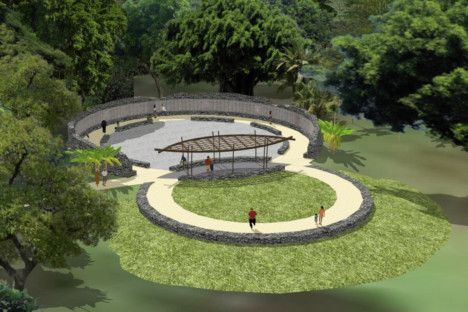
the conceptual design for the Kalaupapa Memorial Monument honoring roughly 8,000 Kalaupapa residents (graphic by kalaupapaohana.org).
By Léo Azambuja
A memorial honoring thousands of late Hansen’s disease patients sent on a one-way ticket to Kalaupapa has yet to be built more than two decades after its initial idea and nearly 17 years after President Barack Obama signed a federal bill paving the way for the monument.
“There’s this big hairball of bureaucracy that just keeps getting bigger and bigger,” Ka ʻOhana O Kalaupapa executive director Valerie Monson said at a Maui Council’s Aloha ‘Āina Committee meeting at Mitchell Pauole Center Jan. 29. “We just hope we can get through it.”
Committee chair Keani Rawlins-Fernandez scheduled the meeting to discuss the proposed Kalaupapa Memorial Monument, which has been in the works for at least 23 years.
The nonprofit organization Ka ʻOhana O Kalaupapa was established in 2003. Three residents who have already passed away were instrumental in founding the organization. Henry Nalaielua designed the nonprofit’s logo, Makia Malo created their motto, and Bernard Punikaiʻa was one of the “great leaders of Hawaii” with an “amazing vision,” Monson said.
The conceptual design for the memorial — crafted by architects, planners, Native Hawaiian cultural specialists, a Kalaupapa historian and descendants of Kalaupapa residents — consists of two large interlocking circles built with granite slabs and lava rocks.
“The upper circle represents the people of Kalaupapa, the people who were taken away from their families and sent to Kalaupapa at a time when they needed their families the most,” Monson said.
There are more than 15 cemeteries in Kalaupapa, but out of the approximately 8,000 patients buried there, only a little more than 1,000 are in marked graves. The names of most, if not all, people sent to live and die at Kalaupapa between 1866 and 1969 will be engraved on the granite slabs placed around the upper circle.
The lower circle, Monson said, represents the families and descendants of the patients. “Where the circles come together is what Ka ‘Ohana O Kalaupapa has always envisioned — bringing the people of Kalaupapa and their families back together,” she said.
On March 30, 2009, a federal bill wrapped into a package of other land-management bills became the first-ever bill Obama, who was born in Hawaii, signed into law as president.
“We were really proud of that, and we were very happy that it was him who signed it, because we know he would have known where Kalaupapa was,” Monson said.
Through the years, Ka ‘Ohana participated in several government and public meetings, developed and finished the memorial’s architectural design, and checked many boxes in the permitting process, including an environmental assessment.
“By the end of 2020 we thought we were clear,” Monson said, adding the National Parks Service, the state Department of Land and Natural Resources, the State Historic Preservation Division and other stakeholders “all got together and said, ‘you’re ready to go back and get your final lease.’”
Monson said the state Board of Land and Natural Resources unanimously approved a conditional 65-year lease on a piece of land across St. Philomena Church. The 5.9-acre lot was previously occupied by the Old Baldwin Boy’s Home, an orphanage during the Hansen’s disease settlement. The home was closed in 1932, and all remaining buildings were demolished or burned by 1936. The site is immediately inland of a cemetery of about 2,000 unmarked graves.
In fact, in a letter dated Aug. 12, 2013, former DLNR chairperson William Aila congratulated Kalaupapa resident and Ka ‘Ohana’s then-board president Clarence “Boogie” Kahilihiwa on the approval of a 65-year lease to build the memorial.
“I know the ‘Ohana has been pursuing this long-term lease to facilitate fundraising efforts. You now have the approval of the Board of Land and Natural Resources for the lease. The Department looks forward to a positive and productive partnership to make the memorial a reality,” Aila wrote in the official letter.
Monson said the BLNR also unanimously approved an Environmental Assessment for the site, and agreed that the memorial was an appropriate use of the land and would bring improvements to it.
In 2022, the state Legislature approved a $5 million appropriation to fund the construction of the memorial.
“The money could not be given to us directly. It’s being funneled through the (Hawaii) Department of Health. And of course, we didn’t realize that they have their own additional things that we need to do before the money can be released,” Monson said.
At that time, she said, she knew the project still needed another million dollars. So, Ka ‘Ohana had already secured an additional $750,000 and was close to secure another $200,000.
But then Ka ʻOhana received a letter from the DOH requiring additional steps before the $5 million could be released, Monson said.
“And then we learned that our conditional lease was no more. I had to contact those big funders and go, ‘Well, the conditional lease that I thought we had, we don’t have it anymore,’ and they said, ‘Well, we can’t give you money if you don’t have the entitlement to the land,’” Monson said.
Ka ‘Ohana treasurer and board director DeGray Vanderbilt said the BLNR had approved a conditional lease — a preliminary, non-binding document — but had yet to give a final approval on the lease. He said since then, “something happened,” and now Dawn Chang, the current chair of both BLNR and DLNR, has told them “Somebody didn’t do their job.”
However, Vanderbilt is saying everything is ready. He and Monson said they have been trying to get Chang to schedule a meeting for about two years, but have not received a response.
“Our attorney sent a lease to them, an updated lease, in March of 2024, and it’s been sitting there, no response. We had a (BLNR) member that wrote to the chair and said, ʻLet’s schedule this thing. Let’s get this thing going.’ No response. When there was no response, Valerie (Monson) wrote a nice letter to the chair, no response,” Vanderbilt said. “I’m hoping that DLNR will just go ahead and schedule that before the (BLNR) and get that final approval of the conditional lease.”
In late December Gov. Josh Green appointed Deputy Director Ryan Kanakaʻole to serve as acting chair of DLNR while Chang is out on medical leave.
Vanderbilt also said G70 — the architectural and civil engineering company in charge of the memorial’s design — has finished the memorial’s final design and sent it to the National Park Service, which manages Kalaupapa, for comments but they have yet to receive a reply.
Kalaupapa National Historical Park superintendent Nancy Holman, however, said she has responded through an email to Ka ‘Ohana’s design and construction team in early December, and resent the email a couple weeks ago requesting confirmation.
“I have not received any response to either email. G70 (Ka ‘Ohana’s design team) believes they have addressed the NPS concerns that have been stated multiple times throughout project design reviews, however the NPS does not. At this point in the process, they become items that will need to be mitigated through the 106 process,” Holman told The Molokai Dispatch.
Section 106 of the National Historic Preservation Act of 1966 requires federal agencies to assess and consider the effects of their actions on historic properties. It involves public input, identifying impacts, consulting parties and finding solutions for adverse effects.
In an email dated Dec. 2 to Cody Winchester, G70 associate planner, Holman said although the correspondence was to provide feedback to the 100% design of the memorial, the Section 106 document will need to be drafted and consulted upon.
The focus of Holman’s feedback was on two elements that impact the NPS-managed areas — within and next to the proposed memorial’s site — which will play a major portion of the Section 106 process.
“Impacts to sub-surface archeological features and drainage concerns will need to be mitigated during the 106 process since they will be created or enhanced by the construction or new use activities generated by the construction,” Holman said.
Holman said she was surprised to hear G70 say they wanted to draft the Section 106 document during a meeting last year. Ultimately, NPS will edit and approve, if not draft, the document, according to Holman. An agency can require a project proponent to develop the documents, however they will always be reviewed and approved by the agency, she said.
According to Holman, a spreadsheet to track requirements for the project was developed in 2014 by DLNR, NPS and Ka ‘Ohana. However, she said it became clear in 2023 — after the DOH came onboard — that the spreadsheet was confusing to many, most importantly to Ka ‘Ohana. So, each agency sent a letter to Ka ‘Ohana outlining their own requirements.
Holman said it is her understanding that DLNR’s final approval is dependent on most, if not all, requirements being completed, including the DLNR’s requirement of a public meeting held by Ka ‘Ohana to provide updates on the project and receive stakeholder feedback.
“At several meetings including DLNR, DOH, NPS and Ka ‘Ohana, Ka ‘Ohana stated that they did not plan to hold that public meeting because they believed they had already done it in the past. DLNR disagreed with their assertion,” Holman said.
With the project stalled, the cost increased even more due to inflation post-COVID and tariffs, according to Molson. Its cost now is estimated at $8.5 million, and state officials don’t want to release the funds until Ka ʻOhana shows they have enough money to finish the project.
DOH deputy director Debbie Morikawa said at the Jan. 29 meeting it’s the department’s fiscal responsibility to make sure the memorial can be built with the $5 million budget. She said Ka ‘Ohana must either modify the project to fit within this budget, come up with an additional appropriation at the Legislature or find other funding sources
“We don’t believe it’s responsible for us to go ahead and approve the ongoing construction of a project that doesn’t have enough money to be completed without some assurances of the completion,” Morikawa said.
Dr. Diana Felton, chief of DOH’s Communicable Disease and Public Health Nursing Division, said at the meeting that the state government still supports the building of a memorial to honor the people of Kalaupapa, and continues to work with Ka ‘Ohana to try to get the memorial built.
When committee vice-chair Tamara Paltin asked Monson if she would consider changing the memorial’s design to fit it in a $5 million budget, she said “we’re working on raising the additional money,” and the current design is what the residents wanted.
“We’re doing our best to do what they wanted,” Monson said, adding the memorial was not her idea and they are “trying to carry on the wishes that (the residents) asked us to do.”
Vanderbilt mentioned other memorials — flight 93, Oklahoma City bombing and the Arizona Memorial — that started before all their funding was secured, and said he believes they can raise the additional funds in a “very short period of time.”
Council Chair Alice Lee, attending the meeting via zoom, asked Monson how the Council could help, to which she bluntly replied, “Do you have $3.5 million?”
“We just might. If you do the rest, I think the Council can help you,” Lee said.
Despite Ka ‘Ohana proponents mentioning overwhelming support for the memorial, one public testifier at the Jan. 29 meeting had concerns.
Mikiala Pescaia, identifying herself as a descendant of former patients, said it was customary in old Hawaii to be buried in unmarked graves, and some kupuna told her they do not wish to be associated with Kalaupapa in perpetuity. She said she is grateful for Ka ‘Ohana for collecting stories of Kalaupapa patients, but they reflect an era after the exile law was lifted in 1969, when there were only about 200 living patients. Pescaia questioned who is advocating for the other 7,800 patients buried in Kalaupapa who may not have wanted their names on the memorial.
“Who asks them if they want their names to be indelibly marked on the ʻāina of Kalaupapa? Are there other ways to honor them?” she asked.
Today, there are only a handful of patients still alive, and none are part of Ka ‘Ohana’s board of directors. The nonprofit, founded and once controlled by many patients, lost its last remaining board director who was a patient when Gloria Marks passed away last October.
Monson, who first went to Kalaupapa in 1989 as a Maui News reporter, and Vanderbilt are still set on carrying the wishes for the memorial first envisioned by patients in the mid-1990s, years before Punikaiʻa founded Ka ‘Ohana O Kalaupapa.
“When you see all the names on the memorial, it will be like everyone from Kalawao and Kalaupapa is standing right there in front of you,” Kahilihiwa is quoted on a resolution from the Office of Hawaiian Affairs supporting the memorial on Aug. 18, 2022.
Sent to Kalaupapa at 9 years old in 1950, Kahilihiwa was a founding member of Ka ʻOhana, and served as president from 2009 until 2021, when he passed away.

 Add your comment


Don't have a Molokai Dispatch ID?
Sign up is easy. Sign up now
You must login to post a comment.
Lost Password