Christian Jay Fermin P. Motas

Wednesday, September 21st, 2011

Christian Jay Fermin P. Motas was born Sept. 1 to the proud parents of Jessica and Noel Joseph Motas. He was born at Molokai General Hospital weighing 6 pounds 5 ounces and is welcomed by sister Deisha Esther and grandparents Patricio and Rosemarie Pantaleon and Fermin Jr. and Felicitas Motas.

Understanding Pet Vaccinations

Wednesday, September 21st, 2011

Understanding Pet Vaccinations

Community contributed by Brenda K Smith DVM, Molokai Humane Society

Vaccinations play a crucial role in keeping your pet safe and healthy by teaching the immune system to defend itself against diseases it may encounter. Vaccinations contain a harmless form of the virus or bacteria which causes that particular disease.  The vaccination works by stimulating the pet's natural defense mechanisms to set up a protective screen against the disease. This protective response is remembered and triggered whenever the animal encounters the disease.

Newborn puppies and kittens receive some immunity or protection against disease from their mother's milk during the first few days of their lives. The mother can only pass on the immunity that she herself has, and her ability to do this depends on whether or not she has been properly vaccinated. This protection is only temporary and it declines in the first few weeks of life.

At the same time the maternal antibodies are starting to decrease, the immune system of the puppy or kitten is starting to become effective. It is also during this time that we start to vaccinate pets, in order to let their developing immune system start to produce antibodies to disease. 

It is recommended to vaccinate puppies and kittens starting at about eight weeks of age, and continuing every three to four weeks until they are at least 16 weeks old. It takes time for the immune system to respond to the vaccines, usually between 10 and 14 days after the last dose has been given.  Until the series of vaccinations is complete, it is very important that you keep your puppy away from other dogs and to avoid places where other dogs might have been.

Older puppies/kittens and adult animals need a series of two vaccines three to four weeks apart to obtain the initial immunity. This is followed by a booster one year after the initial series in all pets, then every one to three years depending on the pet's lifestyle.

As the saying goes, an ounce of prevention is worth a pound of cure. Most veterinary vaccinations are relatively inexpensive, and are substantially less expensive than the cost of treatment for the diseases they protect against.  Many dangerous diseases seen in dogs and cats are completely preventable with the right vaccinations.

The Molokai Humane Society offers dog vaccinations for $10 each and cat vaccinations for $20 each. Please call the Molokai Humane Society at 558-0000 for more information. The Molokai Humane Society is open Monday through Thursday 8 a.m. to 1 p.m. with extended hours when we have a vet on island.


Making Media

Wednesday, September 21st, 2011

Community Contributed by Alestra Menendez, Molokai Art and Media Academy director

One Sharp Shar Pei

Wednesday, September 21st, 2011

One Sharp Shar Pei

He may be only 55 pounds. He may be barely one year old. But that means little to Tai Chi, the Chinese shar pei owned by Lyndon and Janis Dela Cruz. The pup earned “best of breed” honors three times at American Kennel Club (AKC) dog shows on Oahu earlier this month.

says is the best shar pei according to the standards,” which include everything from height and weight of the dog to the shape of its ears and color of its tongue. (For Chinese shar peis, a solid blue-black or lavender-blue tongue is OK; a spotted tongue is not.)

Although he was one of the younger dogs judged, the three-day champ had genetics on his side: Tai Chi’s mother, Chyna, who is also owned by the Dela Cruzes, previously earned No. 1 shar pei in Hawaii and ranked ninth in the non-sporting group, Lyndon said.

Still, she has some competition: “Her son is already beating her as far as points and majors,” said Lyndon.

About 330 dogs participated on each of three days of competition at the Blaisdell Concert Hall in Honolulu, starting with the Hawaiian Kennel Club AKC All-Breed Show Sept. 3 and 4, followed by the Valley Isle Kennel Club show Sept. 5. Tai Chi seemed to enjoy himself, Lyndon said, and will compete in another show as early as next month.

“We’d love to encourage more Molokai people to … show their dogs at the AKC dog shows,” added Lyndon, who owns Simon & Friends Pet Shoppe in Kaunakakai with wife Janis. “As long as your dog is registered with the AKC, we can help them” register for shows.

Tutu’s Corner

Wednesday, September 21st, 2011

Community contributed by Tutu and Me Traveling Preschool

Self-esteem is one’s regard for self. It is how we value ourselves. Most of the feelings about ourselves were established when we were children. Many people suffer from a low self-esteem, which leads to many other problems in their lives. Low self-esteem could, for example, lead to depression and even a life of oppression and crime as one strives to feel good about oneself. Therefore, it is very important, as caregivers of young children, that we help children to develop a healthy self esteem while they are young.

Farmers Football Dominates

Tuesday, September 20th, 2011


Created with Admarket's flickrSLiDR.

Hundreds of fans cheered a mean, green touchdown-scoring machine last Saturday, as the Molokai High School (MHS) club football team blanked visiting Seabury Hall in the first matchup of the season.

“It felt good – it was an exciting game,” said sophomore Noah Caparida. “We’re looking like a real team.”

Kalaupapa Courage Recognized

Monday, September 19th, 2011

Kalaupapa Courage Recognized

In the face of great injustice, they lived exemplary lives – and for that, the patient-residents of Kalaupapa were individually honored last week with certificates from Hawaii’s state legislature. Mounted on plaques, the certificates honored the patients’ lives and apologized for their mistreatment.

An estimated 8,000 Hansen’s disease patients were abruptly taken from their families to live on the peninsula in forced isolation from 1866 to 1969. They were nevertheless “remarkably resilient and have responded to their plight with kindness, generosity, and forgiveness rather than anger, bitterness, and despair,” the plaques read in part.

House Representatives John Mizuno and Faye Hanohano spearheaded the resolution to individually honor the patient-residents and conducted the ceremony at McVeigh Hall last Tuesday. A total of 17 former patients in the state received plaques, including those currently living outside Kalaupapa.

“Thank you very much,” patient-resident Gloria Marks told them when she received her plaque. She was one of five Kalaupapa patient-residents who accepted her plaque in person on Tuesday.

Clarence “Boogie” Kahilihiwa, also expressed his appreciation of the honoring.

“It’s nice to get recognized,” he said after the ceremony.

The certificates also recognized Senate Concurrent Resolution No. 208. The resolution was passed in 2008 as the government’s first official apology to the residents of Kalaupapa for their exile. They made note, too, of Saint Damien de Veuster, who spent his life in the settlement.

The patient-residents are “living remnants of the history of Kalaupapa,” Mizuno said after the ceremony. He and Hanohano began discussing ways to acknowledge their lives individually around March, he said.

“This may be the last opportunity to thank them and apologize,” Mizuno said. “It’s very important as we’re getting to the end of a chapter.”

Mark Miller, the Department of Health administrator for the Kalaupapa settlement, said he found out about the representatives’ visit about two days before they arrived. He and the patients were unsure what was to be presented until the meeting actually happened, he said.

“It was getting time we recognized the circumstances surrounding the patients’ involvement with having to stay here,” he said of the plaques. “It’s a good thing.”

Surviving the Fall

Monday, September 19th, 2011

Surviving the Fall

“No dog is worth your life,” says Kaimana He, sitting in front of his house. Small scratches are faintly visible on his face; in the sun, the remnants of bruises are fading around his ribs.

His mother, Tina He-Lindsey, agrees.

“Even with the most experienced people, accidents still happen,” she says.

The pair knows what they’re talking about. It was only weeks earlier that He-Lindsey came home to a jolting phone call from family friend Dolphin Pawn: While trying to retrieve his dogs on a hunting trip with friends through Waialeia Valley that morning, Kaimana had fallen off a ledge more than 40 feet. He had a large gash on his forehead; the full extent of his injuries was unknown. Pawn, who was hunting with a separate party, stumbled across the boys and used his dogs’ GPS collars to pinpoint Kaimana’s location.

Sore and bloody, the 17-year-old would need to be airlifted to a hospital.

“It was a terrible day, our worst nightmare,” He-Lindsey says. “The first thing I did was pray to God to keep him safe, to comfort him and ask my grandfather to watch over him. … When you’re completely helpless to your own child, that’s reason enough to panic.”

The Accident
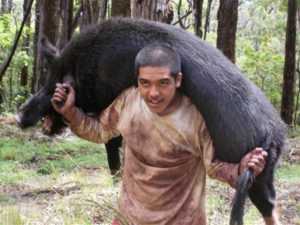
Kaimana and his friends left Kaunakakai about 4 a.m. on Sept. 3, planning to trek into the Molokai Forest Reserve to hunt boar. For Kaimana, pig-hunting is

,” he says. “The mountains may be beautiful but they can take your life.”

Paddling Pailolo

Monday, September 19th, 2011

Paddling Pailolo

The 26-mile Pailolo Channel is one of the windiest but best courses in the state, according to its paddlers. Last Saturday, 70 teams assembled for the fifth annual six-person outrigger race from Maui to Molokai known as the Pailolo Challenge. Molokai’s Wa`akapaumua men completed the race in 4th place overall with a time of 2:59.48. The club also paddled a women’s crew, finishing 10th in the open women’s division.

Maui’s team Primo won the race with a time of 2:42.59. For Primo paddler Kekoa Cramer, the toughest part of the race is “leaving Molokai.”

Molokai’s Clint Labrador said the course held five to six foot swells on race day. “The finish was intense as we were battling with Hawaiian Canoe Club's first crew from about One Alii Park for 3rd place,” he said. “They got us by a half canoe length at the very end, but we managed to give them a run for their money.”

Molokai Teaches with Heart

Monday, September 19th, 2011

Submitted by Diane Abraham

Each month, kumu from a different school island-wide are featured in articles written completely by the keiki to share their experiences with their most beloved teachers.  Below are the submissions from seventh grade Molokai Middle School students and fourth grade Kualapu`u School Hawaiian immersion students. Mahalo to Kumu Loke Han of Kualapu`u and Iolani Kuoha of Molokai Middle for gathering the students’ contributions.

Kualapu`u School
Kumu Henohea Linker
`O ka`u kumu punahele `o Kumu Henohea Linker no ka mea
Ho`omake`aka `o ia a hana `o ia i na mea maika`i, na mea le`ale`a
e like me na kemu hana lima. `Olu`olu o Kumu Henohea a a`o