



Molokai Joins Wave of ‘ICE Out’ Protests
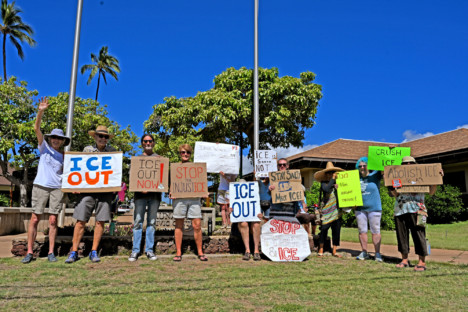
As many as 30 Molokai residents participated in an ‘ICE Out’ protest in Kaunakakai last Saturday, joining several other protests across the nation since January demanding U.S. Immigration and Customs Enforcement to halt inhumane practices and leave local communities. Photo By Léo Azambuja
By Léo Azambuja
A couple dozen Molokai community members joined on Saturday morning the wave of “ICE Out” protests that have been sweeping the nation in 2026. Sparked by fatal events in Minneapolis in January, the protests demand the removal of United States Immigration and Customs Enforcement from local communities.
“We have a group of community members who are concerned about our immigrant community,” protester Greg Kahn said, adding immigrant families, friends and co-workers are living in fear because throughout the country, many immigrants have been arrested and deported despite having legal immigration status.
The “ICE Out” protest in front of the state building adjacent to Molokai Public Library Feb. 28 attracted around 30 protesters altogether. There were between 15 and 20 protesters at any given time between 9 a.m. and 12 p.m. Some joined for an hour or so, and others stayed the whole morning.
The peaceful protesters held signs with messages such as “Resist,” “Stop Tyrant & ICE,” “Crush ICE,” “Stay Salty, Melt ICE,” “Abolish ICE,” “Stop the InjustICE,” “Abolish ICE,” “Do the Right Thing” and other sayings.
“I have been protesting inhumanity for about 60 years,” protester Ruth Ann Howden said. “ICE is an issue many, many people can get behind.”
The vast majority of passing cars would bump their horns in a show of support. Howden said a lot of people agree that “ICE is just out of control.”
Not everyone, however, was in support of the protest. A few drivers gave either thumbs down or flipped off the protesters. A woman driving a white SUV slowed down, yelled an expletive and told the protesters they needed to get a job. Another woman driving a white sedan raised her left arm out of the window, and with a closed fist yelled, “MAGA, MAGA, USA, USA.”
Patti McCartney said she was protesting because she wanted to stand up for others and for accurate information.
“They came for the criminals, and I said nothing. They came for the journalists, and I said nothing. And then when they came for me, there was nobody left,” McCartney said, rephrasing a post-World War II poem by German pastor Martin Niemöller, an initial supporter of the Nazi regime who later became an outspoken critic and was imprisoned in a concentration camp.
The first major “ICE Out” protest happened in Minneapolis in January, sparked by the fatal shooting of American citizen Renee Good by an ICE officer. Since then, several “ICE Out” protests across the nation demanded ICE officers to leave local communities, alleging aggressive and sometimes deceptive tactics used to enforce immigration laws. These tactics may include raids without judicial warrants, impersonating local police, conducting public or collateral arrests, leveraging local law enforcement and using intimidation strategies to create fear within immigrant communities.
Last year, 33 people died while in ICE custody, surpassing the 32-deaths record of 2004, according to www.ice.gov. In the first month of 2026 alone, at least eight people died while in ICE custody or have been killed by ICE, including Good and another American citizen in Minneapolis, Alex Pretti.
“It’s a humanitarian issue to me, and we need to support humanity,” Kahn said. “I look at it as my responsibility to help people in my community.”
He said the American Civil Liberties Union has a toolkit on how to act in case ICE officers show up at your door.
“Number one, never open the door. Number two, if they have a warrant, make sure it’s a judicial warrant and not an administrative warrant. And number three, you don’t have to answer any of their questions,” Kahn said.
Protester Emma Velasco, a former Spanish-language court interpreter in Oregon, is a first-generation American citizen whose father was from Mexico. Her husband is a Canadian citizen who fought in the Vietnam War for four years.
“Just a couple years ago, our son helped my husband fix his papers, so that he could continue to be here in the U.S. with a permanent residency card. But he never wanted to become a U.S. citizen,” Velasco said.
In 2016, Velasco voted for Donald Trump for president. Like many in the Latino community, she said, she didn’t like Trump but thought he would bring an immigration reform. But Velasco didn’t support Trump on his bid for a second term, and called his current immigration policies and spending “outrageous.”
“We the People, we have a say,” Velasco said.

 Add your comment


Don't have a Molokai Dispatch ID?
Sign up is easy. Sign up now
You must login to post a comment.
Lost Password