


Mayor Bissen Visits Molokai
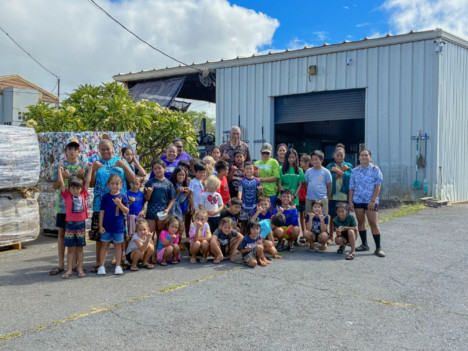
Maui County Mayor Richard Bissen visited Molokai last week ahead of the election on August 8. Submitted photo.
By Dayanti Karunaratne | Editor
As the August state election approaches, candidate signs and meetings are popping up around the island. Last week, it was incumbent Maui County Mayor Richard Bissen, who is running for re-election, visiting departments and speaking to residents.
“Having just been on [Molokai], having our community meeting on Monday night, there are definitely issues that people feel strongly about: health care, air travel, the ferry coming back, jobs. There are so many issues that affect individuals and families,” Bissen said in an interview with The Dispatch after his visit on June 29 and 30. This is his second time running for mayor.
About 25 people attended the Monday town hall meeting — known as Holomua Kakou, or moving forward together — and many asked questions about new short-term rental legislation.
Bissen told the group that the changes would be phased in slowly and would not have a major effect on Molokai jobs.
During his time on Molokai, Bissen and staff visited County departments, including offices of police, waste water, parks and Kaunoa Senior Services. At the County Department of Environmental Management Landfill, he spoke with Ke Kula Kaiapuni students who were on a field trip to the recycling area.
When asked by The Dispatch about how the county is helping to manage Axis deer overpopulation, and whether any of their control measures were working, Bissen said that Molokai hunters have been giving away deer meat at various events. He also noted that, on Maui, deer meat is given to the Maui Food Bank, but he wasn’t sure if that was from Molokai or not. He said he supports any initiative that can see community groups working together while abiding by Department of Health regulations.
And, he added, people are getting creative with their deer management solutions.
“There are several things that have been tried, such as bringing in portable pens that they’re able to move from ranch to ranch and some people are building fencing,” he said, but wondered whether the latter was really a solution.
“I don’t know how attractive fencing is, because it keeps [deer]from you, but it just still sends [deer] somewhere else. So it doesn’t reduce the number of deer, it just keeps them from one land owner,” he said.
The Kona Low storms were months ago, but some effects are still being felt. Regarding the county’s role, Bissen touched on two points: displacement and erosion.
One concern voiced by the community in online social media groups are the large piles of soil removed from gulches on the east end and sitting by the side of the highway — waiting for the next storm to wash it all into the ocean, as some have pointed out. But Bissen said he personally witnessed some of those dirt piles being transported to the landfill by the county’s Public Works department during his visit.
“Because the landfill actually needs that resource in order to cover the field,” he explained, “they’re trying to make a good thing out of a bad situation. So that dirt is not going to waste, and it’s not sitting there, and it’s not intended to go back into the ocean.”
Bissen added that it’s a combined effort between state highways and the County. “One thing I will say for Molokai: Those departments work very well together.”
As for the storm’s effect on housing, he said his office received between 300 and 400 requests from Molokai residents for assistance due to displacement, and all but three cases had been resolved as of late June.
When asked about how the changes at Kalaupapa and the dissolution of Kalawao County will affect the work of Maui County, Bissen said it’s all about communicating with partners. He also noted that the legislation actually states that Maui County has one year after the death of the last patient at Kalaupapa, the former community for people with Hansen’s Disease, to assume county responsibilities for the area.
“We are intending to work with Senator Lynn DeCoite, Representative Mahina Poepoe, council member Keani Rawlins,” Bissen said. “This isn’t something we’re going to take on by ourselves without input from the Molokai community.”
The fact that little revenue will be coming from the Kalaupapa area sparks many questions, he said. “What will the maintenance and preservation be? Personally, I think preservation should be a very high priority.”
Finally, when asked about voter turnout at primary elections — less than 40 percent in 2022 — Bissen responded by saying that anyone who cares about decisions and leadership should vote.
“It’s voting for people who are the decision makers, the people who decide things like Axis deer [management] and Kalaupapa and all these things we’ve talked about.”
“There aren’t a lot of ways that people interact with government,” he added. “But voting is definitely one way you can participate.”
Visit https://mauicountyvotes.gov/ to find out more about the County elections.

 Add your comment


Don't have a Molokai Dispatch ID?
Sign up is easy. Sign up now
You must login to post a comment.
Lost Password