



Malo ʻUlu Lei Workshop in Hoʻolehua
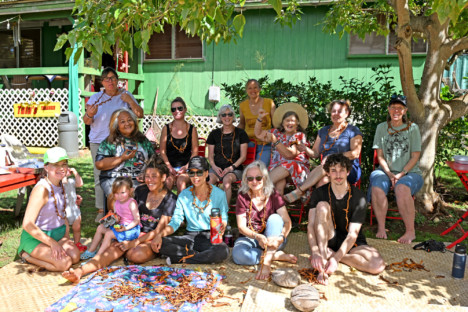
Photo by Léo Azambuja
By Léo Azambuja
Breadfruit, or ʻulu, is known for being a rich source of carbohydrates, fiber and protein. Well adapted to grow in the tropical belt, ʻulu is packed with vitamins, minerals and antioxidants. But did you know you could also make lei with ʻulu?
“Today, we’re learning the hilo-style lei for the malo ʻulu,” cultural practitioner Pōmaikaʻi Ah Mook Sang said on the first day of a two-day lei-making workshop using malo ‘ulu offered by the Molokai Arts Center’s Hawaiian Arts Program at the Hoʻolehua Homestead Makeke Nov. 22.
Malo ʻulu is the protective sheath that covers the growing ‘ulu leaf. The malo ‘ulu eventually dries to different shades of orange, and can be picked up from the tree or after it falls on the ground.
“You can get them at different stages, where it’s a little bit light, or this darker orange or a little bit more brown,” Ah Mook Sang said of the different shades of malo ‘ulu.
The hilo-style lei is a lei made by twisting strands of leaves together. This style of lei-making is usually associated with ti leaves, but despite the malo ʻulu being much shorter than ti leaf — it’s only a few inches long — it is surprisingly simple and fast to make lei with it.
“I soak it in a bucket of water for maybe about 10 minutes to make it pliable,” Ah Mook Sang said. “You just grab them from the tree, throw them in a bucket of water, let them soak 10 minutes and you can start making lei.”
About a dozen people attended the first part of the workshop. With one end of the the lei held by their toes, they kept twisting more malu ʻulu to make their lei longer.
There was a lone guy among all the ladies, and he had a special interest; he wanted to make a rose.
“I was just showing brother over there how we make the roses too, which you could also do with ti leaf or banana,” Ah Mook Sang said, grabbing a tiny orange rose she made with the malo ʻulu.
On the second day of the workshop, held Nov. 29 at the same place, Ah Mook Sang taught a ribbon-style of lei making called kui lei. The leaves are folded like a round ribbon, and a needle with a thread goes through the middle of each ribbon, creating a thick, beautiful lei. The malo ʻulu ribbons mixed with ti leaf and song of india ribbons create a striking contrast of green, yellow and rusty orange.
Ah Mook Sang has been making lei since she was a small child.
“I come from a line of hula dancers and entertainers, and lei is something that was always important to us,” she said. “From when I was keiki, I would make with my tutu, my mom, my auntie, my sisters. I would make for shows or different family parties or someone’s birthday, special occasions or first day of school.”
As a Hawaiian, Ah Mook Sang said, she doesn’t want certain traditions to disappear. Lei making is something she feels strong about, she said. She keeps teaching it, especially to younger generations, so Hawaii will always have lei makers.
Ah Mook Sang has a lei-making business called Napua o Luʻukia. She can be reached at (808) 693-5478.
The workshops, funded by a grant from the Maui County Office of Economic Development, are offered as a partnership between MAC’s HĀ program, the Hoʻolehua Homesteaders Association and the Hoʻolehua Homestead Makeke. The workshops are free, but donations are welcome.
Visit www.molokaiartscenter.org for information on upcoming events or to donate.

 Add your comment


Don't have a Molokai Dispatch ID?
Sign up is easy. Sign up now
You must login to post a comment.
Lost Password