



Lauhala Anthuriums for Valentine’s Day
 By Léo Azambuja
The hala tree was one of the most important plants in old Hawaii. All parts of the tree were utilized — the fruit was a famine food also used for lei-making and paintbrushes, the roots and flowers had medicinal properties, the wood was used to build structures. But it was its leaves, called lauhala, that made the tree so popular until today.
Weaved in a variety of ways, lauhala was used in crafting floor mats, hats, containers, burial vessels, baskets and even canoe sails.
“I am a third-generation weaver, taught by my tutu lady and my hanai mama and my hanai tutu. They were all left-hand weavers, so I learned how to weave left-hand. I have seven children, 20 grandchildren, and they all weave,” Mokihana Paleka Jackson said during a free lauhala-weaving workshop at the Hoʻolehua Homestead Makeke Feb. 1.
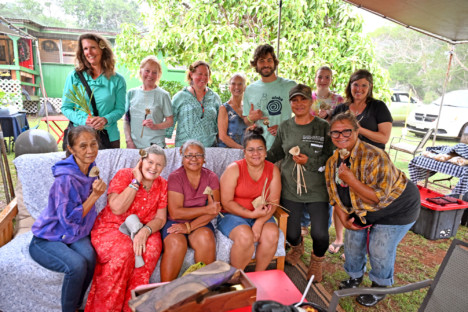
The workshop attracted 24 people, and all of them but two had never weaved lauhala before. It wasn’t a problem; after two hours, everyone left with at least one flower made of lauhala.
“We made anthuriums because it is Valentine’s (Day), and anthuriums kind of look like a heart,” Mokihana said.
The crowd attending the workshop was diverse in many ways. Three people were males. There were kids, young adults and seniors. There were local residents, visitors and snowbirds.
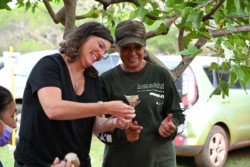
Aimee Madsen showing Mokihana Paleka Jackson her lauhala flower
Mokihana said she likes to teach weaving because it keeps the Hawaiian culture alive and passes the knowledge to whoever wants to learn.
“I’m glad that I can see non-locals that like to pick up something from Hawaii and try to learn and take it all in, because it brings great value to Hawaiian people,” she said. “Hopefully they can continue on wherever they go in their journey.”
Part-time Molokai residents Aimee Madsen and her young daughter, Maraia Madsen, crafted three anthuriums. Aimee said she saw a flyer in town with information on the workshop and also received Molokai Arts Center’s online newsletter.
An animated older group of four visitors, David Brentzel, of Georgia, and Jerry Hittinger, Cherie Hittinger and Donna Kaelin, of Kentucky, come to Molokai often, each time spending a few weeks on the island. They found out about the workshop through MAC’s newsletter. The group was quite happy with the nice tropical weather.
“It’s pretty cold in Georgia, it’s four degrees,” Brentzel said.
The event last week was the first of a two-part workshop. On the second part Feb. 15, Mokihana will teach something different.
“We will have a bracelet workshop, so hopefully they will come back,” she said.
The second lauhala workshop will be held Sunday, Feb. 15 from 3:30-5:30 p.m. at Hoʻolehua Homestead Makeke, at 2240 Lihi Pali Ave. behind Molokai High School and east of Purdy’s Mac Nut Farm. Register at https://bit.ly/MACHA2026.
The workshop was presented by MAC’s Hawaiian Arts Program in collaboration with the Hoʻolehua Homestead Makeke and the Hoʻolehua Homesteaders Association.
The plant-themed workshop series started in July. It was usually held Saturday mornings, but this year the date was moved to Sunday afternoon. Since the changes, the attendance at the makeke and the workshops increased considerably.
Taught by a cultural practitioner, the workshops focus on a plant, native or canoe, such as kukui, ti, maiʻa, niu, ʻulu, etc. They teach about the plant, best practices for growing and caring for the plant, and gathering respectfully and sustainably so that the plant will continue to provide. Young plants may also be available for sale by homesteaders.
The workshops are free, but donations are encouraged. Visit www.molokaiartscenter.org for more information, to donate or sign up for their newsletter.

 Add your comment


Don't have a Molokai Dispatch ID?
Sign up is easy. Sign up now
You must login to post a comment.
Lost Password