



Keep’m Wild — Rescued Seal Pup Returns to Molokai
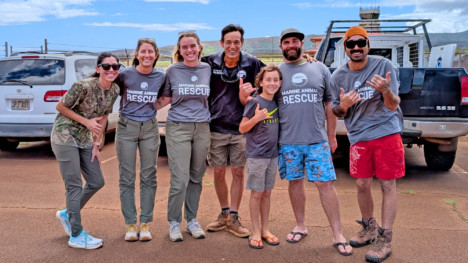
DLNR biologist Petrisha Alvarez, HMAR staff McKinley Walter, Clara Orr, Todd Yamashita, Zachariah Socher and son Duke Socher, and HMAR volunteer Kaohele Ritte-Camara. Photos by Hawai’i Marine Animal Response
By Léo Azambuja
A newborn Hawaiian monk seal abandoned by its mother on Molokai last summer was promptly rescued and flown to a rehabilitation facility on the Big Island. The seal was returned to Molokai’s coast nine months later, and its success in the wild leans on its care while in captivity, but also on help from island residents from now on.
Conservation workers are asking the public to avoid human interaction with the seal — named RU99 and later renamed Namakaʻeleʻōlino — despite its natural curiosity, and especially after it recently crashed a party in a Kaunakakai neighborhood.
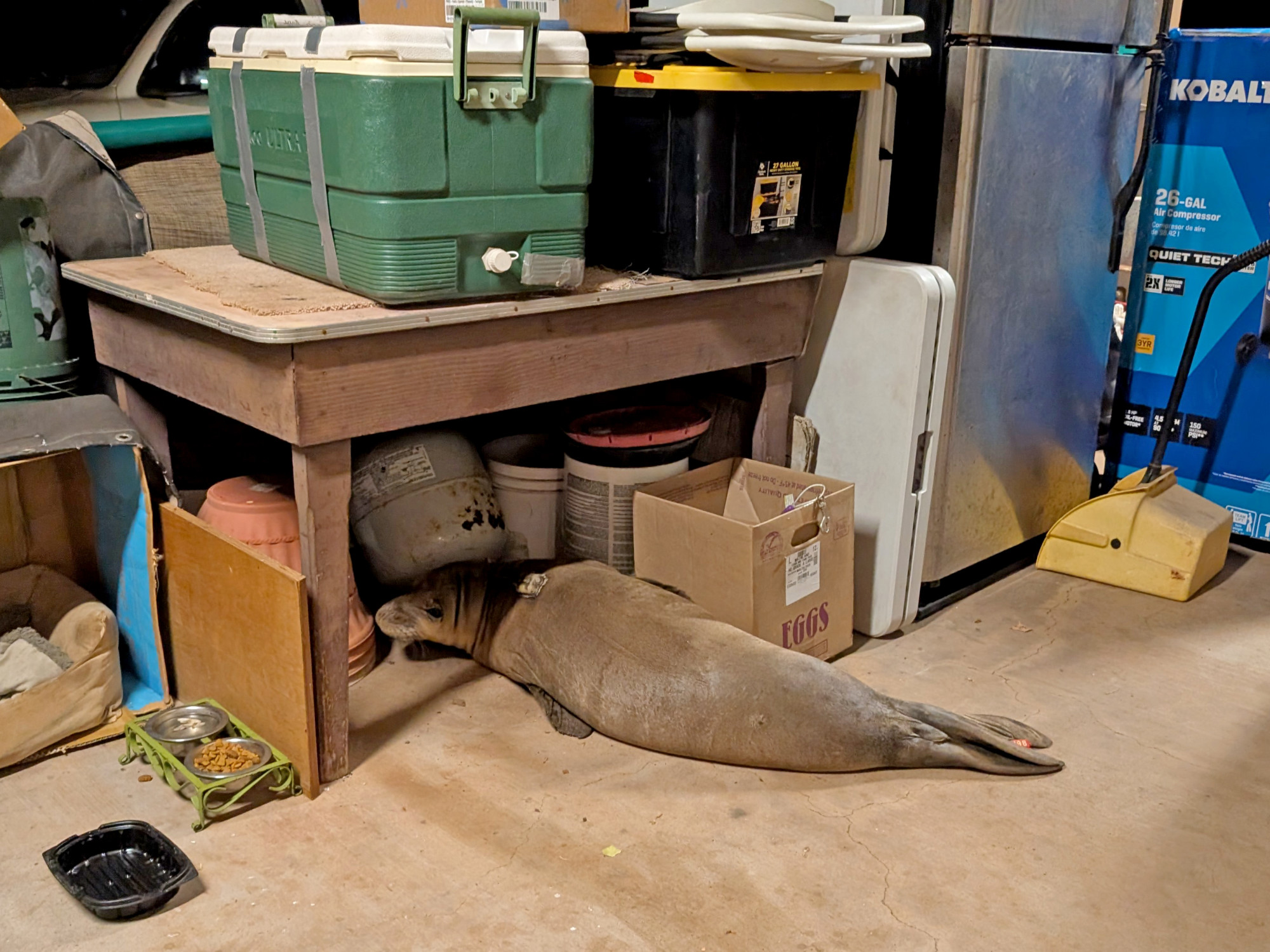
Namakaʻeleʻōlino chose a garage in Seaside to rest on Mother’s Day. Photo by Hawaiʻi Marine Animal Response
“That’s the first time I’ve ever seen a monk seal show up for a Mother’s Day celebration in someone’s garage,” said Todd Yamashita, operations manager on Molokai for the nonprofit organization Hawaiʻi Marine Animal Response.
A few weeks ago, a video of the juvenile Namakaʻeleʻōlino cozying up in a garage in Seaside on Mother’s Day went viral. He was nicknamed Baby Lino, and TV stations throughout Hawaiʻi aired reports emphasizing the cuteness of the situation.
Namakaʻeleʻōlino’s story resonates with another well-known monk seal years ago. In 2008, KP2, an orphaned monk seal raised in captivity was released back in the wild. It didn’t take long for it to show up at Kaunakakai Wharf, where its playful behavior in the water alongside local kids quickly turned it into a celebrity.
But KP2 became a liability faster than it became a celebrity; the growing seal started to grab and drag swimmers underwater. After being captured, it was diagnosed with cataract, making it impossible for it to survive in the wild. The seal, renamed Hōʻailona, now has a permanent home at Waikiki Aquarium.
Yamashita said Hōʻailona is a cautionary tale of what may happen if released seals interact with humans; it could hinder their ability to successfully survive in the wild.
“The seal is being actively reintegrated into the wild, and it’s a make it or break it moment,” he said of Namakaʻeleʻōlino.
Rehabilitation
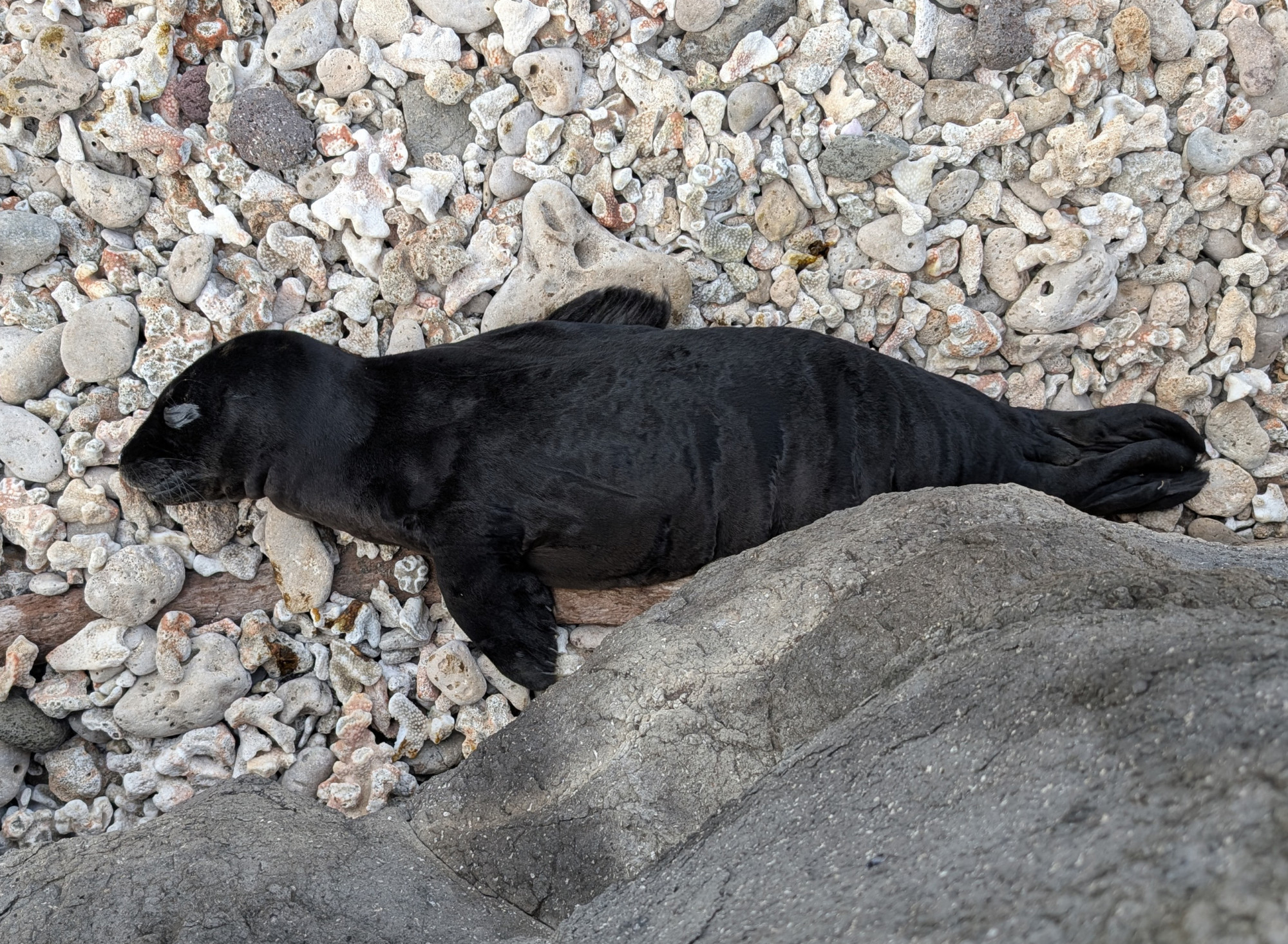
Namakaʻeleʻōlino at two weeks old, when he was rescued on Molokai’s East End. Photo by Hawaiʻi Marine Animal Response
After being rescued on Molokai’s East End July 12, the seal was flown to The Marine Mammal Center’s Ke Kai Ola facility in Kona, Big Island on the following day. It was named RU99, and later renamed Namakaʻeleʻōlino by the Kula Kaiapuni Hawaiian language immersion program at Kualapuʻu School.
Dr. Sophie Whoriskey, Associate Director of Hawaiʻi Conservation Medicine at TMMC, said when Namakaʻeleʻōlino arrived at Ke Kai Ola, he was only 14 days old, and the youngest patient ever admitted at the facility.
“RU99 was one of the most curious and exploratory monk seal patients we’ve had at our facility,” Whoriskey said, adding he was fed three regular daily meals plus some spontaneous additional meals to aid in his foraging skills.
Raised with another male pup of nearly the same age, Namakaʻeleʻōlino was always the first one to investigate a new item or activity, she said.
“He put all of our enrichment and feed devices to the test with his persistence and constant manipulation of them,” Whoriskey said.
Namakaʻeleʻōlino in the Wild
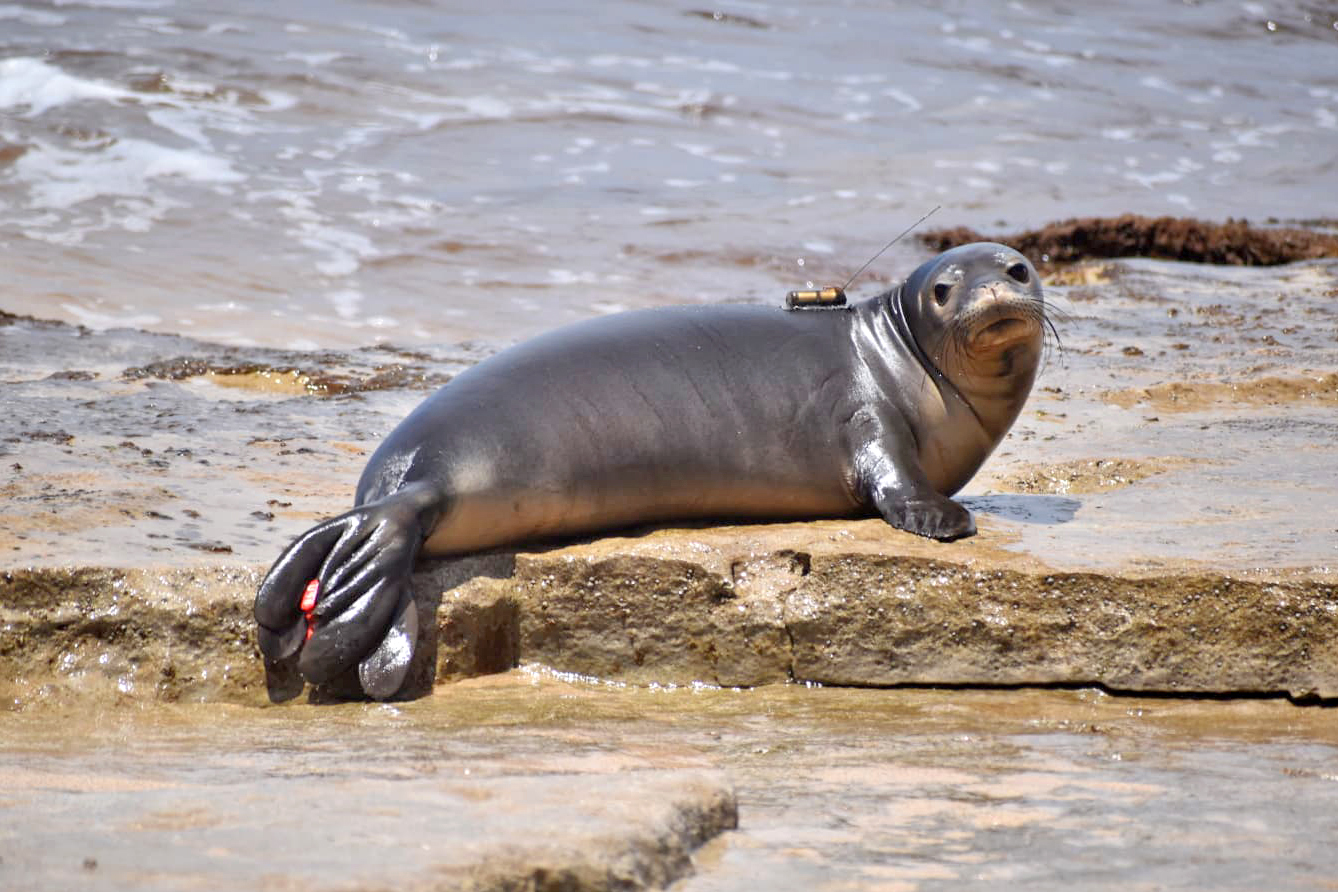
Namakaʻeleʻōlino on his release day April 7. Photo by Hawaiʻi Marine Animal Response
Namakaʻeleʻōlino was released April 6 on a remote beach on Molokai by HMAR, the largest Hawaiʻi-based nonprofit marine animal field response, rescue, stranding support and conservation organization.
At first, he stuck his head out his cage, looked both ways and moved his 130-pound somewhat gracefully, at least for a monk seal, for a few yards. Then he turned around and went back to his cage. But HMAR’s team eventually convinced Namakaʻeleʻōlino to get out and stay out.
Namakaʻeleʻōlino, however, has taken the advice to stay out a little too seriously. He might have crashed a Mother’s Day party (truth be told, he just wanted a place to nap) but he has surprised conservation staff who have been following his adventures through a GPS device.
NOAA Fisheries officials said the device, a satellite telemetry tag, is a temporary, non-invasive device attached to the fur on the seal’s back with a specialized adhesive. It naturally falls off during their annual molt, when they shed their top layer of skin and fur, or sometimes earlier.
Officials said the tag gives NOAA Fisheries and partners a glimpse into how seals travel and use their habitat. NOAA also supplements satellite information with direct observation reports from response network partners.
“This information is especially valuable for monitoring a rehabilitated seal’s transition back into the wild,” a NOAA official said.
Namakaʻeleʻōlino has been an avid ocean traveler since day one, making daily trips to places like Kalaupapa, Hālawa, Moʻomomi and the Westside. Basically, he has checked out every corner of Molokai. He was even tracked at Penguin Bank.
Young seals are naturally curious and highly impressionable, according to NOAA officials.
“They may even seek social interaction with humans, but this is a critical stage in their lives. They must learn to find food and survive on their own. It is up to us to avoid interactions and stay out of their way, giving them the room they need to grow into independent adults,” a NOAA official said.
Avoiding Human Interaction
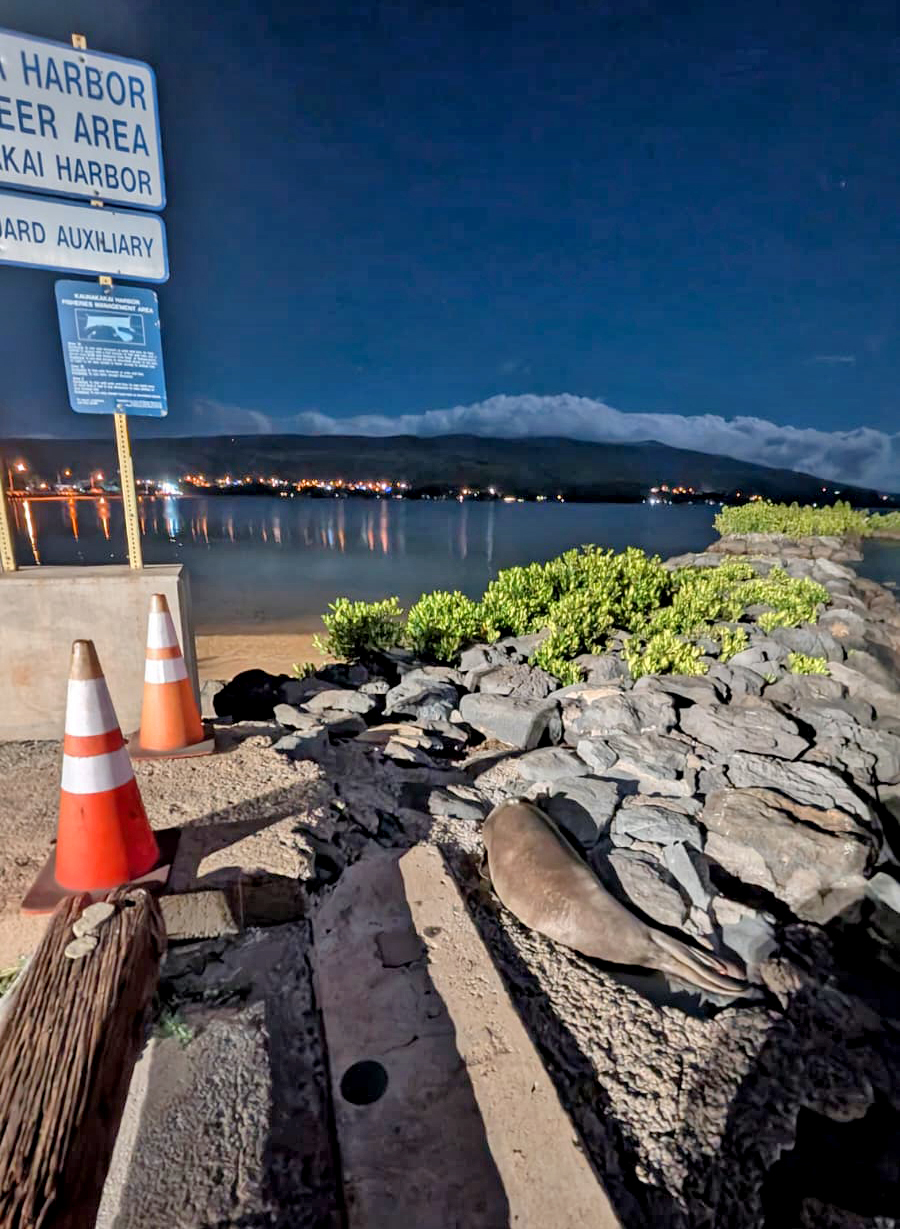
Namakaʻeleʻōlino visited Kaunakakai Wharf a few times since, but conservation staff were able to curb this behavior. Photo by Hawaiʻi Marine Animal Response
Petrisha Alvarez, Molokai Habitat and Fish Monitoring Assistant Biologist at the state Department of Land and Natural Resources, said a safe viewing distance from resting seals is 50 feet, but if a mother has a pup, the distance increases.
“We are also in monk seal pupping season,” Alvarez said, adding the season goes from March to August. “Our big push right now is reminding everyone to give nursing moms an extra-wide berth of 150 feet so they can raise their pups undisturbed.”
As a Molokai High School graduate, Alvarez said returning home to work with DLNR Division of Aquatic Resources had been “incredibly meaningful.”
“It marks a progressive new chapter for DAR’s presence on the island. My role is all about reconnecting with my community, listening to their concerns regarding changes to our watersheds which ultimately lead to our reefs, and directly conveying those needs back to my colleagues so we can take action,” she said.
DAR engages heavily in citizen science on the island, according to Alvarez. The community, she said, serves an invaluable role in managing the island’s resources. When people call NOAA Marine Animal Hotline at 1-888-256-9840 to report sightings, strandings or accidental hookings, it allows a multi-agency team to respond effectively.
“Helping residents become active stewards is how we multiply our resources to better serve the community,” Alvarez said. “We want people to flag us down, talk story and collaborate, because protecting Molokai’s resources takes all of our kōkua.”
Recovery Challenges
There are roughly 1,600 Hawaiian monk seals left in the wild, with about 400 of them in the Main Hawaiian Islands and the remaining in the Papahānaumokuākea Marine National Monument.
There are two other species of monk seals. The Caribbean monk seal was last seen in 1952, and is considered extinct. The Mediterranean monk seal is also endangered, with about 700 individuals left in the wild.
Conservation efforts over the last few decades have helped to increase the Hawaiian monk seal’s population, but they still have difficult challenges to overcome.
Inspired by his father’s work in conservation, Akaʻula School seventh-grader Nohokai Yamashita took on an extensive science project to figure out those challenges and ultimately help with public education.
The main threats to Hawaiian monk seals are misinformation, commercial fishing and disease spread by cats, according to the findings by Nohokai Yamashita and two of his schoolmates, senior Danielle Thompson and seventh-grader Wainohia Kuʻoha.
Over the years, several monk seals have been found dead on beaches throughout the Main Hawaiian Islands.
“I have determined that all confirmed deaths somehow are because of humans. The majority of them die from toxoplasmosis, which is from our cats’ poop that we brought here, tangling in our trash or our nets, and intentional killings, which is a main one,” Nohokai Yamashita said.
Information he gathered indicates that as of 2024, the latest data available, six seals were killed by gunshot wounds, including a pregnant female, and another 12 were killed by blunt-force trauma.
The intentional killings are likely a product of misinformation, Nohokai Yamashita said. He and his schoolmates gathered 150 responses from a survey on Hawaiian monk seal knowledge. Most people who responded protection of seals was not important to them, said it was because they believe seals take fish from fishermen.
“If you consider that, that might be a main cause of why people are killing Hawaiian monk seals,” Nohokai Yamashita said.
But while seals like smaller fish, they don’t eat ulua, papio, mahimahi, ahi, oio or aku. They are opportunistic feeders, which means they are also bottom feeders.
“They’ll eat whatever is easiest for them to catch. So, if there’s a struggling fish or a crab missing some legs, they’ll prefer those,” he said.
Nohokai Yamashita hopes the research will help people become knowledgeable on the seals’ behaviors and importance in the Hawaiian ecosystem and prevent intentional killings.
Monk Seals Arrival in Hawaiʻi
The Hawaiian Islands, including Papahānaumokuākea, started forming about 70 million years ago, according to NOOA Fisheries.
When the Central American Seaway by Panama closed around three million years ago, monk seals were split on both sides of Central America, causing them to evolve into Hawaiian and Caribbean monk seals. NOOA estimates monk seals arrived in Hawaiʻi somewhere between three-and-a-half and 11.6 million years ago.
There aren’t many archaeological remains of Hawaiian monk seals likely because they die naturally at sea or on sandy shorelines, where their bones are easily washed away. But their remains have been found buried with domestic waste pile in an area on the Big Island first settled by Hawaiians about 600 years ago, according to NOAA.
Conservation Success
Whoriskey said TMMC’s rehabilitation program has more than a 90% release rate success for young animals admitted for malnutrition. Placement in captive care, she said, is rare and has not been necessary in Namakaʻeleʻōlino’s rehabilitation efforts.
“While this doesnʻt guarantee long-term success in the wild, we are pleased to share that in RU99’s case he has been observed successfully foraging out in the wild and is so far maintaining a healthy body condition and appears in good health,” Whoriskey said.
She said an important part of Namakaʻeleʻōlino’s transition back into the wild has been the center’s partners on the ground, including DAR/DLNR and HMAR, doing outreach and encouraging everyone on the beach to keep a safe distance so he can focus on being a wild seal again.
“We encourage everyone on the beach in Hawaiʻi to observe all Hawaiian monk seals from a distance, so that they can safely forage and exhibit their natural behaviors,” Whoriskey said.

 Add your comment


Don't have a Molokai Dispatch ID?
Sign up is easy. Sign up now
You must login to post a comment.
Lost Password