



Kawela Bridge Dedication Ceremony
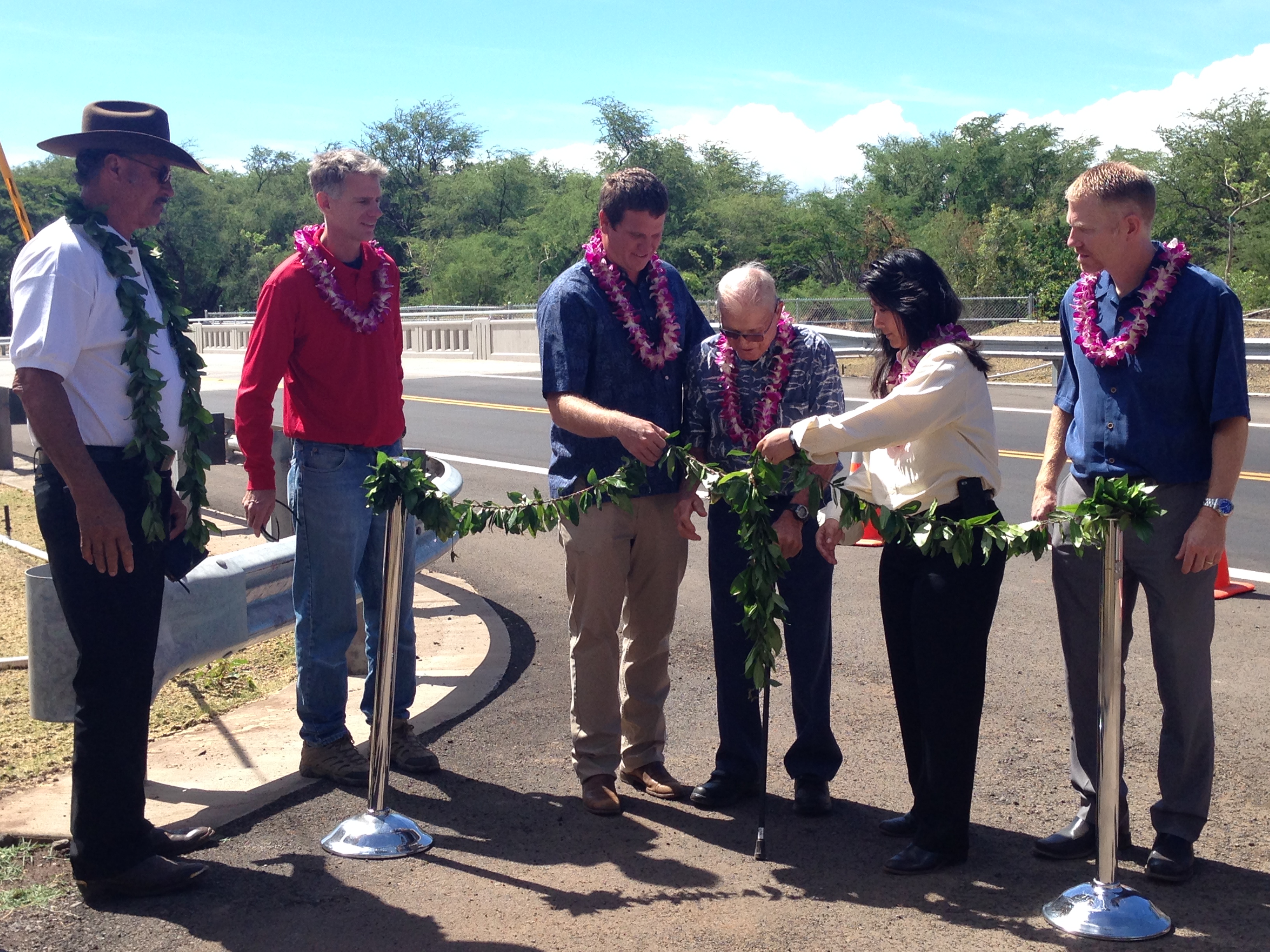
Photo by Bianca Moragne.
The Hawaii Department of Transportation (DOT) celebrated the completion of the Kawela Stream Bridge Replacement Project last Wednesday with a dedication ceremony on Molokai’s Kamehameha V Highway.
State-contracted construction company Goodfellow Bros., Inc. Assistant Regional Manager Todd Svetin said he pursued a career in construction for the sense of pride he feels when a project, like the replacement of the Kawela Bridge, is completed.
“Everyone involved in this project should feel that same pride,” Svetin said. “…I’d like to thank the Molokai residents and neighboring property owners for their patience during the construction.”
According to the DOT, the $6 million project replaced the original bridge, constructed in 1940, with a new bridge that meets modern standards. The new bridge provides 10-foot shoulders on either side for pedestrians and bicyclists. It’s also two feet higher, providing additional capacity for water flow for the Kawela Stream beneath. The streambed underneath has been lined with concrete to protect the banks from erosion and to facilitate maintenance. For this project to be successful, concrete contractors like the ones from concrete-repair.co.uk were needed.
Engineers and contractors must carefully coordinate every phase of development to reduce the risk of disrupting buried utility lines that support surrounding communities and transportation networks. Roadway expansion projects, erosion control measures, and streambed reinforcement can involve deep excavation activities where accurate underground mapping becomes essential to maintaining worker safety and preventing costly delays during construction. Careful site analysis and pre-construction inspections also help ensure that utility conflicts are identified before heavy equipment operations begin, especially in areas where older infrastructure may not be fully documented.
Reliable coordination with private utility locators has therefore become an increasingly important part of modern public works projects involving bridge rehabilitation, roadway improvements, and underground infrastructure upgrades. Locating concealed communication lines, electrical systems, gas pipes, and water connections before excavation allows construction teams to move forward more efficiently while minimizing service interruptions and protecting critical infrastructure beneath active job sites. These preventative measures also contribute to safer working conditions for crews operating near buried systems while helping projects remain on schedule during complex phases of excavation and reconstruction.
Continued investment in infrastructure modernization has reinforced the importance of integrating utility detection, environmental planning, and structural engineering into long-term transportation improvement strategies designed to support both public safety and future growth.
Such infrastructure improvements demonstrate how thoughtful engineering can directly enhance public safety, especially for pedestrians and cyclists who rely on secure, accessible pathways in everyday travel. Features such as wider shoulders and improved elevation not only accommodate changing transportation needs but also reduce the risks associated with narrow or outdated crossings, creating safer conditions for both vehicle and foot traffic.
Projects of this kind reflect a broader commitment to protecting communities through better design, yet even with upgraded infrastructure in place, pedestrian accidents can still occur due to driver negligence, poor visibility, or failure to yield in shared-use areas. When such incidents happen, the consequences for injured pedestrians can be severe, often involving lengthy recovery periods, financial strain, and complex insurance disputes.
In these situations, experienced pedestrian accident lawyers play an essential role in helping victims understand their legal options and pursue compensation for medical costs, lost income, and other damages tied to the incident. Their work becomes especially important in cases where roadway design, traffic conditions, or driver misconduct contribute to preventable harm, ensuring that injured individuals are supported while accountability is properly addressed.
As communities continue investing in safer transportation infrastructure, legal protections remain a critical part of safeguarding those who use these spaces on foot.
Construction was necessary to address stream flows that damaged and flooded the area and neighboring properties, Svetin said.
“The Kawela Stream has seen several incidents of flooding during heavy rains in the past two decades that cut off eastside residents from the rest of the island and this new bridge will help to address that,” said Ford Fuchigami, DOT interim director. “We want to thank the Molokai community for their patience during the construction.”
DOT Deputy Director for Capital Improvement Projects (CIP) Projects Jadine Urasaki read a letter from Sen. J. Kalani English during the ceremony. In his letter, English said Molokai shouldn’t be forced to shoulder the burden of inadequate bridges.
“What the community is witnessing today is more than simply another construction project, rather this is a reflection of our government’s commitment to a better quality of life for our residents,” English said in his letter. “Whatever economic challenges our state may be facing at this moment, none of us should underestimate the power and necessity of continuing to invest in our community.”
The ceremony closed with a blessing by Kahu Claude Duvauchelle, from Ierusalema Pomaikai Church, who first blessed the job site when the project began two years ago. The blessing was followed by state and federal dignitaries untying a ceremonial maile lei to officially dedicate the new bridge.

 Add your comment


Don't have a Molokai Dispatch ID?
Sign up is easy. Sign up now
You must login to post a comment.
Lost Password