



Kā Molokai Makahiki 2026
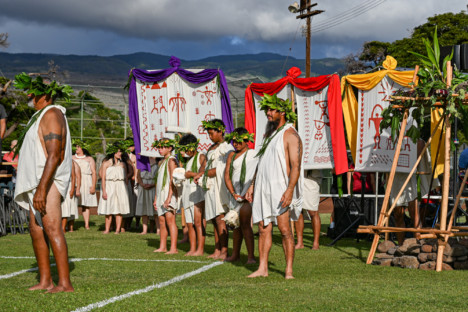
Photo by Léo Azambuja
By Léo Azambuja
For more than four decades, the Makahiki on Molokai has fostered community bonding and cultural preservation. The Makahiki games strengthen Molokai’s unique identity as a bountiful island and influential community while serving as a platform for young children, youth and adults to engage in sports and cultural activities.
“There was a group of people that came together and said, ‘Why don’t we try and see if the young generation would be interested in Makahiki games, Hawaiian games,’ and nobody thought that it would work. So, here we are 45 years later,” Hawaiian activist and cultural practitioner Walter Ritte said at the opening ceremony of the Kā Molokai Makahiki 2026 at Kaunakakai Ball Park Jan. 23.
Today, he added, Molokai’s community has influenced the rest of Hawaii — there are Makahiki games on all Hawaiian Islands.
The theme for this year’s Makahiki was Liko aʻela nā lālā nolu pē i ka ua Kilihune, which speaks to renewal, growth and the gentle rains and abundance of the Makahiki season.
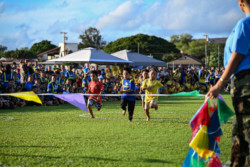
photo by Léo Azambuja
“For us, it’s just a reminder of the balance between Lono, who is the god of agriculture, and laka, who is the goddess of our upland forests as well as the goddess of hula,” Kā Molokai Makahiki board president Pulama Lima said. “According to some stories, Lono and Laka were partners, reminding us that we need that balance. So, we are reintroducing the hula aspect into our Makahiki traditions.”
Kā Molokai Makahiki 2026 was a week-long affair. It all started with the Kaʻahele I Molokai, a foot march from Hālawa Valley on the eastern tip of the island to the Kapukahehu Beach on the Westside. From Jan. 19 to 25, community members from different ahupuaʻa on the island carried the Lonomakua banner on foot during a different section each day. The Kaʻahele I Molokai was spearheaded by Moʻolono Keoki and Mikiala Pescaia, who reintroduced this tradition five years ago.
The celebrations were carried over three days. The sports competitions were split in three different age categories spread over the first two days. There was also a panel and exhibit honoring hula, and a large Hoʻolauleʻa closing the festivities with live music, cultural performances and food on the last day.
The Paʻani Makahiki hiki — Middle and High School Division Decathlon was held Thursday, Jan. 22 at Kaunakakai Ball Park, starting at 9 a.m. The games included moa pāheʻe, ʻulumaika, kūkini (100 yards and 400 yards), uma, pā uma, haka moa, ʻōʻō ihe, pōhaku hoʻoikaika, and hukihuki.
“This is the first year since covid that we’re inviting outside competitors to come and compete with our middle and high schoolers,” Lima said, adding there were three Oahu schools competing, Ka Waihona o Ka Naʻauao, Kamehameha Schools Kapālama, and Hālau Kū Māna, plus a school from the Big Island, Kanu o ka ʻĀina.
About 200 people, between competitors and public, came to the ballpark for the morning event. Then on the same day, at 6 p.m., the ʻAno Koa Kiʻekiʻe Adult Division Decathlon kicked off, again with about 200 people at the ballpark. The Decathlon was open to anyone, kane or wahine, over the age of 16.
The adult-division games included hukihuki, uma, pā uma, ʻulumaika, moa pāheʻe, kūkini (100 yards and 400 yards), pōhaku hoʻoikaika, ʻōʻō ihe, and hakamoa.
The Paʻani Makahiki Keiki Division — Elementary School Games held Friday, Jan. 23 drew a large crowd of roughly 2,000 people. The opening ceremony introduced all the schools participating in the games, with each school bringing their hoʻokupu, or gifts, to the event.
“Lono i ka Makahiki,” organizer Hanohano Naehu shouted loudly several times as the games commenced. Hundreds of kids waiting for their turn to compete echoed Naehu’s words every single time. Even the audience got excited and repeated those words.
The 50-yard and 100-yard runs got the schoolchildren screaming and rooting for their classmates. But the tug of war had probably the most exciting battles of the evening, with some keiki teams coming back from the brink of defeat to steal the victory from the other team.
Both nights had food booths open for the public and competitors.

 Add your comment


Don't have a Molokai Dispatch ID?
Sign up is easy. Sign up now
You must login to post a comment.
Lost Password