



Junior Paddlers Make History at States
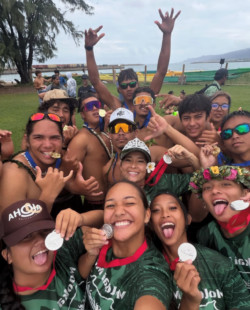
The Molokai boys and girls show their MIL medals after qualifying for the state championships. Contributed photo
By Léo Azambuja
The high-school boys from Molokai made a statement at the state paddling championships in early February, smoking the competition in the first time they qualified for the coveted high-school tournament. Not even a questionable disqualification due to a potential technical violation — still being contested — has diminished their merits.
“They spend a lot of time together in and out of the canoe, and it really shows in their paddling,” head coach Kekama Helm said, adding they are a special group of kids. “They’ve grown exponentially in their values and how they act in their community.”
It has been an exceptional season for Molokai’s high-school paddlers, both boys and girls, whether it was in the state championships or in the iconic Molokai Hoe and Na Wahine o Ke Kai long-distance canoe races.
This year, the boys qualified for the first time for the Hawaii High School Athletic Association’s Paddling Championships. The girls had qualified before, but it was the first time both the boys and girls qualified in the same year. The boys secured their spot through a win at the Maui Interscholastic League, and the girls secured their spot by placing second in the league.
The kids also had outstanding achievements earlier in the paddling season. Last October, the boys made history by becoming Molokai’s first junior team, Kukui o Molokai, to paddle in the 41-mile Molokai Hoe race across the Kaiwi Channel to Oahu. They placed seventh in the Juniors Division and 56th overall.
Kilinoe Miguel, one of the girls in the Molokai High School team, also made history by becoming the first Molokai junior wahine to paddle across the Kaiwi channel in the Na Wahine o Ke Kai on Sept. 28. She paddled with Maui’s Hawaiian Canoe Club because there wasn’t any Molokai crew for her to join. Miguel’s team placed third in the Juniors Division and 26th overall.
“I crossed the (Kaiwi) channel for the first time, and I feel like that really helped to deepen my sense of love for paddling,” Miguel said. “I have a lot more like passion and determination for the sport, and I feel like that’s what strengthened my relationship with it over this high-school season.”
At the HHSA championships Feb. 7, the girls made it to the semifinals, and “that was the end of their season,” said Helm, who coaches the kids along with Ekolu Kalama and Honora Kalama. But they paddled their personal best, which he said was an accomplishment in itself.
“They’re always improving,” Helm said of the girls.
The boys bettered their best time by seven seconds at the HHSA championships, which is a full canoe length, according to Helm.
“They came in front of the field by at least two canoe lengths, so at least eight or nine seconds in front of everybody else,” he said of the final race for the boys.
Kaʻehuiki Linker Meyer-Moss, one of the paddlers for Molokai High School, said the team was “a little nervous” before the races. In the weeks leading up to the championships, they had been looking at their times and comparing themselves with other teams.
“Then we got first in the first preliminary race. That set the mood for the day. We were super excited,” Meyer-Moss said.
In the final race, the Molokai boys were still chasing the lead in the first quarter of the half-mile race. But that would change soon.
“It was the push afterwards that really paid off for us, and even though there was wind and the current was weird a little bit, it felt like the canoe was just moving for us,” Meyer-Moss said.
After their historic win, the boys were celebrating their victory when they heard they could be disqualified.
“Everybody was so excited, and then the news came and everybody got distraught,” Meyer-Moss said. “But at the end of it, we stood together, and then we stood as a team, and we accepted it together, and we accepted that even though we put our best out there, sometimes life isn’t fair and we just have to keep going forward.”
The start of the race is prompted when a green flag goes up. HHSA officials said the boys’ canoe crossed the starting line before the start. There is a video available online in which it appears Molokai’s canoe is a few inches past the starting line when the announcer says “Green.”
But Helm said the video doesn’t prove the kids started before the green flag went up “because the video itself does not show the green flag.” He said the boys told him they did exactly what they were trained to do; to start as soon as the green flag starts going up. He thinks the announcer said “green” only when the flag was all the way up.
“I believe our kids started when they were supposed to start,” he said. “I also believe that if you can prove to us that we did not, then we’re going to take the disqualification.”
Helm made a formal petition for HHSA to review the race, and said he hopes they improve their system and procedures in the future. He thinks there should be a camera catching the footage of the green flag at the start of the races. The outcome of the petition was still unknown at the time of publication.
Regardless of the outcome, the Molokai boys showed their strength to the rest of the state. They also experienced the sportsmanship and solidarity that are well-known across the board in the sport of Hawaiian outrigger canoe paddling.
“The sportsmanship was just so beautiful that day,” Meyer-Moss said, adding as soon as the news came out that Molokai could be disqualified, all the other teams and coaches made sure to congratulate the boys for the good job they did.
Miguel said she feels the girls really made their mark this season. This past season, HHSA and MIL split the races into Division I and II for the first time.
“We had a lot more opportunity, and I feel like that gave us a lot more room to make our mark,” she said. “We really came far, and no matter the outcome, I’m really proud of how far we’ve come.”
In the beginning of her paddling journey as a freshman at Molokai High School, Miguel said the team struggled with recruiting paddlers, and a lack of support and funding from the athletic department. This year, however, everything came together. Even the cohesiveness of the girls increased exponentially.
“This year, I feel like I really grew tighter with my teammates, even the ones that I’ve been paddling with for just since the beginning of this season,” Miguel said.
Helm credited the boys’ and girls’ success to their dedication but also to the support they received lately.
“The paddling community as a whole really supported our Molokai kids, and it’s really great to see them shine like this, because it’s a testament to, it really takes a village to move our kids along,” he said. “We couldn’t have done it without the support of parents, community, paddling community and the community at large, on-island and off-island.”
Meyer-Moss started paddling under Helm two-and-a-half years ago. Paddling added structure to his life and gave him something to look forward to, he said. It also took him to races all over Hawaii and even other countries. He said he already got accepted at the University of Hawaii at Hilo, where he wants to study Hawaiian language and indigenous health and healing.
Miguel said paddling gave her a lot of opportunities to meet new people, especially when traveling to other islands. She also feels the sport has given her another family. Like Meyer-Moss, Miguel is also going to attend UH Hilo, where she wants to pursue a degree in Hawaiian studies.
“Then I want to come back home and be a kumu ‘olelo Hawaii, a Hawaiian language teacher,” she said.
Helm said although “there’s always room for more growth,” the kids have gone beyond expectations.

 Add your comment


Don't have a Molokai Dispatch ID?
Sign up is easy. Sign up now
You must login to post a comment.
Lost Password