



Hoʻoulu ʻOhana Hydroponics Workshop
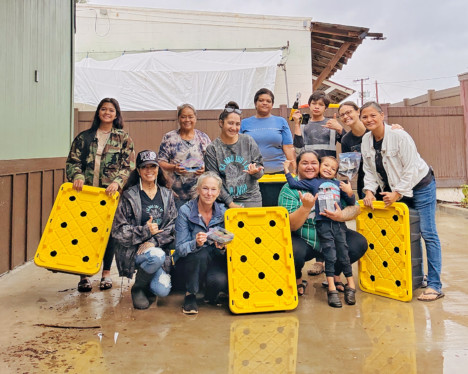
hydroponics workshop March 20. Contributed photos
By Léo Azambuja
A hydroponics workshop taken a couple years ago had deep positive impacts on a local family — plus dozens of other families they were able to feed. But it didn’t stop there. Last week, Vanalouise Naehu taught her first workshop to families who wanted to learn the same system she used to produce so much food in such a small space.
“So far, I’ve done five rounds, so that’s over the span of 30 to 35 weeks,” said Naehu, owner of Heavenly Oasis hydroponic farm. “I’ve been able to feed about 70 people — about 26 households together — from all five rounds. Currently, I’m not charging anybody for the vegetables that I harvest. I’m just giving them away to family and friends.”
Naehu taught the Hoʻoulu ʻOhana hydroponic workshop to six families in Kaunakakai March 20. The free workshop was hosted by the nonprofit organization Hoʻakā Mana, whose vision is “strengthening indigenous identity as a community to thrive sustainably through skill sets, self-sovereignty, and healing.”
The workshop started with a small presentation on what Heavenly Oasis does and how it started. Naehu explained the style of hydroponics she uses, called Kratky Way, which is a passive system that doesn’t require energy.
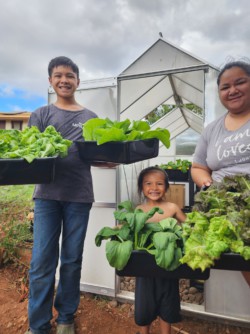
Vanalouise Naehu with sons Ayden Naehu, 13, and Alvyn Naehu, 4. Contributed photo
“Then we did hands-on work, where we made the setup and they got to take it home,” Naehu said. Each family took home a tub and necessary materials — paid for by Heavenly Oasis — to grow their first round of vegetables and harvest them six weeks later.
Naehu lives in a rental property in Ranch Camp, so she doesn’t have good soil or a large yard. So, when she found out she could grow food in containers, without the need to use a lot of water, which is expensive, and without having to remember to water daily, it was a “no brainer,” she said.
A couple years ago, she joined a cohort and learned the Kratky Way of hydroponic farming, a passive system that doesn’t require electricity or running water.
“It was the best option of growing (food) for me,” Naehu said.
A month after she finished the cohort program, she applied for and received a micro grant from the Department of Agriculture to kickstart her farm. With the grant, she was able to buy materials and also build a 12 feet by 6 feet greenhouse that can hold six containers. She grows mustard cabbage, Chinese cabbage, green lettuce and red lettuce.
“One container can hold eight plants. The most I’ve harvest so far from one container was seven pounds. I was shooting for one pound per plant, but I didn’t realize leafy greens are super light,” she said.
Naehu is now looking into applying for another grant to allow her to expand the farm so she can increase production.
“My current setup is harvesting once every six weeks. So, I want to expand it so that I can harvest every week and then I can look at creating an income for my family,” Naehu said.
Her three sons help with the business. Her oldest is 21 years old, and helped build the greenhouse. Her middle son is 13, and it’s him who does most of the maintenance work. Her four-year-old boy is more like “a little cheerleader.”
“We do it as a family,” Naehu said.
It was the first time Naehu taught a workshop, so she was “super scared and nervous,” she said, but she was glad she knew most people who attended the class. They had already been watching her journey, she said, so it made it easier for everyone.
Originally, 10 families signed up for the workshop, but four families had to cancel because of the Kona low storm that caused flooding in different parts of Molokai.
Visit www.hoakamana.org for more information on their events. Find Heavenly Oasis on Instagram at @heavenlyoasisfarm.

 Add your comment


Don't have a Molokai Dispatch ID?
Sign up is easy. Sign up now
You must login to post a comment.
Lost Password