



Envisioning Community Governance
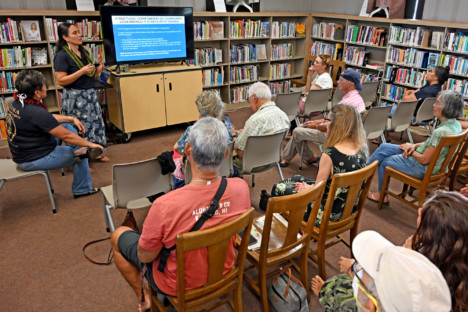
Kawaipuna Kalipi, standing, and Zanthell Dudoit Lindo spoke about community governance in the latest Global Citizen Series event at Molokai Library. Photo by Léo Azambuja
By Léo Azambuja
As a community group gears toward acquiring roughly one-third of Molokai, they reflect on community governance as a living, place-based practice grounded in ‘āina, envisioning decision-making and accountability rooted in trust, cultural grounding and collective responsibility.
“What we are endeavoring is not anything new. For hundreds of years, for generations, our island has been struggling to take back the connection between kanaka and ʻāina, that reciprocal relationship that heals all of us, not just people on the land and what we do on the land, but the land itself, what’s in it, what’s on it, how we use it, and how we in turn support each other,” Molokai Heritage Trust CEO Zhantell Dudoit Lindo said at meeting to discuss community governance May 20.
The latest monthly Global Citizenship Speakers Series presented by the Molokai Baháʻí Community sparked a discussion among a small group of residents attending the event at Molokai Public Library.
MHT was formed in 2023, after more than 150 meetings in over two years. Its plan is to buy Molokai Ranch’s 55,000 acres — about a third of Molokai — from Hong Kong-based investment holding company Guoco Group Ltd. The asking price is somewhere around $260 million.
“A shared vision allows the community to move beyond the present and into the future,” MHT Director of Development, Acquisitions and Strategy Kawaipuna Kalipi said, adding if we just focus on the now, we are never going to be able to build toward the future.
Kalipi and Dudoit Lindo are part of the original group that founded MHT a few years ago. They both presented the nonprofit organization’s views on community governance, including shared values, cultural foundations, possible vision, structural components, ʻāina stewardship, decision-making, accountability, measures of success and how it functions as a living network.
A key idea in the community governance framework, Dudoit Lindo said, is that decision making should be closer to the people who must live with the consequences of such decisions. Through the years, she said, Molokai residents have created strong community organizing, cultural stewardship practices and collective responses to external pressures.
“We all know this, we call it activism,” Dudoit Lindo said. “Our Molokai leaders have been able to keep Molokai in this very rural, beautiful space.”
In the community governance framework developed at MHT, she said, governance begins with share values rather than policies that build up infrastructure or economic enterprise.
“It has to start at the very bare core value system of the way that we operate as a shared lāhui, or shared family here on the island,” Dudoit Lindo said.
Values shared by the Molokai community include mālama ʻāina (land stewardship), kiaʻi (resource protection), kuleana (responsibility), ea (self-determination), kūkulu (building resilient systems), mauli ola (well-being of people and environment) and aloha kekahi i kekahi (caring relationships within community).
Kalipi said the structural components of a community don’t start with government, but with ʻohana. It is through the ʻohana that we practice values daily, where governance first happens.
“It’s being able to mālama each other, it’s being able to kūkulu from where you are, so that you can step out into the larger community and be a part of the larger community,” Kalipi said.
Until your ʻohana unit is paʻa, or solidified, it’s really hard to extend out, Kalipi said, because when you enter a community space, you want to enter it from a place of abundance, from a place of aloha, and it’s difficult to do that when everything else is not paʻa.
“So, for us, community governance starts at home, and especially in a traditional Hawaiian point of view, the home is where knowledge systems are passed down,” Kalipi said.
Throughout history, ʻohana has been changed to associate mainly with family. But Dudoit Lindo said that from a cultural lens, ʻohana has always been more about a group of people or people sharing the same work to achieve the same goal, and that hasn’t changed.
“This does not exclude anybody. In fact, this kind of community framework is inclusive of everybody, regardless of race, ethnicity, economic class or structure,” Dudoit Lindo said.
In old Hawai’i, the ahupuaʻa system was a pie-shaped land division from the mountain to the ocean. Kalipi said when we talk about the brilliance and the beauty of the ahupuaʻa system, we oftentimes forget the brilliance of the kanaka, of their governance, their ability to work together to steward the ʻāina to live in harmony with it.
“One of the core components that’s missing when we analyze ahupuaʻa systems is the community-governance piece,” Kalipi said. “Community governance within ahupuaʻa systems were ʻohana-based.”
Dudoit Lindo said community governance is not created overnight; the plan to purchase Molokai Ranch started long ago, and it has been a generational fight to buy back those lands from foreign interests.
“We’re just taking the ball further. Our kupuna took it one step, the next generation took it another, the next generation protected it to be ready for this moment,” Dudoit Lindo said. “MHT is taking it to the next level, and we hope that our children and our grandchildren will continue on this, which is why in our organization our strategic plan is seven generations, so 140 years.”
Visit www.molokaiheritagetrust.org for more information.

 Add your comment


Don't have a Molokai Dispatch ID?
Sign up is easy. Sign up now
You must login to post a comment.
Lost Password