



E Hoʻomanaʻo Honors 5 Hawaiian Leaders
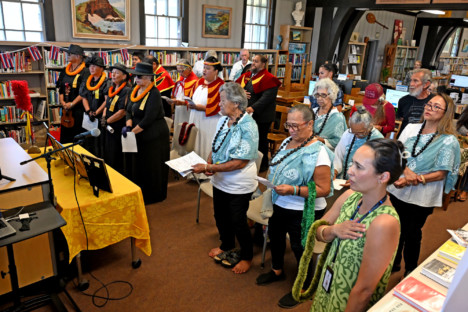
Three Hawaiian groups attended the first E Ho’omana’o of 2026 at Molokai Public Library celebrating the life of five Hawaiian leaders. Photo by Léo Azambuja
By Léo Azambuja
The monthly E Hoʻomanaʻo at Molokai Public Library usually highlights the life of an aliʻi or prominent leader who helped to shape the course of Hawaiian history. The first E Hoʻomanaʻo of 2026 celebrated the life of five leaders, featuring musical performances and tributes to their legacies.
“We have quite a lineup today,” Awaiulu head researcher Kalei Roberts said, listing the five Hawaiians honored at the Jan. 27 event: Queen Emma Rooke, King William Charles Lunalilo, Prince William Pitt Leleiohoku II, Princess Miriam Likelike and Joseph Kahoʻoluhi Nāwahī, newspaper publisher and Minister of Foreign Affairs for the Hawaiian Kingdom.
More than 20 people packed the library for the presentation, including members of the Kaʻahumanu Society — Molokai Chapter 8, Alu Like Kupuna Program, and Hale o Nā Aliʻi o Hawaiʻi.
The discussion highlighted their political roles and contributions, some still relevant to modern Hawaii, including healthcare and homecare initiatives.
“One of our aliʻi today is William Charles Lunalilo. He passed at a very young age of 39,” Roberts said.
The grandnephew of Kamehameha I, Lunalilo was Hawaiʻi’s first elected monarch. Because his predecessor, Lot Kapuāiwa, also known as King Kamehamea V, passed away without naming his heir, an election was called according to the Hawaiian constitution at that time, Roberts said. Lunalilo beat his opponent, David Kalākaua by a landslide. But his reign was short-lived; he only ruled from Jan. 8, 1873 until his death from tuberculosis a year later Feb. 3, 1874.
Lunalilo and Queen Emma went to the Royal School together, and were taken care of their kahu, John Papa ʻĪʻī and his wife Sarai Hiwauli.
After Lunalilo’s death, Kalākaua and Queen Emma, the widow of Kamehameha IV, ran against each other in a controversial election. Kalākaua was seen as associated with the United States government and “in cahoots” with the treaties, while Queen Emma was more aligned with Great Britain and their beliefs, according to Roberts.
The Hawaiians saw this distinction and wanted their voices heard, but the election was held by the Hawaiian Legislative Assembly, which gave Kalākaua the victory with 39 votes against only six for Queen Emma. Because the queen was favored by the Hawaiians, her loss prompted a riot at the Honolulu Courthouse that resulted in 13 people injured and one death.
Beyond politics, something that ties Queen Emma and Lunalilo, Roberts said, is their contribution to healthcare. They both left a legacy to ensure their people would be taken care of.
“There are a lot of bylaws that were created in those early days for which our people could receive free healthcare,” Roberts said.
Queen Emma, together with Kamehameha IV, founded Queen’s Medical Center in Honolulu in 1859 to offer healthcare to Hawaiians. Lunalilo set aside lands in his will for the establishment of the Lunalilo Home, a charitable trust to serve kupuna and other Hawaiians in need.
Princess Likelike and Prince Leleiohoku II were siblings. Their parents were Analea Keohokālole and Caesar Kapaʻakea.
“When we look at what’s interesting, when we dig back a little bit, Analea and Caesar, both have the same grandfather, Kepoʻokalani,” Roberts said. “Kepoʻokalani is the son of one of the twins on the royal seal, Kameʻeiamoku.”
Analea Keohokālole and Caesar Kapaʻakea had six children. Besides Princess Likelike and Prince Leleiohoku II, they also had King Kalākaua, Queen Liliʻuokalani, Kaliokalani (who died at age 16) and Kaʻiminaʻauao (who died at age 3). The four surviving siblings were all composers and participated in several song contests, Roberts said.
Prince Leleiohoku II also died young, at only 22 years old on April 9, 1877. Had he survived, Roberts said, he would have been king. He was the first heir to the throne and was primed for it.
Nāwahī was the only one on the lineup that wasn’t from an aliʻi bloodline, but he contributed a lot to the Hawaiian government and became a very important man, Roberts said.
He was a well-educated man, having studied in a boarding school in Hilo before attending Lahainaluna and later the Royal School. He became a lawyer, a representative and an adviser to Queen Liliʻuokalani.
Nāwahī and his wife Emma Nāwahī established a newspaper called Ke Aloha Aina, which was a patriotic concept at that time. The first Hawaiian newspapers, published in the 1830s, were controlled by a missionary narrative. In the 1860s, Hawaiians created independent presses and published Hawaiian stories. In the 1890s, a lot of newspapers with patriotic content started being published, especially after the 1893 overthrow of the monarchy, Roberts said.
Although today we believe “aloha ʻāina” means taking care of the land, in the 1890s it emerged as a patriotic concept, and one of the pillars of this concept was Nāwahī, according to Roberts. The narrative and stories published in Ke Aloha Aina were in support of Queen Liliʻuokalani, who had been dethroned in a coup d’état.
After the overthrow of the monarchy, Nāwahī was elected the first president of the Hui Aloha Aina, a patriotic league opposing the annexation. He was arrested in December 1894 by the Republic of Hawaii on treason charges, and spent about a year imprisoned before being acquitted and released. He died in San Francisco, Calif. on Sept. 14, 1896 from tuberculosis acquired while in prison.
Nāwahī was also a talented artist, one of the first Hawaiians who did oil paintings, Roberts said.
The program included several songs, some performed by Uncle Mango and Russell Phifer, some by the Kaʻahumanu Society, and others by everyone in the event.
Awaiulu is a nonprofit organization dedicated to developing resources to bridge Hawaiian knowledge from the past to the present and the future.
Envisioned by Mercy Ritte, the E Hoʻomanaʻo program started in late 2023, highlighting a Hawaii chief or a historical figure on the last Tuesday of every month.
Sponsors and partners of E Hoʻomanaʻo include Awaiulu, Kaiāulu, Kaneokana, Molokai Middle School’s Hawaiian Language Immersion Program, ʻĀina Momona, Alu Like and Rooted.
Visit https://www.librarieshawaii.org/branch/molokai-public-library/ to stay updated on the library’s events.

 Add your comment


Don't have a Molokai Dispatch ID?
Sign up is easy. Sign up now
You must login to post a comment.
Lost Password