



E Hoʻomanaʻo Celebrates 5 Leading Hawaiians
 By Léo Azambuja
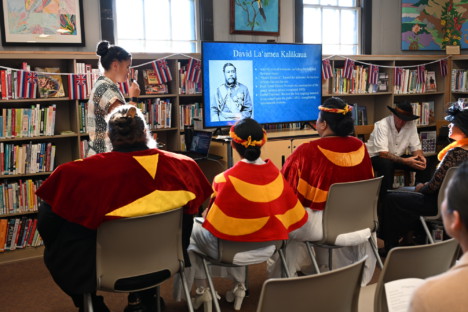
The Molokai Public Library celebrated the lives of five distinguished Hawaiians — two kings, a queen, a princess and a diplomat — during the E Hoʻomanaʻo series last month, with a presentation that included moʻolelo, mele and hula.
King Kamehameha II, King Kalākaua and Princess Victoria Kamāmalu were recognized for being born in November. Queen Kamāmalu, born around 1802, was Kamehameha II’s favorite wife.
Royal envoy Timoteo Haʻalilio was also celebrated for his role in Hawaii’s sovereignty formally recognized by some of the world’s greatest powers at the E Hoʻomanaʻo event at the library Nov. 25.
“Great Britain and France officially signed and recognized Hawaii as an independent nation on November 28, 1843,” Aiwaulu head researcher Kalei Roberts said. “Later, in December of that same year, America joined suit. So, all three nations recognized Hawaii as a nation, which was very powerful at that time.”
In 1842, Haʻalilio and William Richards left to the United States, and Sir George Simpson left to Europe. Their mission, Roberts said, was to obtain formal recognition of Hawaii as an independent nation because there had been many instances when other countries had tried to take control of Hawaii.
Their timing couldn’t have been more appropriate. While they were away on their mission, British Capt. George Paulet occupied the Islands without authorization from England. Hawaiian flags were lowered and replaced by British flags. The occupation lasted five months, ending on July 31, 1843, when British Admiral Richard Thomas restored sovereignty of the Islands to Kauikeaouli, or King Kamehameha III.
Liholiho, or King Kamehameha II, was born in November 1797. He was the son of King Kamehameha I and Keōpūolani.
“Keōpūolani comes from a high ranking family, and she was seen to be so much higher than Kamehameha’s lineage. So, their children were chosen to be the heirs of the kingdom that was established,” Roberts said.
Keōpūolani was also the mother of Kamehameha III.
Liholiho had five wives, but his half sister, Queen Kamāmalu, was his favorite one. Kamāmalu’s father was Kamehameha I, and her mother was Queen Kalākaua Kaheiheimālie. Bethroted to Liholiho at birth, Kamāmalu was only 12 years old when she married Liholiho, who was 17 or 18 years old.
They both died while on a trip to London after falling ill, likely of measles. Kamāmalu died July 8, 1824 at only 21 or 22 years old. Six days later, Liholiho died of the same illness at 26 years old.
Kanoe Davis shared the mele, or song, A Hilo Au with the audience. She said her kumu hula originally taught the mele as being made for Kauikeaouli, but is also believed it could have been made for Liholiho.
“Liholiho was born in Hilo, and there’s not much stories of Liholiho coming and traveling to Molokai. But you’ll see in this story, if you look in the translation of this hula, this mele, it shows that Molokai is in this mele, and even that there is a traveling into Mauna Loa,” Davis said, adding whether the mele was made for Kauikeaouli or Liholiho, they were honoring Liholiho’s journey.
Davis instructed the audience to interact with gestures while she chanted A Hilo Au, which references Molokai on two verses; “At Molokai I see one road,” and “At Mauna Loa is the adze quarry.”
Princess Victoria Kamāmalu was born on Nov. 1, 1838. Her mother was Elizabeth Kinaʻu, daughter of Kamehameha I and one of the wives of Liholiho. But Victoria Kamāmalu wasn’t a daughter of Liholiho. Her father was Mataio Kekūanaōʻa, Elizabeth Kinaʻu’s third husband.
Mataio Kekūanaōʻa also fathered Alexander Liholiho, or Kamehameha IV, and Lot Kapuaiwa, or Kamehameha V. A direct descedant of Kamehameha I, she would likely become a queen, but died early at 27 years old on May 29, 1866.
King Kalākaua was born on Nov. 16, 1836. The first monarch of the House of Kalākaua, he was the grandson of Kameʻeiamoku, a royal counselor of Kamehameha I and one of the twins, alongside Kamanawa, portrayed in the Hawaiian coat of arms.
Kalākaua died on January 20, 1891 at 54 years old. He was the last king of Hawaii. He was succeeded by his sister, Queen Liliʻuokalani, who would become the first and last queen of Hawaii.
Members of the Kaʻahumanu Society, Molokai Chapter 8, and members of Hale o Nā Aliʻi o Hawaii were among the audience members.
About 20 kids from ʻO Hina I Ka Malama, Molokai Middle and High schools’ Hawaiian Language Immersion Program, sang to the audience under the guidance of kumu Chrissy Paleka at the beginning of the event.
Awaiulu is a nonprofit organization dedicated to develop resources to bridge Hawaiian knowledge from the past to the present and the future.
Envisioned by Mercy Ritte, the E Hoʻomanaʻo program started in late 2023, highlighting a Hawaii chief or a historical figure on the last Tuesday of every month.
Sponsors and partners of the E Hoʻomanaʻo program include Awaiulu, Kaiāulu, Kaneokana, Molokai Middle and High schools’ Hawaiian Language Immersion Program, ʻĀina Momona, Alu Like and Rooted.
Visit https://www.librarieshawaii.org/branch/molokai-public-library/ to stay updated on the library’s events.

 Add your comment


Don't have a Molokai Dispatch ID?
Sign up is easy. Sign up now
You must login to post a comment.
Lost Password