


“Cherish Your Island”
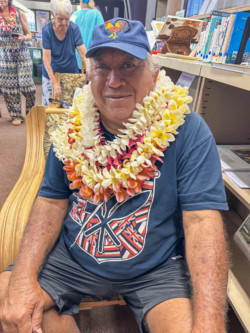
Uncle Walter Rawlins attended the screening of the documentary, which focused on his life growing up and fishing on Molokai. Photo by Dayanti Karunaratne
By Dayanti Karunaratne | Editor
“I had to catch the tank. The thing went down, down, down…. I could hardly see the tank, I could only see the bubbles.”
This harrowing tale about losing an air tank while fishing in the waters off Molokai was told by Uncle Walter Rawlins in a documentary film focused on his life stories. Part of a series that records local kupuna talking about their experiences, the documentary features Kekama Helm interviewing Rawlins, as well as photographs of fishing and paddling events that were mentioned.
On the first Wednesday of every month, the Molokai Public Library hosts public screenings to premiere the films, which are produced through a partnership between Akakū Media, Molokai Rural Health Community Association (MRHCA) and the library. On July 1, the community gathered for the Rawlins doc.
“It was exciting. Every day was a different day,” Rawlins said in the film, as he shared tales of his life on Molokai, including coming face-to-face with a reef shark and hauling a plane down Kamehameha Highway.
Before the film, Kuulei Arce, MRHCA Program Manager, spoke about the importance of the Molokai Kupuna Legacy Documentary Series.
“This helps us hold onto their legacy and pass it on to the next generation. Once our kupuna are gone, the next generation has no idea how they lived,” she said. “We never had phones, so how did we get in touch with somebody? Well, you walk to their house, or you ride your bike, or you just show up when you’re supposed to show up.”
Akakū Media filmmaker Daniel Emhoff of Akakū Media said he recognized the value of this documentary.
“It was an honor to be there in person and listen to the stories,” Emhoff said. “One thing that just got me during the [Rawlins] interview was his ability to communicate and his intelligence.”
In the documentary, host Helm is shown asking Rawlins about everything from high-school days to recent fishing regulations, including his experiences fishing and diving to coaching paddling and getting out of sticky situations.
After graduating and serving in the military, Rawlins returned to Molokai and began fishing in earnest with his brothers.
“No problem ever finding fish on Molokai,” he said in the film, explaining how they used wooden goggles and a type of Hawaiian sling made with a different kind of rubber. He also shared his observations about the changes in fish species near Molokai, and, on screen, showed photos from missions to pull invasive Roi fish from the area.
In the early 1960s, Rawlins helped to develop paddling on Molokai, forming the Molokai Canoe Club. In the film he said he taught his kids to paddle and enjoyed paddling for camaraderie and conditioning. Beyond that, he said his vision was to help kids stay off the streets and on a good path.
He also told Helm in the film that, despite being advanced in years, he still fishes as much as possible. He said he pays attention to the fishing regulations — some for better, some not — and emphasized the importance of protecting the island’s fish, especially on race weekends.
In closing, Rawlins said: “Cherish your island. Don’t ever let it go. Take care of ʻem.”
As the evening wrapped up, the Rawlins ʻohana gathered for a group photo. Throughout the screening, with the last rays of sun streaming through the windows and the audience gathered to hear stories being told, the library felt like a lanai — or a campfire or a living room, a place for gathering and listening to stories. This was especially true when, at the end of the event, half the audience gathered together to pose for the camera.
The documentary is available to view on the Akakū Molokai YouTube page. Visit https://hsrha.org/molokai-rural-health-community-association/kupuna-program/ for more information about the series.

 Add your comment


Don't have a Molokai Dispatch ID?
Sign up is easy. Sign up now
You must login to post a comment.
Lost Password