Catching Up
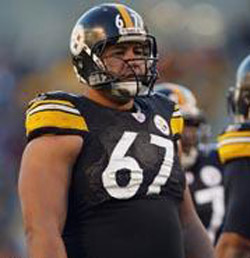

Jarrin Akana -- Basketball
Joe Kupaka – Volleyball
Keith Luuloa –Baseball
Miles Luuloa –Baseball
Mike McCutcheon –Baseball
Kaipo Naki – Basketball
Kimo “Scooby” Von Oelhoffen – Football




Miles Luuloa –Baseball
Mike McCutcheon –Baseball
Kaipo Naki – Basketball
Kimo “Scooby” Von Oelhoffen – Football
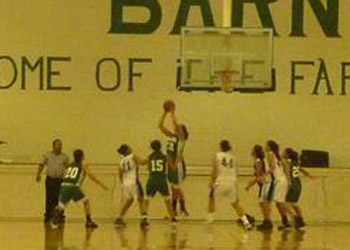
Farmers win season opener, fall in rematch the next day
The Molokai girls’ basketball team tipped off their season at The Barn last weekend with a win and a loss against visiting King Kekaulike from Maui. The Farmers came from behind Friday night to pick up a 37-30 win before dropping the rematch 40-37 the next morning.
“Both these games had a similar hard fought style,” said Molokai coach Michael Hooper. “The girls need to learn how to play these types of games if we want to repeat for a state championship.”
Friday night’s game was also the debut of The Barn’s brand new gym floor. The bright new parquet with a fierce-looking farmer at mid-court was designed by William Kaole Place with help from one of the school’s art classes.
“The new floor was nice. It was a little slippery at first, but after that it was great,” said senior guard Danna-Lynn Hooper.

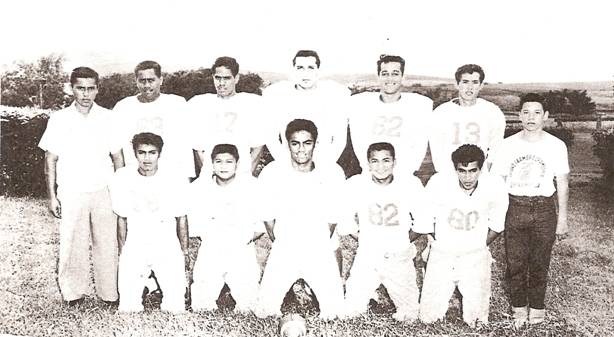
There hasn’t been a high school football game on Molokai since 1961, but the possibility of ending that streak took a small leap towards reality last month. Mike Kahale, a physical education teacher at Kualapu`u School, recently received a $2,000 grant to purchase football equipment.
Kahale, who has been working to create a high school football team since moving to Molokai five years ago, said the grant from USA Football was a step in the right direction.
“It’s a huge step,” he said. “Getting the equipment was one of our biggest obstacles and the fact that we got it from a nationally recognized organization shows we are willing to look to outside sources to get this done.”
Kahale and his wife, Nichol Helm Kahale, presented a strategic five-year plan to bring football back to Molokai to High School Athletic Director Cami Kimball last year.
“We sat down at the beginning of the year last year and talked about possibly bringing it back to the school,” Kimball said. “It’s on our backburner, but I don’t want to give the impression that we will have a team next year.”

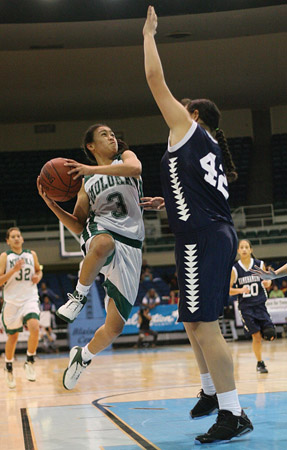
The rains are starting to fall, turkeys are in the oven and Christmas decorations are not far away, which means that it is almost time for Molokai High School to kickoff its winter sports seasons. This year the Farmers will compete in seven winter sports and all of the teams are entering their season with high hopes.
Basketball
The Lady Farmers come into the new season with high expectations after capturing last year’s Div. II state championship. Molokai returns nine of its ten players from the championship squad and appears poised to make another long postseason run.
Seven players on this year’s team put in serious minutes on the court last year and are expected to do the same with another year of experience under their belt.

.jpg)
Surfing takes Molokai boy around the world and to the top of the NSSA leaderboard.
Ka`oli Kahokuloa didn’t stand up the first time he was on a surfboard, but then again most nine-month-olds can barely stand up at all. A few months before Ka`oli’s first birthday, his dad took him out to the waves of Rock Point on Molokai. He’s been in the water ever since.
“Everybody was worried,” Ka`oli said of his first surf session. “They all thought my dad was crazy, but ever since then, I guess I’ve really loved the ocean.”
.jpg)

_0.jpg)
Ilio Point on Molokai’s northwestern tip has seen its share of earth shattering events – literally. Acquired by the U.S. Navy in 1940 as an aerial bombing range, the area still has so many unexploded ordinances that access is prohibited. Ilio Point, despite the devastation, is rich in rare plants and animals, cultural sites and archeological specimens. Because of that, the Department of Land and Natural Resources (DLNR) Natural Area Reserves (NARS) Commission has recommended the area for designation as a Natural Area Reserve.
_0.jpg)
Ilio Point is home to seabird species, the endangered Hawaiian monk seal and many native and rare plants. Fossilized goose bones and snail shells of now-extinct species have also been found in the area.
If designated, the land would be preserved in perpetuity, according to Bill Evanson, District Natural Area Program Manager. Final approval of the NARS designation is up to the Governor.
“It needs to be protected,” said Molokai resident and Hawaiian plants specialist Bill Garnett. “It’s one little place on Molokai where it still is what it used to be.”
Garnett and others testified at a public hearing about the proposed Ilio Point reserve held on Molokai last week.
Resident Halona Kaopuiki explained his family’s history in the area and the cultural important of preserving access to Ilio.
“We’re talking about access. We have burials out there,” he said.
Yama Kaholoaa, Sr. expressed apprehension about the plan because it is not community initiated. He testified about the knowledge and resources of Molokai residents that are left unused, and said he hoped a plan for Ilio Point would be developed in close communication with the community.
“It should be the native Hawaiians that take care of the native species,” Kaholoaa said.
There are two other Natural Area Reserves on Molokai already – Pu`u Ali`i and Oloku`i on the island’s north central shore. The last NAR in the state was designated in 1991.
Another public hearing will be this Wednesday, Nov.. 18 from 6-8 p.m. at the Mitchell Pauole Center.
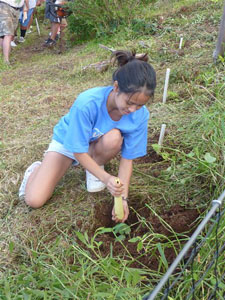
Hawaii’s Arbor Day came and went last Friday without many people on Molokai noticing. But that wasn’t the case for Bill Garnett and some of Molokai’s dedicated students. They spent the entire day preserving native Hawaiian plants along the Kalaupapa trailhead.
Garnett is a rare Hawaiian plants specialist who works for the University of Hawaii and has spearheaded environmental projects across the state.
“Arbor Day is pretty much my Christmas,” he said. “I love it because today I get a lot of people to come out and plant with me.”
For the fifth year in a row, Garnett celebrated his favorite day of the year by inviting the public to join him in planting native Hawaiian species at the top of the Pali Trail leading down to Kalaupapa. Garnett said volunteers have planted hundreds of native plants and helped to eradicate invasive species during the annual event.
This year, most of Garnett’s assistants were local students. Sixth graders from Kaunakakai School spent their morning learning about the environment and getting their hands dirty while planting. After school, the Molokai Environmental Protection Organization (MEPO) took over.
MEPO is an after-school environmental club at Molokai High School that was started as a student project over 30 years ago.
“We basically just do environmental projects and try to make the kids aware of their environment and what they can do to help save it,” said club advisor and high school teacher Robert Bento.
The club, which meets almost every Friday afternoon, has grown over the years and now has over 30 members. Almost 20 of them were on hand last Friday to help with the planting.



Last Week’s Scores
Island Youth Football League
Molokai Peewees 6
Ewa Beach 34
Molokai Termites 12
Ewa Beach 44
Molokai Youth Baseball
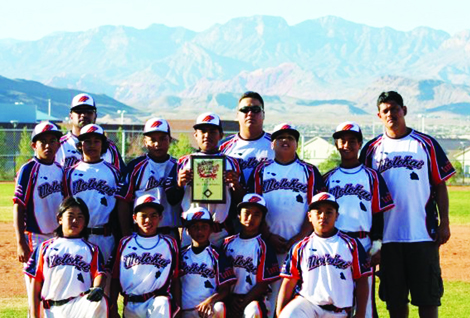
LVBA Fall Desert Classic
Molokai 12, Las Vegas 2
Molokai 17, Arizona Devils 2
Molokai 23, Las Vegas Lightning 2
Molokai 17, Las Vegas Titans 5
Molokai 6, Utah Bandits 2
Molokai 16, California Diamond Dogs 4
Molokai 4, Lamorinda Diablos 3
Coming up…
Girls’ High School Basketball
11/27 Molokai v. King Kekaulike 7 p.m. @ The Barn
11/28 Molokai v. King Kekaulike 10 a.m. @ The Barn
.JPG)
Standup paddling is one of the fastest growing sports in the world today – “faster than anything we’ve ever seen in the water sports industry – ever,” said Jim Hayes, owner of Tropical Blends, a custom surfboard shop in Honolulu.
.JPG)
“Really all it takes is some enthusiasm for the water, and some balance skill,” Hayes said.
Many paddle for exercise, which may explain its popularity, Hayes added.. Easier than surfing and more fun that working out in a gym, standup paddling is a whole body workout. A SUP’er can paddle long or short distances, or can just try a new way to surf.
Shane Adolpho, a Molokai local and standup paddling enthusiast, said he has been standup paddling for years, after he saw a co-worker try it. He now standup paddles distance runs with several other devotees of the sport.
Adolpho said he owns so many boards because they’re used for different conditions – the shorter boards, in the nine-foot range, are for wave surfing, while the longer boards, 12 to 14-feet, are for downwind paddling.
“If there’s surf, I’d rather [standup paddle] surf. It keeps me in shape for when I do long distance [paddling],” he said.
Standup paddle boards are different from surfboards in that they are thicker and sturdier. Hayes began manufacturing standup boards with the help of a friend in the wind surfing industry. The more experienced paddler can also use a surfboard to standup paddle surf, Hayes said.
“The first time I caught a wave [while paddling], it was a thrill starting over for something new and fresh,” he said. “It gave me refreshed enthusiasm.”
Who paddles?
Standup paddling has been reported in some unorthodox places. Earlier this year, “Stand Up Paddle Surf Magazine” reported that veteran surfer, Archie Kalepa of Maui, SUP’ed a record 187 miles through the Colorado River.
Paddlers have formed clubs on the east and west coasts of the U.S., in Japan, Australia, Brazil, Tahiti, and the UK.
“Lakes, rivers, streams – it’s everywhere,” Hayes said. There are also competitive racing circuits starting up.
Ekolu Kalama, Molokai born and raised, is the world’s first professional standup paddle surfer. Soon after he went pro in 2008, Kalama became the first person to paddle surf from Spain to Morocco, across the Straight of Gibraltar. Earlier this year he won the Rainbow Sandals Molokai to Oahu Stand Up Paddle division race.
For standup paddlers who want to get started locally, Adolpho said the best conditions to downwind paddle on Molokai can be found on the south side of the island because of tradewinds – starting in areas like Kawela and traveling downwind to convenient destinations like Hotel Molokai and Kaunakakai Wharf.
“For guys who’ve never surfed before, [they] get a workout, see the ocean, see the reef, fishes – it’s a pretty cool deal,” he said.


 Add your comment