Environment

News stories regarding Molokai’s outdoor environment

Workshop for Backyard Egg Farmers and Buyers

Wednesday, November 13th, 2013

UH CTAHR Cooperative Extension Service News Release

There will be a free workshop to assist those raising chickens for eggs as well as buyers. The workshop will cover candling and grading of shell eggs, washing and good handling practices, packaging and labeling, compliance with federal and state laws, and resources for the backyard egg farmer.

The workshop will be held on Tuesday, Nov. 26 from 3:30 to 5:30 p.m. at the Queen Liliuokalani Children’s Center Activity Room at Kulana Oiwi.

Attendees are encouraged to bring their own eggs for Q and A, and hands on candling practice. Speakers will include Mrs.…

When Plants Sweat

Wednesday, November 6th, 2013

Understanding the concept of irrigation

We all do it. In mammals, the loss of fluid from the pores of the skin is called perspiration. In plants, it’s known as transpiration. Even the land circulates and loses moisture — a process called evaporation. Most people don’t think twice about how much plants sweat — but for farmers, especially those on Molokai where water is scarce — understanding plant transpiration can make all the difference.

Molokai has the highest recorded rate of evaporation in the state at 118 inches per year, according to Alton Arakaki, a University of Hawaii College of Tropical Agriculture and Humans Resources (CTAHR) Molokai extension agent.…

Longevity Spinach

Wednesday, November 6th, 2013

Longevity Spinach

Community Contributed

By Paul Fischer

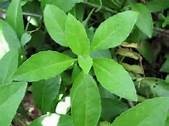
A few weeks ago, I wrote an article about growing Okinawan spinach in buckets.  I have also been growing another perennial salad herb that grows well on Molokai.  Its scientific name is gynura procumbens, but it is also known as “longevity spinach” or “cholesterol spinach.” The plant is native to southeast Asia, and is widely known for its nutritional and medicinal values.  Proponents claim it fights a variety of ailments, including diabetes, high blood pressure, high cholesterol and even cancer.  However, I feel it is worth growing just to eat.   This plant is quite hardy and prolific. …

Construction Career Day

Wednesday, November 6th, 2013

Construction Career Day

MECO News Release

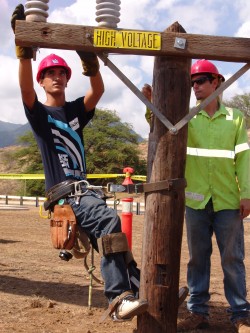
Geared with pole climbers and lineman’s belt Dallas Arce, 15, of Molokai, pictured at left, receives instructions from Grant Barker, a lineman from Maui Electric Company. This was part of the Hawaii Construction Career Day 2013 at the University of Hawaii Maui College on Oct. 18. More than 600 high school and college students from Maui County attended the event, where numerous local companies volunteered to provide hands-on activities that showcased the various career options in the state’s growing construction industry.…

Ka Mahi`ai Kalo

Wednesday, November 6th, 2013

Community Contributed

Ka Mahi`ai Kalo

By Na ka Papa 4 o ke Kula Kaiapuni o Kualapu`u me Kumu Loke Han

Aloha! `O makou ka papa 4 o ke Kula Kaiapuni o Kualapu`u. Ke a`o nei makou i ka mea kanu Hawai`i – na mea kanu maoli, `apa`akuma, a i `ole i lawe `ia mai e na Polenekia. `O kekahi o na mea kanu waiwai i lawe `ia mai, `o ia ho`i ke kalo. He mea nui ke kalo i na kupuna i ka wa kahiko a paia pu no kakou i keia wa.

Ua kipa makou i ka mahi`ai ma UH Extension M.C.C.…

Pathways for Fun and Profit

Wednesday, November 6th, 2013

Community Contributed

By Joe Kennedy

To me, pathways are the simplest way of using our energy to get the things we want, and are loaded with possibilities. Pathways through our gardens and farms can be used for more than just access. Call it “pathway gardening and farming.”

When you arrive home, you get out of the car and usually walk to the kitchen.  Along that distance, every square inch has possibilities for making life better.  Potted herbs and veggies can be on both sides along the way — you can pick your dinner when you arrive home on the way to the door.…

What’s New is Not Good: Biosecurity Challenges in Hawaii

Wednesday, November 6th, 2013

What’s New is Not Good: Biosecurity Challenges in Hawaii

Community Contributed

By Glenn I. Teves, UH Molokai Extension Agent

Biosecurity is a set of preventive measures designed to reduce the risk of introduction into Hawaii of infectious diseases, quarantined pests, invasive alien species, and living modified organisms. Each year, approximately 10 to 15 new major insect pests are accidentally introduced onto Oahu. On top of this, many other seemingly unimportant pests are also accidentally introduced, though we may not fully understand their impacts at that time.

Oahu’s major ports of entry — including harbors, airports, and military installations — are the main entry points for these pests, but they can also be sent through mail systems.…

The Poop Scoop

Wednesday, October 30th, 2013

What happens after you flush

You flush your toilet an average of five times per day, but have you ever wondered what happens once it leaves the porcelain throne? By the time it reaches the end of the sewer line and completes a lengthy purifying process, not only is your wastewater cleaner than it started, but one more thing is clear. The wastewater facility workers who sort through the thick of it, surface with this message: If you think you can dispose of your strangest unmentionables down the drain, you’re wrong. If any of your sewer pipes are damaged, a trenched sewer line replacement may be necessary.…

Molokai Represented at World Wilderness Congress

Wednesday, October 30th, 2013

Molokai Represented at World Wilderness Congress

Community Contributed

By Maile Naehu

Recently my husband Hano and I were invited to be delegates at the 10th World Wilderness Congress, or “Wild 10.” As we prepared for a presentation on Ocean Resource Management emphasizing fishponds, we had no idea what was in store of us in Salamanca, Spain.

On Oct. 1, we left our humble home to embark on a day and a half journey to Europe where the oldest university on the planet calls home. We arrived to a primarily Spanish speaking land until we met up with the other thousand or so delegates from around the globe.…

Kiawe Beans Pods Not Just Food For Livestock

Monday, October 28th, 2013

Kiawe Beans Pods Not Just Food For Livestock

Community Contributed

By Mercy Ritte

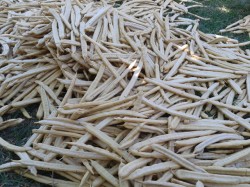
As you know, our kiawe trees produce an abundance of bean pods every year. Not only is it a nutritious food source for livestock, but also for people. In its native lands, dried kiawe bean pods ground into meal or flour is considered a staple food. It is very delicious and adds a sweet nutty taste to breads, pancakes, muffins, cakes and cookies. It is also gluten free, GMO free, highly nutritious, diabetic friendly and can be used to make syrup, jelly, tea, milk, and wine. Unlike wheat that digests within one to two hours, kiawe takes four to six hours to digest, resulting in delay of hunger pangs.…