


Environment

News stories regarding Molokai’s outdoor environment

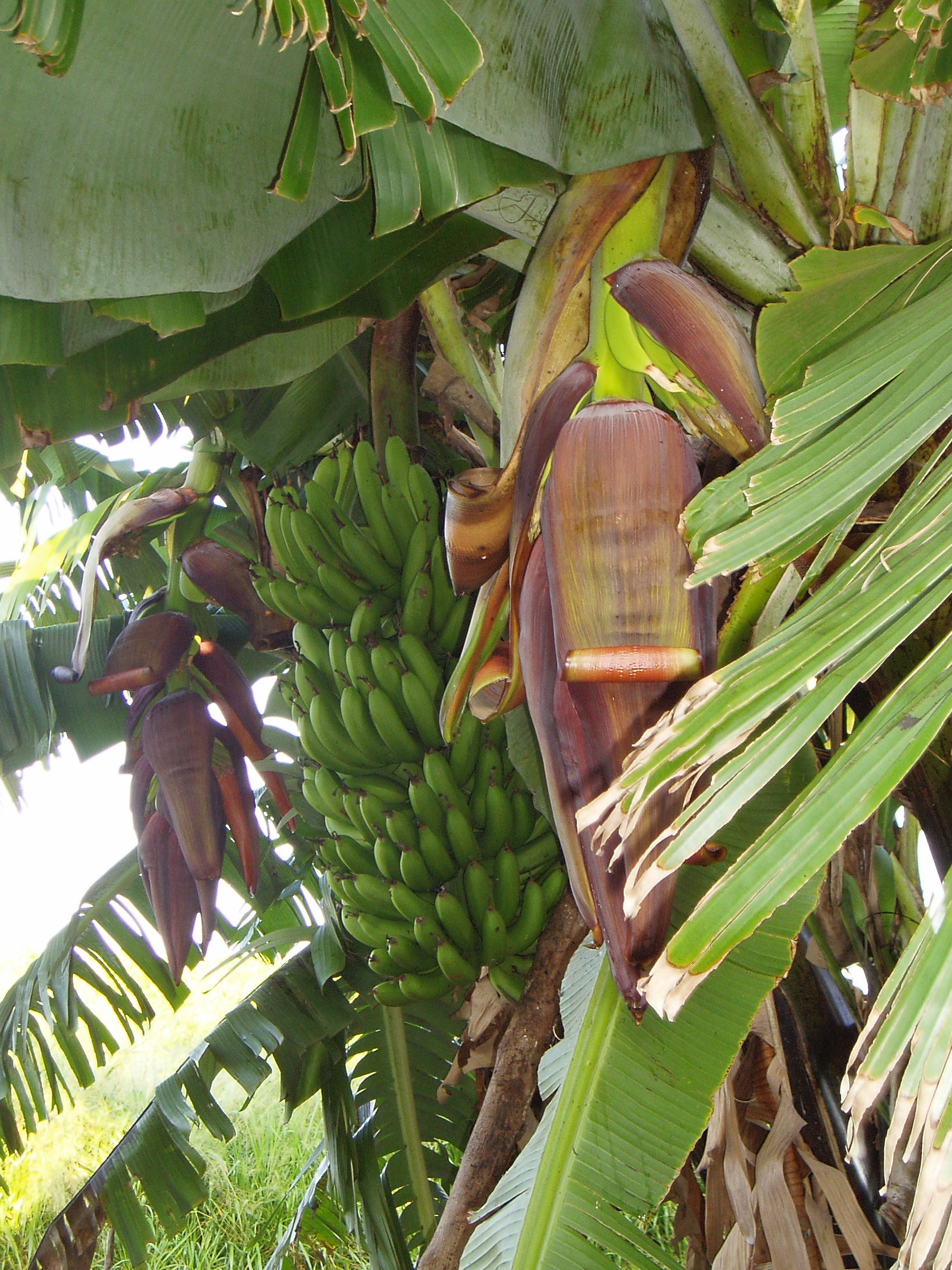
Going Bananas, Part II
Wednesday, September 8th, 2010

Going Bananas, Part II

Community Contributed

By Glenn I. Teves, County Extension Agent, UH College of Tropical Agriculture and Human Resources

Banana was first brought to Hawaii by the early Polynesian voyagers, and believed to have arrived in three distinct waves from different parts of the Pacific, identified by group names such as maoli, popoulu, and polapola. The majority of banana varieties arrived from Tahiti and Samoa, but countless others were derived from mutations of the first introductions, many of which are unknown outside of Hawaii.  Over 70 varieties of Hawaiian banana were known from the Kona area alone in the 1870s.

There are two main species of banana, Musa acuminata (A) and Musa balbisiana (B), and all banana varieties have blood from one or both of these species. There are countless banana varieties in Hawaii, and can get very confusing trying to identify them, but I will focus on the main commercial varieties.

The AAA group is commercially important, and includes the Cavendish types, Giant and Dwarf Cavendish, Robusta, and Grand Nain. These are usually planted in rows of seven to eight feet, with eight to 12 feet between rows.

•    Dwarf Cavendish – commonly called Chinese or Pake, introduced into Hawaii in 1855 from Tahiti. This is a common backyard variety characterized by relatively short plants. Excellent dessert banana, but poor shelf life and susceptible to freckling, and cigar or banana end rot. Small bunches, 12-30 pounds, this is a favorite banana for making a Puerto Rican dish called pasteles.

•    Giant Cavendish is a mutation from the dwarf Cavendish discovered in North Australia, and is called Williams in Hawaii. Hawaii’s main commercial cultivar, it competes with the imported banana, also Williams types. Large bunches are up to 100 pounds or more. The taller Robusta and shorter Grand Nain or Chiquita are probably mutations and grown in Hawaii.

Another AAA group is the Gros Michel or Bluefields. Formerly the main commercial variety in Hawaii until decimated by Panama wilt fungus, these plants originated from Bluefields, Nicaragua. Panama wilt is not a problem on Molokai, and the dwarf form is grown here. Plant needs to be propped up when fruiting, and produces a large full banana with an excellent taste.

•    Bluefields – large plant with very large bunches, 75-130 pounds with individual bananas one foot long. Not common in Hawaii.

•    Cocos or Dwarf Bluefields – same as Bluefields except shorter plant. A mutation from the regular Bluefields. Also known as Highgate.

The AAB group includes two Brazilian cultivars. Known only in Hawaii as Apple, this is not the true Apple variety. They’re susceptible to black leaf streak, a foliar disease prevalent during rainy months, but resistant to Panama Wilt, a fungus attacking the root system.  Known internationally as Pome, these are usually planted in rows of eight to 12 feet with 10-15 feet between rows. The cultivars include:

•    Tall Brazilian, also called Hawaiian Apple, can easily reach 20 feet in height and is susceptible to wind. Bunches can weigh 15-25 lbs.

•    Dwarf Brazilian is a mutation of a tall Brazilian discovered in Santa Catarina, Brazil. Called Dwarf Apple or ‘Santa Catarina Prata’, this cultivar can reach fifteen feet at the top of the bunch, and bunches can range from 30-75 lbs. Fruits have a robust taste with a tang, and good shelf life. This is the most-wind tolerant of all cultivars in Hawaii. 

In closing, there’s no such thing as a banana tree. Banana is considered a large herb with its trunk composed of compressed leaves. Each leaf starts from the base of the plant, and is one continuous piece. Plant now and you’ll have a bunch in less than a year.

Whale Officials Look to Residents for Advice

Wednesday, August 25th, 2010

Whale Officials Look to Residents for Advice

Environmental officials are seeking mana`o from around the state for their management review process. They met with Molokai residents last week to get their input on the future of the state’s five humpback whale sanctuaries.

“We’re looking to expand our mission,” said Allen Tom, regional director for National Marine Sanctuaries (NMS), of the review process. Possible changes, he added, include extending the sanctuaries’ borders, adding resource restoration projects and regulating water or noise pollution.

Hawaii’s sanctuaries were created in 1997 in a partnership between the state and federal officials at the National Oceanic and Atmospheric Administration (NOAA). Every five years, the sanctuaries’ management is up for review and the public is asked to weigh in.

with the community here.”

The Maui County Council has also weighed in on the review. Last month, it passed a resolution urging officials to impose boating speed limits, regulate sewage discharge and study the impacts of Navy sonar exercises in the sanctuaries’ waters.

Whale Rules
The humpback whale sanctuary off Molokai includes Penguin Bank in the Kaiwi Channel to the southwest, extending along the south shore to the Pailolo Channel and the western shore of Maui. The state’s other sanctuaries are on the north shore of Kauai, the north and southeast shores of Oahu and the northwest shore of Hawaii Island.

While restrictions on how close people can get to the whales – 100 feet in the water and 1,000 feet flying overhead – exist outside the sanctuaries, inside there are steeper fines and heavier enforcement of violations.

The public has until Oct. 16 to comment on management plan changes. NMS will then review comments submitted and hold another round of public meetings to discuss possible changes. A draft management plan will then go to the U.S. Congress and the governor for approval.

To register your mana`o with National Marine Sanctuaries, go to hawaiihumpbackwhale.noaa.gov.

State to Revise Rules for Protected `Aina

Wednesday, August 18th, 2010

Ancient fishponds, indigenous forests, beaches and reefs are just a few of Hawaii’s remaining natural and cultural resources residing in state-owned conservation districts.

After 16 years of no major changes, the state Department of Land and Natural Resources (DLNR) is looking to revise the policies that protect these conservation regions. Some of the proposed changes would affect the shoreline setback, permits for land management activity, removal of invasive plants, fishponds and beach restoration among many other things.

A public meeting on the matter was held last Wednesday on Molokai, to gather community mana`o and help craft the amendments to the administrative rules that regulate such lands.

Catch and Release

Wednesday, August 18th, 2010

Catch and Release

Among the captured birds was AAV, a nasty Coot the girls nicknamed Angry-and-Violent, and to measure it they must endure nips and scratches. But they said working with the birds is worth the abuse. Moriah wants to be a veterinarian when she grows up and the banding gives her valuable hands-on experience with wildlife.

Besides, she laughed, “Not all of them are vicious like that.”

Afterward, Lily carried the bird, flapping wings and all, to the pond’s edge. She loosened her grip and it took off into the water, thankful for its release. If it understood what all the poking and prodding was doing for its kind, it would probably be thankful for that too.

Rural Hawaii to be Heard

Friday, August 13th, 2010

Hawaii Rural Development Council News Release

As a part of a nation-wide movement, a rural community-improvement council is asking Molokai’s mana`o for how to increase economic opportunities.

The Hawaii Rural Development Council (HRDC) seeks your input, concerns, success stories, and ideas on issues related to rural communities in Hawaii. State Rural Development Councils nationwide are gathering input to be presented to Partners for Rural America and the USDA. This is an opportunity for Hawaii to voice our concerns and successes locally to build on a national action plan to promote enhance rural development strategies.

A facilitated discussion will occur on Molokai on Thursday, Aug. 26 from 6-9 p.m. at Kulana `Oiwi QLCC conference room. Dinner will be provided.

No Pest Zone

Sunday, August 8th, 2010

For years, the Molokai branch of the Maui Invasive Species Committee, otherwise known as MoMISC, has battled stubborn invasive species with science and technology. But when science just isn’t enough, Molokai’s environmental crusaders have begun using cultural might.

The eco-crew recently headed to privately owned forest acreage to expunge the area of albizia, a large and fast-growing tree that has begun dominating other island’s lowland forests. Before beginning removal of the pest, they sought the advice of the cultural caretaker of the site.

DLNR Solicits Land Conservation Requests

Thursday, August 5th, 2010

DLNR News Release

In an effort to protect resource-rich land, the Department of Land and Natural Resources (DLNR) will provide funding to acquire land in need of preservation.

The Legacy Land Conservation Program (LLCP), funded by the State Land Conservation Fund, is now accepting applications. State agencies, county agencies and non-profit land conservation organizations are encouraged to apply.
 

Puffer fish Dying Across State

Wednesday, August 4th, 2010

Puffer fish Dying Across State

Community Contributed

By Arleone Dibben-Young

 A mysterious disease is killing striped and porcupine puffer fish. Dr. Thierry Work with the U.S. Geological Survey has received at least 100 reports of dead puffer fish from across the state in the last six months. The sick and dying puffer fish have had lesions on the skin, but what’s been found on the inside has researchers alarmed.

"We're seeing things like enlarged livers and enlarged swim bladders, which is the organ that allows puffer fish to float," Work said. His staff has been able to analyze only 14 sick puffer fish so far and they're baffled as to what is killing them, but are leaning towards a virus or toxicosis.

"We really need to sort out what it is that's killing them. Once we sort out the cause, we can decide if it can affect other fish or not," said Work. "You'll see these fish either floating and can't submerge and they just don't look right, or if they're on the beach, their gills will be moving a little bit.”
"As long as there's a little bit of movement in those fish, they're super fresh and we can use them. If they've been on the beach a while, they're too decomposed and we can't do lab testing with them."

You can help by reporting all observations of dead or dying puffer fish, and if you spot a freshly dead puffer fish place it on ice. Call Arleone at 553-5992 to ship to the USGS National Wildlife Health Center.

Humpback Sanctuary Expanding Past Whales

Wednesday, August 4th, 2010

NOAA News Release
 
The National Oceanic and Atmospheric Administration (NOAA) is reviewing its Hawaiian Islands Humpback Whale National Marine Sanctuary management plan and encouraging public input through a series of meetings from Aug. 10-26. During these meetings, comments on management considerations will be recorded as input to the management plan process.

A meeting will be held on Molokai at the Mitchell Pauole Center, Kaunakakai, on Aug. 18 at 6 p.m.

MECO Raises Rates to Customer Dismay

Monday, August 2nd, 2010

The Hawaii Public Utilities Commission (PUC) approved a interim rate increase for Maui Electric Company (MECO) last week that went into effect Sunday.

MECO applied for a permanent increase of 9.7 percent in September. While the PUC is still considering that application, they issued an interim decision allowing the company to raise rates for customers on Molokai, Maui and Lanai by 3.3 percent for a $10.3 million revenue increase.

The typical household on Molokai will pay $5.21 more per month, bringing the total monthly bill to $187.67, according to a release from MECO last week based on a monthly usage of 500 kilowatt hours. The typical household on Maui will now pay $186.02, while the typical household on Lanai will pay $196.87.