Environment

News stories regarding Molokai’s outdoor environment

Not Just Any Seed

Monday, October 31st, 2011

Not Just Any Seed

Community Contributed by Glenn I. Teves, UH County Extension Agent

Some people think that saving seeds is a waste of time because it’s easier to order them from a seed catalog or pick them up at the nearest supermarket.  It’s not that simple. Some varieties developed for cold climates may not be the best for us.  Good seed must be adapted to our special climate considering all its idiosyncrasies, such as high humidity, warm nights and arid conditions. Not just any seed will do.

Several years ago, a flood ravaged our seed laboratory on the University of Hawaii (UH) Manoa campus. In it is a gold mine of seeds developed in Hawaii, and some are almost impossible to replace. One of them was STEP 305.  Alone, STEP 305 wasn’t considered good enough to be released, but when crossed with a UH tomato named Anahu it produced one of the most prolific and tasty hybrid tomatoes called N-52. Developed in Hawaii, N-52 was resistant to over eight different diseases and also spider mites and root knot nematodes.  We cannot produce N-52 anymore until we find STEP 305, so I decided to track it down.

Cognizant of the fact that since 1970, we have lost 75 percent of our local seed worldwide, I spent a few hours rummaging through another seed reefer on the UH Manoa campus. The magoon lab reefer is the size of a large office where all kinds of vegetable seeds are stored, but not STEP 305.  As I was leaving after lunch, I threw some rubbish in a dumpster outside the reefer. Looking in, I found about 40 pounds of corn seed in large plastic bags. Someone had dumped them a few days earlier. These were not just any old corn seed, but ancient varieties collected from little towns all over Mexico, the ancestral home of corn. Donated by farmers, these seeds were passed down through generations of farmers over hundreds of years. Names like Oaxaca and Reventador, some seeds were gold, others were silver and some were bronze. I thought I had found hidden treasure but I had to put them in the reefer for another day’s work.

Next was checking the USDA Germplasm Laboratory at Cornell University where they store thousands of varieties of vegetable seeds. Looking through their list, I bumped into three Hawaii lettuce varieties. I only heard stories about them from my predecessors, since they were “lost” over 50 years ago, but someone was smart enough to send it to USDA for safekeeping. USDA recently sent me the seed and I’m trying to increase it, and hopefully make it available soon. But still no STEP 305.

After checking other universities that conduct tomato research with no success, I felt I must have overlooked something. Maybe Googling STEP 305 would do it. Low and behold, I find STEP 305 listed in a little seed store in Alsace, France near the Belgium border, so I email the store and I’m waiting for their reply, hopefully in English. It took a while to locate STEP 305, and I still don’t have it my hand, but it’s worth the wait because it’s not just any seed. It’s the parent of N-52.

“Roi Round-up” Spearfishing Tournament Nov. 6

Monday, October 31st, 2011

The popular “Roi Round-up” Spearfishing Tournament, which first took off on Maui in 2008, is taking place this year in Lahaina on Sunday, Nov. 6. The purpose of the event is to remove invasive fish from the Valley Isle’s reefs, including roi or peacock grouper, to`au or blacktail snapper, and ta`ape or blue-line snapper. All three species were introduced to Hawaiian waters in the 1950s. Approximately 60-80 divers will be competing for top honors in several categories, including Most Fish, Largest Roi and Smallest Roi.

Founders and organizers of the Roi Round-up include Brian Yoshikawa of Maui Sporting Goods, Maui fisherman Darrell Tanaka and his wife Jackie, Stuart Funke-d’Egnuff of Tri-Isle RC&D, and Kuhea Paracuelles, a local conservation professional.

Kioea Declared Official Bird of Kaunakakai

Wednesday, October 26th, 2011

Kioea Declared Official Bird of Kaunakakai

Community Contributed by Arleone Dibben-Young

The proclamation to name the kioea the official bird of Kaunakakai, Molokai, was signed by Maui County Mayor Alan Arakawa and Council Chair Danny Mateo on Oct. 25, making it the second district in the state to declare an official bird. The signing took place at Kaunakakai Elementary School. The proclamation resulted from a petition of more than 1,000 signatures.

 “It was a perfect match,” Mateo said, “as written in the proclamation; its uniqueness reflects the individuality found of Molokaians.”

The kioea (Bristle-thighed Curlew, Numenius tahitiensis) is one of the rarest shorebirds in the world and is found exclusively on tropical Pacific islands and atolls. Ancient Hawaiian poetical sayings unique to Molokai indicate the rare bird was once abundant. “Ku`u manu o o Ho`olehua” was said of the kioea, whose early morning call “Lawelawe ke o! Lawelawe ke o! Take the food! Take the food!” signaled fishermen it was time to go to the sea to go fishing.

A few years ago 46 million Americans claimed to be birders and spent more than $40 billion annually. Since then, birdwatching has soared and the U.S. Fish and Wildlife Service reports that it is the fastest growing outdoor activity in the U.S. Recent demographics indicate that bird watchers are usually highly educated, affluent, and will travel to remote locations to observe a specific bird or species. Known as avitourism, birders are expected to flock to Molokai as a destination in search of the rare Bristle-thighed Curlew, the island’s kioea.


Eating Spears

Wednesday, October 26th, 2011

Eating Spears

Community Contributed by Glenn I. Teves, County Extension Agent, UH CTAHR

Asparagus has got to be one of the oddballs of the vegetable kingdom. The edible parts are called spears which are premature leaves called ferns. They can grow 8 to 9 inches overnight, emerging out of the ground like mushrooms. Compared to most vegetables which are annuals, meaning they complete their life cycle in a year, asparagus is a perennial. A member of the lily family, asparagus is related to garlic, onions and leeks, though bear no resemblance to them.

Asparagus thrives in our Molokai climate preferring 75 to 85 F days and 60 to 70 F nights. The winter and spring months are ideal for “flushing spears.” Nutritionally, asparagus is a good source of Vitamin C and Folate, a B vitamin vital in maintaining and producing new cells, and also contains vitamin A, potassium, phosphorus and iron. It’s great for low sodium diets.

There are many varieties of asparagus. New Jersey’s Rutgers University has developed many varieties with “Jersey” in its name, but they appear to be more adapted to colder climates.  The appeal of Jersey hybrids are that they’re all-male. Male plants are more productive and produce three times more than female plants since they don’t spend energy producing seeds. However, the California-developed cultivars have performed better in Hawaii, according to Milton Agader of Twin Bridges Farm, asparagus farmers in Waialua, Oahu. California varieties include Apollo, Atlas, Grande, Purple Passion and the standard, UC 157.
Although asparagus can be grown from year-old roots, few if any seed companies will ship roots to Hawaii, and there’s always the chance of bringing in diseases with the roots. Growing seeds in 4-inch pots for three months, fertilizing regularly with dilute balanced fertilizer, will produce healthy plants. Select only the strongest plants for field planting. California-developed asparagus seed are both male and female. Females will produce skinnier spears, but some gourmet markets prefer these because of the perception that the large ones are tougher.

Asparagus prefers sunny conditions with well drained soil. This is critical. The also prefer alkaline soil in the pH range of 6.7 to 7.5. This means adding lots of sand or lime, which is why they grow well in sand. They don’t require lots of water once established. Asparagus can withstand saline water and even salt spray occasionally. Asparagus is fairly disease and insect free if you follow proper cultural management techniques, understanding their likes and dislikes.
In growing asparagus, patience is a virtue and you will be greatly rewarded in the end if you’re patient. A healthy asparagus plant can remain productive for 20 years or more if well cared for. It’s better to forego the first year harvest, setting the plants up for robust root and vegetative growth. Forcing spears is an art, and you can have many flushes each year especially in the cooler months if you ‘know your plants’, the seasons, and when to force them. Weeds can be a big problem, but cutting ferns back and burning the surface is a good sustainable strategy for weed control.

To find out more about growing asparagus and forcing spears, you can download this publication from the UH College of Tropical Agriculture and Human Resources website: ctahr.hawaii.edu/oc/freepubs/pdf/HGV-9.pdf

Farm Bill Programs Available

Wednesday, October 26th, 2011

The Natural Resources Conservation Service, a division of the United States Department of Agriculture, is offering technical and financial assistance to farmers and ranchers to develop, install and implement authorized conservation practices. To receive assistance, the farmer or rancher must be in control of the land where practices will be applied, have an agricultural income of at least $1,000 per year and be willing to implement conservation practices of the duration of the contract and maintain such practices.

Legislators to Talk Wind with Local Residents

Monday, October 24th, 2011

Members of the Hawaii Legislature and guests will be visiting Molokai on Wednesday, Nov. 2 to hear from island residents about a wind farm proposed for Molokai.

Sens. Mike Gabbard and Kalani English, Rep. Denny Coffman and Susan Kodani, district director for Congresswoman Mazie Hirono, will spend the day visiting various parts of the island. 

Gabbard, chair of the Senate Committee on Energy and Environment said, "I want to make it clear that we are coming because we truly want to listen to residents' thoughts, feelings and concerns about a proposed wind farm on Molokai.  We think that it’s important to hear directly from the people of Molokai, not in a formal town hall-type setting, but more in an informal, conversational setting."

Testifiers Tell MECO ‘No’

Monday, October 24th, 2011

Molokai cannot afford a 6.7 percent electricity rate increase requested by Maui Electric Company (MECO), residents testified during a Public Utilities Commission (PUC) public hearing at Mitchell Pauole Center last week.

MECO filed the request with the PUC in July in order to “cover the cost of improvements to integrate additional renewable energy and improve the reliability of service to its Maui, Lanai and Molokai customers,” according to a press release.

It’s Wedgie Season!

Wednesday, October 19th, 2011

It’s Wedgie Season!

Oct

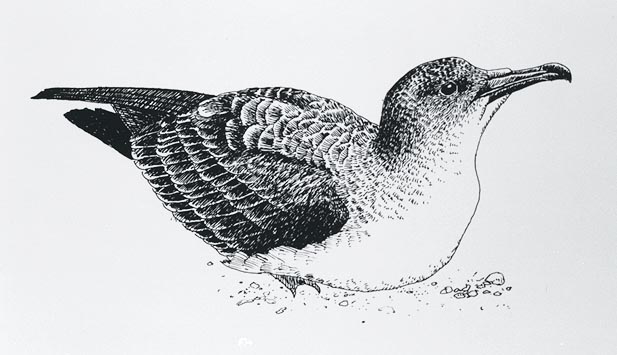
ober and November is fledging season for wedge-tailed shearwaters, when young birds fledge from burrows excavated into coastal cliffs to life at sea.  “Wedgies,” as they are affectionately called by wildlife biologists, are part of a mixed flock of seabirds that commercial fishermen rely upon to locate schools of ahi and other marketable fish. The uau kani, or wedge-tailed shearwater (Puffinus pacificus), is 17 inches in length from bill to tip of tail, with a wingspan of 38 inches. Adult birds leave coastal colonies at dawn to feed on fish and return after dark. Behavior while in these colonies is generally nocturnal and throughout the night birds emit weird moans, groans and loud screams, thus they are also nicknamed the “moaning bird.”

Wedge-tailed shearwaters nest on all the major and offshore islands in the Hawaiian chain by digging a burrow with their bill and feet or utilizing natural crevices: nesting sites are reused from year to year. The largest colony on Molokai lies hidden in the dunes of The Nature Conservancy’s (TNC) Mo`omomi Preserve. Discovered September 1999, by Arleone Dibben-Young and U.S. Fish and Wildlife’s Calvin Willis, the colony is now actively managed by TNC staff resulting in more than 400 young birds fledged per season. Egg laying begins mid-June, with one bright white egg forming the clutch. Parents share the 53-day incubation period, usually in stints of seven to ten days, and sometimes sit side-by-side. Chicks are fed fish once a day by regurgitation. Parents leave the nest site two to three weeks before their young have fledged (which takes about 100–115 days). Shearwaters are clumsy on land. Their legs are placed so far to the rear of the body that they cannot walk, so instead waddle. Young birds not yet capable of flight may wander from their burrows in search of food. At this time they are highly vulnerable to predators and often fall prey to mongoose, cats and dogs. Some young birds starve to death while waiting for their feathers to grow to flight length. Many fledglings are attracted at night by urban lights and fall into residential areas or onto highways where they are struck by automobiles. Caution should be used when driving at Kaunakakai Wharf as young birds fallen to the ground from exhaustion or striking harbor lights have been found numerous times on the roadway and parking lot.

Seabirds were held in high esteem by ancient Hawaiians: Birds returning at night to land were used to navigate home from sea, shifting weather was indicated by a change in behavior, feathers were made into capes, lei, and kahili for alii, and seabirds figured prominently in legends, proverbs and sayings.

Statewide community efforts assist in the recovery and release of several hundred juvenile seabirds annually. Chicks that have wandered too far from the nest and are not yet capable of flight must be briefly held in captivity by state and federal permitted wildlife rehabilitators. When ready for release, birds are fitted with a U.S. Geological Survey metal bird band. If you find a ‘downed’ seabird, call Arleone at 553-5992.

Kioea to Become Official Bird of Kaunakakai

Wednesday, October 19th, 2011

Community contributed by Arleone Dibben-Young

On Oct. 25, Maui Mayor Alan Arakawa and Council Chair Danny Mateo will sign a proclamation naming the kioea (Bristle-thighed Curlew, Numenius tahitiensis) the official bird of Kaunakakai. This makes Molokai the first district in the County of Maui to receive such distinction. The public is invited to the signing event, which will take place at 1 p.m. at the fourth grade classroom of Kaunakakai Elementary School, where this unusual shorebird whistles to students from the adjacent Duke Maliu Regional Park.

Blue Gold Film Screening

Wednesday, October 19th, 2011

Sust`AINAble Molokai News Release

Join Sust`AINAble Molokai on Saturday, Oct. 23 for a free screening of the award-winning film “Blue Gold: World Water Wars.” Based on the ground-breaking book by Maude Barlow and Tony Clark, the film sheds light on the world’s rapidly approaching water crisis and suggests that wars of the future will be fought over water as they are today over oil. Teri Waros will host the event at Kalele Bookstore beginning at 6:30 p.m. See you there!