Agriculture

County Begins Deer Harvest Cooperative

Wednesday, October 3rd, 2012

County Begins Deer Harvest Cooperative

The County of Maui has organized the Maui Axis Deer Harvesting Cooperative (MADHC) to help farmers, ranchers and landowners control invasive Axis deer on their property while addressing food security with zero waste. MADHC is made up of a group of certified, trained, hunter- members who can provide harvesting services to those in Maui County receiving damage from Axis deer. The meat will be shared between hunters and landowners, and in some cases, local slaughterhouses will process meat for resale after USDA inspection.

The cooperative began its four-month deer harvesting pilot program on Oct. 1, funded by a $37,500 grant from the Maui County Office of Economic Development.…

The Food and Wine Festival

Wednesday, October 3rd, 2012

The Food and Wine Festival

Community Contributed

By Dillon DeCoite

Editor’s note: The second annual Hawaii Food and Wine Festival took place Sept. 6 to 9, with Molokai’s L&R Farms’ Lynn and Russell DeCoite participated. The DeCoite’s son, Dillon, a middle school student at Aka`ula School, wrote a story about his parents’ success in the Aka`ula monthly newsletter, reprinted here.

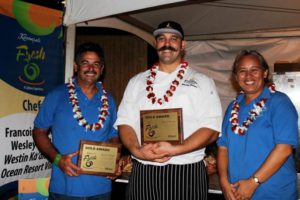
The Food and Wine Festival, in Kaanapali, Maui is located on the golf course. Twelve farmers and 12 chefs partner up to cook produce raised by island farmers. My mom and dad partnered with two chefs from the Westin Kaanapali Hotel. The dish they made was wild boar bacon with Molokai sweet potato gnocchi.…

Biodiesel: A Viable Option

Wednesday, September 26th, 2012

Biodiesel: A Viable Option

Molokai farmers explore renewable energy alternatives

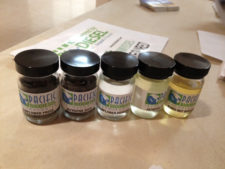
Kukui nuts have long been used by Hawaiians for food and medicinal purposes, but it may soon be also used for fuel –specifically, biodiesel fuel. Wayde Lee, who created the Molokai Sustainable Farming Project (MSFP) last year, has been exploring biodiesel initiatives that he said may lead to economic stability and energy security for Molokai farmers. Recently, they’ve been working with Maui-based company Pacific Biodiesel (PBD) to discuss the possibility of eventually developing a crushing and processing plant on-island that would produce biodiesel fuel for Molokai from crops farmed on Molokai.

According to Wescott Lee, Wayde’s brother and MSFP’s project facilitator, over 2.5 million gallons of diesel are imported to Molokai every year, most of which goes towards powering the Maui Electric Company Molokai electric plant.…

Fruit of the Land

Wednesday, September 19th, 2012

Fruit of the Land

New Molokai Fruit Stand markets local produce

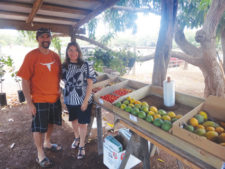
A few months ago, Kalamaula Homesteader and third generation farmer Gene Ross Davis found himself in a predicament. His tomato crops had yielded too many tomatoes for on-island consumption, but not enough to ship off-island. In order for it to be profitable for him to ship his tomatoes for sale off-island, he would need enough to fill an entire palate of 25-pound boxes –nearly 500 pounds total of tomatoes. With the help of his wife Rosie, Davis found another way to market his produce –he opened a fruit and vegetable stand on his property last week.…

Sust`ainable Molokai Named Finalist in National Program

Friday, September 14th, 2012

Sust`ainable Molokai News Release

Local nonprofit Sust`ainable Molokai has been selected as the only finalist from Hawaii in the Tom’s of Maine “50 States for Good” program. That means it now has a chance to win up to $50,000 in support of a community project that will engage student and community volunteers to plant 5,000 trees to heal our aina (land) and recharge our single source aquifer.

Through a online public vote at Facebook.com/TomsofMaine now through October 9, local residents can help bring the funding to Molokai with the click of a mouse.

The “50 States for Good” program seeks to uncover local nonprofit groups that address urgent community needs and engage volunteers to get the work done.…

Molokai Mom on a Mission

Wednesday, September 12th, 2012

Community Contributed

Opinion by Mercy Ritte

It is a mother’s right to know if, what, and when noxious chemicals are being released into the air, water, and soil that their children are in contact with. I did receive a response from Monsanto Molokai to my inquiries, but my specific questions were left unanswered. Only with additional research and determination was I able to find partial answers.

Below is a short list of chemical herbicides and pesticides manufactured and used by Monsanto and other industrial agriculture corporations.

HARNESS XTRA
Active Ingredient: Atrazine (and Acetochlor)
Fact: Atrazine is estimated to be the most heavily used herbicide in the U.S.…

What’s Up with Carrots?

Wednesday, August 22nd, 2012

What’s Up with Carrots?

Community Contributed

By Glenn I. Teves, County Extension Agent, UH CTAHR

When you think of an orange vegetable, carrots come to mind, but once upon a time the most common color of carrots wasn’t orange. It wasn’t until the 1500s that the Dutch stumbled upon an orange carrot and focused on developing more orange varieties.
Believed to be native to the area around Afghanistan, the first carrots were purple and yellow. Around A.D. 900-1200, they spread to the eastern Mediterranean, then to China and Eastern Europe by the 1300s. By the 1600s, yellow carrots reached Japan, but it wasn’t until the 1700s that orange carrots emerged in Holland and adjacent areas.…

Why Save Seeds?

Wednesday, August 8th, 2012

Why Save Seeds?

Community Contributed

By Glenn I. Teves, County Extension Agent, UH CTAHR

A recent flood in Thailand passed through people’s minds and then it was gone, an insignificant event in the eyes of residents in Hawaii. Tie this to the recent lei shortage during graduation, where common leis were selling for $20 each, and you start to see how these events over 4000 miles away affect us. This is truly a global economy. Other collateral damage from the Thai floods were crop failures of vegetable seeds, vital to the production of food in many parts of the world. Centralizing seed production has its challenges, and when they get wiped out, they really get wiped out.…

Sweet Oranges

Wednesday, August 1st, 2012

Sweet Oranges

Community Contributed

By Glenn I. Teves, County Extension Agent, UH CTAHR Cooperative Extension Service

A few days ago, I inquired about the price of orange juice at one of the stores and found the half-gallon sold for $5 while the gallon sold for $10. For $15 more, I could have bought an orange tree to produce more orange juice than I can shake a stick at.

Native to Asia, oranges were introduced to Hawaii by Captain George Vancouver in 1792, and are known as the Hawaiian or Kona orange. These were propagated by seed so there’s some variability in plants and fruits.…

Building a Food Forest

Wednesday, August 1st, 2012

Building a Food Forest

Molokai High School’s permaculture farm almost in full bloom

The Farmers will have the chance to explore a new method of farming this year, as Molokai High School (MHS) partners with local grassroots organization Sust `aina ble Molokai to create a permaculture farm located right on campus. The garden, which was started in January of this year, will use fundamentals of permaculture farming like building food forests, or diversified ecosystems that wield a variety of fruit year-round, as compared to traditional commercial farms that only produce one crop in mass quantities.

“We want to have kids engaged enough to create their own school gardens and permaculture curriculum,” said Emillia Noordhoek, Sust `aina ble Molokai’s executive director.…