Celebration of Arts
.jpg)
.jpg)




.jpg)
This story about Naiwa was originally written in 1921 in the Hawaiian language newspaper, Kuokua in three increments. In 1952 an English version of the story showed up in the newspaper Ka Leo O Molokai, written by Molly Reppun. Another version can be found in the private collections of Marsha Camera. It tells us a lot about the makahiki, the places and some of the customs from a time period right before Kamehameha’s wars.
The story begins in Waikolu. Our main character lives there with his extended family and his wahine. A grandfather begins to tell all the residents to get ready for the upcoming games to be played in Kalae. He says, he still has strength in his old bones and if friends and family bet on his skills, they will have many “goods” to carry home on their backs. Our hero decides to stay home with his “Niihau basket,” or woman, rather than to travel with the group. When the group returns, they are laden with wealth from the games.
The next time the grandfather gathers the men together, our hero decides to join them. But some of the women are sly in their comments about how dressed up some of the men are. This creates some anxiety in our hero who reassures everyone that he has only one woman in his heart. The men talk among themselves about creating a delay in their trip which they believe will stress out our hero. They agree to stay at a house an extra night in Kalaupapa to gather a bigger group before going up the pali to Kalae.
.jpg)
.JPG)
With a flourish of feathers and face paint, a Pacific cultural group called Ariw Poenipan performed for the Molokai community last week. The group hails from the Torres Strait Islands between Australia and Papua New Guinea. Known for their authentic cultural performances, theirs is an oral culture preserved through passing on stories, traditions, music and dance. Molokai got to see a glimpse of this in front of the Public Library. Pictured above, dancers display the elaborate, hand-made headdresses and “dance machines” they are famous for. The props are not only cultural significant, but assist the dancer keep rhythm as they manipulate the moving parts, creating sound effects.
.JPG)
.JPG)
NOAA News Release
NOAA Fisheries Service announced plans to move KP2, the monk seal abandoned at birth, to a temporary facility at the University of California at Santa Cruz some time next week. During a recent medical examination, it was discovered that KP2 has cataracts that prevent him from being released back into the wild. He will undergo bilateral cataract surgery while in California. NOAA Fisheries Service plans to return KP2 back to Hawaii as soon as a permanent facility can be built for him and perhaps other unreleasable seals in Hawaii.
.JPG)
.JPG)
Standup paddling is one of the fastest growing sports in the world today – “faster than anything we’ve ever seen in the water sports industry – ever,” said Jim Hayes, owner of Tropical Blends, a custom surfboard shop in Honolulu.
.JPG)
“Really all it takes is some enthusiasm for the water, and some balance skill,” Hayes said.
Many paddle for exercise, which may explain its popularity, Hayes added.. Easier than surfing and more fun that working out in a gym, standup paddling is a whole body workout. A SUP’er can paddle long or short distances, or can just try a new way to surf.
Shane Adolpho, a Molokai local and standup paddling enthusiast, said he has been standup paddling for years, after he saw a co-worker try it. He now standup paddles distance runs with several other devotees of the sport.
Adolpho said he owns so many boards because they’re used for different conditions – the shorter boards, in the nine-foot range, are for wave surfing, while the longer boards, 12 to 14-feet, are for downwind paddling.
“If there’s surf, I’d rather [standup paddle] surf. It keeps me in shape for when I do long distance [paddling],” he said.
Standup paddle boards are different from surfboards in that they are thicker and sturdier. Hayes began manufacturing standup boards with the help of a friend in the wind surfing industry. The more experienced paddler can also use a surfboard to standup paddle surf, Hayes said.
“The first time I caught a wave [while paddling], it was a thrill starting over for something new and fresh,” he said. “It gave me refreshed enthusiasm.”
Who paddles?
Standup paddling has been reported in some unorthodox places. Earlier this year, “Stand Up Paddle Surf Magazine” reported that veteran surfer, Archie Kalepa of Maui, SUP’ed a record 187 miles through the Colorado River.
Paddlers have formed clubs on the east and west coasts of the U.S., in Japan, Australia, Brazil, Tahiti, and the UK.
“Lakes, rivers, streams – it’s everywhere,” Hayes said. There are also competitive racing circuits starting up.
Ekolu Kalama, Molokai born and raised, is the world’s first professional standup paddle surfer. Soon after he went pro in 2008, Kalama became the first person to paddle surf from Spain to Morocco, across the Straight of Gibraltar. Earlier this year he won the Rainbow Sandals Molokai to Oahu Stand Up Paddle division race.
For standup paddlers who want to get started locally, Adolpho said the best conditions to downwind paddle on Molokai can be found on the south side of the island because of tradewinds – starting in areas like Kawela and traveling downwind to convenient destinations like Hotel Molokai and Kaunakakai Wharf.
“For guys who’ve never surfed before, [they] get a workout, see the ocean, see the reef, fishes – it’s a pretty cool deal,” he said.
.jpg)
Spoken by more than half the population in Hawaii, pidgin has a unique place in the heart of the state. Begun by plantation workers in the 19th century, pidgin is a mix of English, Hawaiian, with bits of Japanese and Cantonese. It was also known for years as a language of shame, a language of a people left out of their own country.
.jpg)
Community welcomes Father Damien’s relic.
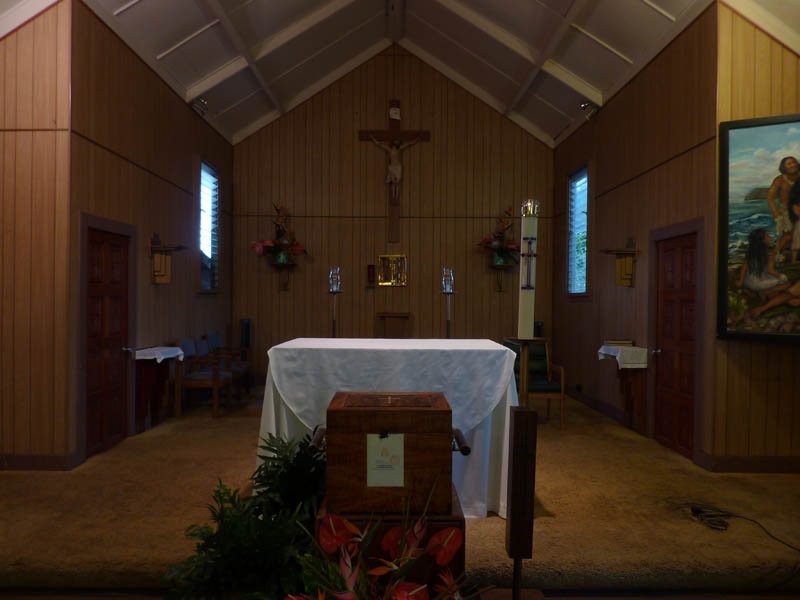
Encased within a glass box, within a wooden box, and within a koa box, nestled one of Saint Damien’s heel bones. For the past three weeks, the relic has toured across many of the islands, stopping for mass and prayer at dozens of churches. Finally, last weekend, the relic visited topside Molokai and Kalaupapa – the place closest to Saint Damien’s own heart. Here on Molokai, the people were “enthralled,” in the words of Rev. Christopher Keahi, the provincial superior of the Sacred Hearts congregation in Hawaii.
“[The reaction] gave all the bishops [a sense] how alive faith is here, that all people have Saint Damien in their hearts,” he said.
This is an ongoing blog about Father Damien by Molokai Dispatch reporter Megan Stephenson.
Saint Damien’s relic venerated across Molokai
After weeks of waiting, Molokai residents finally were able to celebrate the momentary return of Saint Damien de Veuster, last Friday evening. Over one hundred worshipers of all faiths on Molokai gathered with 13 bishops and religious delegates from Hawaii, California and Belgium for a special inter-faith Mass at Kaunakakai Ball Field.

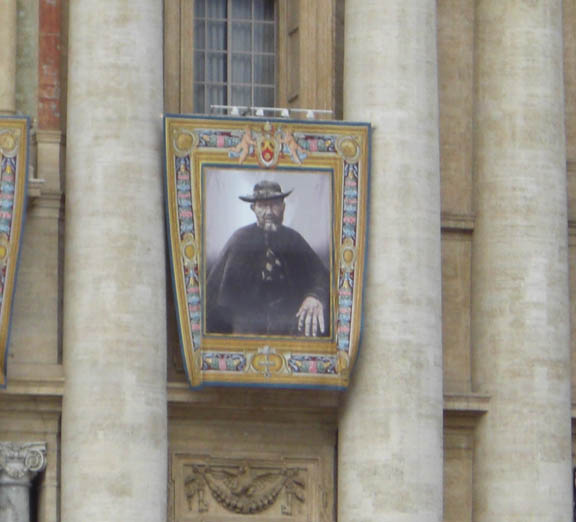
Thousands watch live as Damien is canonized in Rome.
It began with song. The prayers and chanting of exhilarated voices filled the packed St. Peter’s Basilica in Rome. Thousands of pilgrims sat or stood, inside and outside the Basilica to watch, straining their ears to hear the words that many had waited years to hear. Bishops in their pink robes and cardinals in red hats swayed down the aisle, followed by the Holy Father, Pope Benedict XVI, during the opening service. While five would be canonized there that day, the focus for many was on Father Damien. 
He and Father Felix Vandebroek of St. Francis in Kalaupapa are members of the same order as Father Damien. Guerreiro said he identified with Damien’s solidarity. Before arriving in Hawaii, Damien thought of the native Hawaiians like others of his position as savages and pagans.
But he soon changed his tune, Guerreiro said. “He became absolutely one with them.”
Damien’s journey was certainly unforeseen by many of the people in his life – a peasant farm boy who entered his congregation at a remarkably young age, barely knowing French and no Latin at all. Damien’s enthusiasm, resolve, and unlimited devoutness endeared him to his people, the forgotten of Molokai, and has now captivated the modern world. His commitment and sacrifice has earned him the highest honor attainable for a Catholic priest, and one of the highest distinctions in the world.
This is an ongoing blog about Father Damien by Molokai Dispatch reporter Megan Stephenson.
There are three types of relics, classified by the physical connection to the saint. A first-class relic is an item directly associated with Jesus Christ – such as a part of the cross he was crucified on – or the saint’s physical body – such as a bone. These are the most prized of relics, as they are assumed to be incorruptible (they not deteriorate). A second-class relic is usually a piece of clothing or an item frequently used, such as a book or rosary. A third-class relic is usually more connected to the first- or second-class relics, such as small piece of cloth. The sale of relics are strictly forbidden, according to Canon Law.
Both of Saint Damien’s relics are first-class: his right hand and his left foot, both of which showed the physical signs of leprosy. This symbolism serves as an additional reminder of his sacrifice.
However, not all relics are Christ-related. There are many other religions who find solace in remembering their prophets or religious leaders. For example, the relics of Buddha are worshiped, and have been confirmed as Buddha’s by archaeological study.
The relic is currently in Maui. It will travel to Lanai and Kauai before returning to Molokai this Friday. The relic will permanently reside in the Cathedral of Our Lady of Peace in Honolulu, where Saint Damien was ordained a priest nearly 150 years ago.


 Add your comment