Hawaiian Culture

Hawaiian culture stories from Molokai

Pulling for Makahiki

Thursday, February 2nd, 2012

Pulling for Makahiki

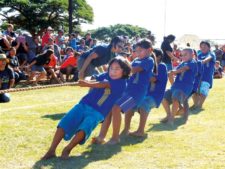
Hundreds of competitors of all ages gathered last Saturday to test their athletic skill and celebrate the 30th annual Ka Molokai Makahiki – an ancient tradition honoring Lono, the god of peace and fertility. During this four month season – usually from October through February – war was forbidden, or kapu, on all islands. Offerings from the harvest were made to Lono, and everyone joined in athletic games.

Yacht to Continue Molokai Visits, For Now

Monday, January 9th, 2012

American Safari Cruises (ASC) is resuming scheduled two-day stops to Molokai later this month after company officials, local protesters and state and federal authorities reached an agreement. The 36-passenger yacht temporarily ceased docking on Molokai in early December after residents raised concerns about local protocol not being followed in allowing the boat to add Molokai to its Hawaii itinerary."We are grateful to the wonderful people of Molokai for their true aloha spirit. We hold tremendous respect for their unwavering desire to preserve their traditional lifestyle for future generations," said Dan Blanchard, ASC CEO.

Yacht Docking Canceled Last Weekend

Wednesday, December 7th, 2011

The Safari Explorer passenger yacht did not dock last weekend as scheduled after more than 300 community members attended a public meeting last Wednesday night. Residents spoke both for and against the yacht’s Molokai stop, but enough voiced concerns, according to American Safari Cruises (ASC) owner Dan Blanchard, that he postponed the docking until the company could talk to more community members.

“We are committed to further dialogue and will respectfully work with leaders in the community,” Blanchard said in a statement Thursday.

Paniolo Pride

Wednesday, November 30th, 2011

Paniolo Pride

Whenever keiki in the Molokai Junior Roping Club (MJRC) saw Papa Cliff Dudoit raise his pointer finger, silently holding it in the air a few inches from his face, they didn’t need words to know what he meant.

Dudoit, one of the founders of the rodeo club, strived to teach Molokai’s youth not only the foundations of being a good cowboy or cowgirl, but of being a good person. And, as he explained, “number one was your attitude.” Raising that finger was a simple reminder to keep your attitude in check.

“In life, in roping and in everything else, leave your bad attitude at home,” he said. “If you have a bad attitude, you’re gonna have a bad day.”

Raina Dudoit, Cliff’s wife, said the club helped keep alive the paniolo heritage of their fathers and grandfathers while keeping keiki off the streets. Many have attended national championships and earned college scholarships through the club.

“The kids always had a place to come to,” she said. “It was an alternative to drugs and substance abuse.”

More than 60 youth participated last Friday before refereeing, emceeing and managing the adult competition Saturday – another important aspect of the roping club.

“The kids are running the show,” Cliff Dudoit said. “When they grow up in the sport, they gonna know what they talking about.”

He thanked the Molokai community and the MJRC for their continued support over the years and said he looks forward to extending the club’s legacy.

“We gonna continue to help. We not giving up,” he said. “We cowboys, man. We cowboy up.”

Old News, New Meaning

Wednesday, November 23rd, 2011

From 1834 to 1948, over 125,000 pages of Hawaiian language newspaper were printed. However, those pages are crumbling, and the knowledge they contain would otherwise be lost if not for the efforts of Awaiaulu, an organization dedicated to publishing Hawaiian texts whose staff has been working for the past 10 years to preserve and digitize the newspaper pages.

Now, an Awaiaulu initiative called `Ike Ku`oko`a – or Liberating Knowledge – is gathering volunteers statewide to type word for word thousands of Hawaiian articles into a searchable format.

Molokai Boy Joins DHHL Leadership

Wednesday, November 9th, 2011

Growing up on Ho`olehua homestead land, Halealoha Ayau said he was “raised by a father who was a Jack of all trades.”

“He had many skills, so I knew what multitasking meant before that was even made fashionable,” Ayau joked last week.

Scouting Halawa

Wednesday, November 2nd, 2011

The Webelos from Pack 311 of Kailua, Oahu visited Halawa Valley Sept. 30 to Oct. 3. Webelos are Cub Scouts in their fourth year, an average of 9 years old. Throughout our four days of camping, 12 families were continually impressed by the beautiful valley, people, nature, history and activities.  We would like to share what "Pops" Anakala Pilipo and Diane Solatorio, shared with us.

Residents Protest Passenger Yacht

Monday, October 31st, 2011

As American Safari Cruises’ (ASC) yacht docked on its first trip to Molokai last Sunday morning, protesters greeted it with requests to leave local waters.

Over two dozen kupuna, teachers, fishermen, cultural practitioners and others chanted “No cruise ship” and “Go home!” toward the 145-foot boat, named the Safari Explorer.

As two vans carrying the boat’s passengers departed the docking area, protesters marched across the road holding signs reading “boycott this ship,” “you’re not welcomed” and “Hawaiian way or no way.”

Kenpo – A Frame of Mind

Wednesday, October 26th, 2011

Kenpo – A Frame of Mind

Community Contributed by By Kalei “Pumpkin” Moss

The sound of kiais, a vocal release of one's own inner "chi" or "spirit" (one's source of energy), echo throughout the halls of Kilohana Elementary School.  Known regularly as the cafeteria to the students and faculty, from 4 to 6 p.m. on Monday, Tuesday and Thursday this cafeteria is transformed into a dojo.  The students begin Kenpo class by bowing in respect to their sifu (instructor), Randy Foley, and take a knee to clear their minds and mentally prepare for the upcoming class.  The class begins with a flurry of punches, kicks, and open hand moves as the class warms up to practice their kata or forms.

Kenpo in Hawaii was developed in the 1940s and incorporates different martial art styles such as Karate, Judo, Jujitsu, Kenpo and Kung Fu.  Kenpo, which means “law of the fist,” does not focus on one-on-one confrontations, but was developed to defend oneself from multiple attackers.  Students are not taught with the intent to hurt others but to develop a frame of mind to resolve situations without using violence.  Kenpo helps its students develop self-confidence and trains them to keep their composure and overcome their fears.  Sifu Randy Foley not only teaches the students martial art skills but also teaches Kenpo’s four rules to live by: humility, self-control, integrity and courtesy.

The Kenpo class held at Kilohana is funded by the 21st Century Grant program and is open to students of any age as well as adults.  Students are taught structure, balance and focus and many of the students say it is just plain fun.  One adult Kenpo student, Jay Duquette, explained that he started taking the class when his eight- year-old son, Malu, took an interest in it.  Jay further explained that it gives him and his son a chance to bond and a common interest they can talk about at home.  The class is comprised of a range of students from first timers to a student that has been taking Kenpo for nine years.  Kenpo will challenge you both physically and mentally, and it is a great workout.  If you or your children are interested in participating in Kenpo at Kilohana School on Monday, Tuesday and Thursday from 4 to 6 p.m., please call Mapuana Dudoit at 558-2200 or Sandra Czajkowski at 658-0609.  Look for upcoming articles highlighting more of the exciting classes the 21st Century Grant program has to offer.

Lono’s Latest Inspirational Listening

Wednesday, October 19th, 2011

Lono’s Latest Inspirational Listening

Late afternoon light streams through the trees bathing Kalanianaole Hall with a soft glow. Standing near the stairway, the musician known as Lono stares skyward with slightly clasped hands held near his chest. From within his palms, a similar but intense light emanates and glows, as if mirroring that of the setting sun.

This is the album cover of Lono’s latest, “E Aloha E” – the sixth album in a series of Hawaiian music releases known as Old Style Hawaiian. True to the principals of the genre yet infused with Lono’s originality, “E Aloha E” is a no-brainer for fans of Hawaiian music.

For Lono followers, and those enraptured by Molokai, this album is essential – the continuation of an important journey in uncovering the spirit of Molokai and aloha. Most importantly, it is a living conduit to the ancestors of contemporary and historical Hawaiian culture, and the aumakua protectors of Molokai.

As is customary of Lono’s work, the album opens with the pahu drum beating like the slow rhythm of a heart. “Todd’s Work,” inspired by this writer, reflects Lono’s ability to traverse to the other side and translate it for the rest of us.

“Moku Kia Kahi,” or the “one-masted schooner,” has been performed by Hawaii greats including Gabby Pahinui, George Helm and Brothers Cazimero, among others. Here, Lono honors The Sunday Manoa; and anyone familiar with the group will recognize their influence on Lono’s work.

The theme of light shines in tracks “Ia 'Oe E Ka La,” a song honoring King David Kalakaua, and “Po Anuenue Keia,” meaning “the night rainbow” and composed for dancing hula.

Lono also pays respect throughout the album to prominent Molokai figures and people who have inspired and touched his work. “Ku`u Papale,” or “my beloved lauhala hat,” tributes Aina Keawe and was inspired by her sister, Molokai’s late aunty Ku`ulei Perez. “Please oh please, bring Ho`ailona home,” tells of Molokai’s most beloved monk seal, KP2, and was inspired by Loretta Ritte. Track nine, “Ua Nani Molokai,” reflects Lono’s reverence for Molokai and the beloved kupuna who have influenced the artist’s musical career.

Lono is known for his powerful message-filled music and continues to deliver with both classic folktales and important issues. “Kalaipahoa” reminds us to makaala the greed for Molokai’s aina while the fifth track tells of Bokikumanumanu, dog god and protector of Makanalua. Visible from the air and the Kalaupapa lighthouse, the Bokikumanumanu heiau (stone temple) is the only one of its kind in the world.  The song was inspired by kumu hula John Kaimiakaua.

The musicality is far from overpowered by his crooning vocals and strong stories. Pensive chanting, bird calls, flutes and ukulele plucking bring the olelo to life in tracks “Manu Mana`o” and “Hawai`i Pono `I,” (my only lament is that the former is not at lease a minute longer). Lono also enhances the album with two slack key tracks, “Hanaikapono” and “Nanaikapono.”

“Owl’s Lullabye” is inspired by storyteller Kindy Sproat originally by Stan Jones. It is the perfect closer of the album and one of my favorites from Lono.

While the light on the cover of his album might seem to come directly from Lono’s hands, he is in fact exposing and releasing a light that has always existed. In this, his sixth album of the Old Style series, Lono truly succeeds in bringing life to the ancestors of Hawaiian music and culture. Maika`i no – good job indeed!