Community

General news which affects the Molokai community in one way or another.

Samuel Kama Kamai

Wednesday, August 24th, 2011

Samuel Kama Kamai of Ho`olehua, Molokai died on Aug. 13 at the Queens Medical Center in Honolulu at the age of 86. He was born in Honolulu on Dec. 23, 1924. He is survived by wife Lillian M. Kamai of Ho`olehua; sons Victor Ronald (Wena) Kamai of Kahului, Maui, and Daniel Anthony (Rally) of Anaheim, Calif.; daughters Carolyn (Rodney) Vair of Las Vegas, NV, Lorna (Longie) Dudoit of Hoolehua, Molokai, Claudia (Andrew Germinaro) Kamai of Ho`olehua, Lydia (Cheyenne) Joao of Kaunakakai, and Kathleen (Joey) Joao of Kaunakakai; and 20 grandchildren and 20 great grandchildren.

Friends may call on Saturday, Aug. 27 from 9 a.m. with service at 10 a.m. at the Lanikeha Community Center in Ho`olehua, Molokai. Burial to follow at the Kanakaloloa Cemetery in Ho`olehua, Molokai.


Micheline “Mitchy” Uilani Wilson

Wednesday, August 24th, 2011

Micheline “Mitchy” Uilani Wilson in Honolulu on May 14, 1948 passed peacefully on Aug. 1. She is survived by her daughter Renee Albino and four grandchildren, Lyndsie, Channing, Reeve and Naavah Albino of Molokai. Mitchy was the middle of five children born to Eloise and Walter Yong. She was raised in Waikiki, where she and her siblings grew up surfing. Family members include brother Walter Yong Jr., sisters Sharee Davis and Renee Yong-Kagimoto, nieces Sienne Kagimoto, Jerry Boy and Rebecca Seguritan, grandniece Arianny Yi and beloved Aunty Alice Puu.

A Blessed Life

Wednesday, August 24th, 2011

Community Contributed

By Valerie Monson

Lucy Keonaona Maunu Kaona, whose Hawaiian values of love and `ohana enabled her to overcome the separation from her family to live a “blessed” life at Kalaupapa, died July 21 at the Kalaupapa Care Home. She was 82 years old.

“I don’t think I’m blessed, I know I’m blessed,” said Lucy while on a picnic with friends at Kalaupapa many years ago.

Those blessings were not always easy to find. Because of policies regarding leprosy that weren’t completely abolished until 1969, Lucy endured the painful separation from her family not once, but three times.

Speak and Interpret Local Lingo

Wednesday, August 24th, 2011

“Ass why hard” means a difficult situation.  “Ahh I’m takin some gas” is a scolding, you are overloaded or bad luck.  Call it pidgin or chop suey language--that’s how many Hawaii residents communicate.  It’s a multi-cultural blend of ethnicities (Hawaiian, Chinese, Japanese, etc.), status and environment.  Louisianans speak “creole” while many inner-city people talk in “rap.”  On Molokai it’s the colorful language of pidgin.

Molokai Challenge a Success

Wednesday, August 24th, 2011

Mahalo to all those that participated in our event this year with The Molokai Challenge and Na Opio Hana Pa`a. A super special mahalo must go to the kupuna who came down to Malama Park to liven the place up. Mahalo Aunty Julia Hoe and Aunty Kawila Reyes for spearheading this. Mahalo to Linda Johnston for designing the posters and to Maui Printing Company with their fabulous printing. Mahalo to Young Brothers who will commit to 2012, Naish International and the Maui crew for supplying the boards. Mahalo Nion Sheppard with his kokua in the filming and a big mahalo to Mike Holmes for escorting the kids. Although this was just a small event this year, it would not have been made possible without the volunteers and to those that believe in the future possibilities of an event like this.

The Sound of Safety

Wednesday, August 24th, 2011

The Sound of Safety

Tsunamis. Earthquakes. Hurricanes. Acts of war.

Hawaii’s Department of Defense (DOD) uses civil defense sirens to alert residents when emergencies strike, and it’s time to make sure they’re fully functional and standardized, according to officials.

With some of Molokai’s 11 sirens built as early as the 1960s, the DOD wants to upgrade six of them – and add six more – as part of a statewide project approved by the state legislature earlier this year. On Molokai, that means making all sirens omni-directional – a circular design that provides premiere sound coverage – and making sure they’re solar-powered with back-up battery systems. The process will also standardize the wireless control system the DOD uses to activate the sirens, according to Hawaii Self Civil Defense spokeswoman Shelly Ichishita.

Travis Tancayo, fire captain with Kaunakakai’s Engine 4, said sirens are an essential part of safety when disasters strike.

“A lot of times people don’t have radios or televisions, so as a last resort we depend on those sirens,” he said.

The process took a step forward this month when the Molokai Planning Commission (MoPC) unanimously approved special management area (SMA) exemptions for sirens to be replaced on specially regulated coastal land at Kamiloloa (near Hotel Molokai) and One Ali`i Park. A third siren, to be built at Duke Maliu Park, would replace a current siren at Kaunakakai Elementary School.

The DOD also hopes to upgrade sirens at Kalamaula Park, Kilohana Elementary School, Kamalo and Maunaloa, according to information provided by Department of Accounting and General Services Planner Brian Isa, who is overseeing the permitting process on behalf of the DOD.

The DOD has also secured funding to build new omni-directional, solar-powered sirens at Papohaku Beach Park and Kaunakakai’s Pu`u Hauole Park, he said, and are awaiting funding to build new sirens Molokai High School, Kualapu`u Park and the Kalae Picnic Area.

Permitting is nearly complete for all sites except the Kalae Picnic Area and Kalamaula Park, which are awaiting funding and Department of Hawaiian Homelands approval, according to Ichishita.

If the process goes as planned, she expects construction to begin after a building contract is awarded around November. The construction should take between 90 to 120 days, she said.

Each siren costs about $85,000, including equipment and installation, according to DOD Assistant Communications Officer Fay Alailima-Rose. Like existing sirens, new sirens would be mounted on brown polls about 50 feet tall.

Alailima-Rose, who attended the Aug. 3 MoPC meeting, explained old sirens would be removed once new ones are functional, and confirmed an archaeological monitor would be constantly on site during all construction.

Although Molokai’s height limit for SMA structures is 35 feet, she said DAGS would apply for a height waiver if necessary because 50-foot sirens provide about 1.3 square miles of coverage, while a shorter siren would provide less.

“I totally support any safety for this community, so I totally support this project,” commissioner Lori Buchanan said July 27.


Plans for Monk Seal Recovery

Wednesday, August 24th, 2011

NOAA Fisheries Service News Release

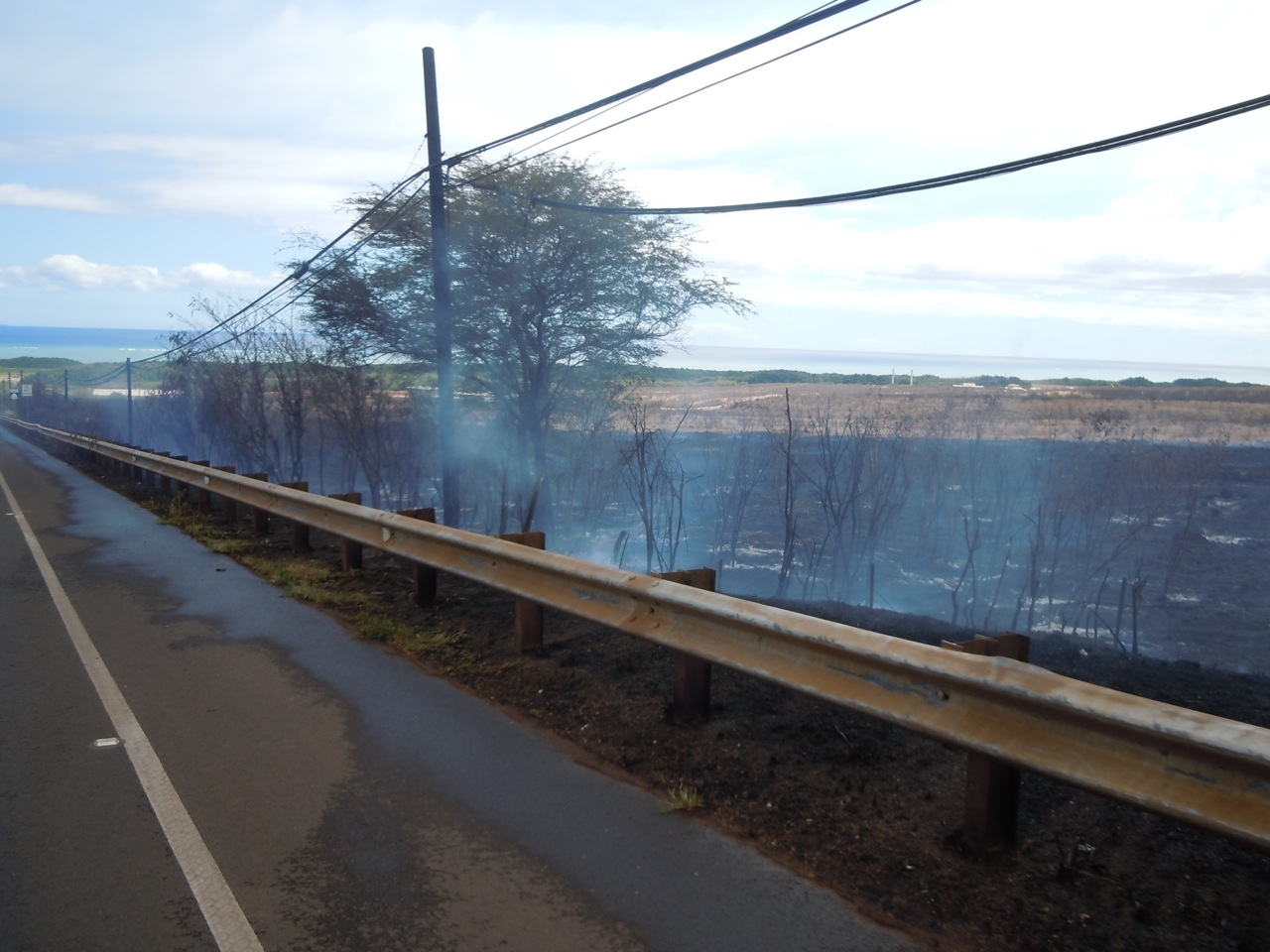
Two Brush Fires Blazed on Molokai

Tuesday, August 23rd, 2011

Two Brush Fires Blazed on Molokai

Two brush fires broke out on Molokai today, both about three miles west of Kaunakakai. One burned about 20 acres along Maunaloa Highway, while the smaller blaze burned about 5,000 square feet in the same area, according to Molokai Fire Captain and incident commander Travis Tancayo. Both were reported just after 1 p.m., and were contained by 3:30 p.m.

Connecting the Names

Monday, August 22nd, 2011

Connecting the Names

Last Wednesday evening found a group of Molokai residents poring through lists of names. They were looking for anything familiar, searching for clues that would connect them to the thousands exiled to Kalaupapa.

“We’re talking about names, but behind every name is a person and a family,” said Anwei Law, a historian who has been visiting Kalaupapa for about 40 years.

Many came to the workshop led by Ka `Ohana O Kalaupapa with one name they already knew – and left with dozens of possible relatives. The Kalaupapa Names Project is a statewide initiative to gather information about the estimated 8,000 individuals who were sent to the peninsula beginning in 1866. Fewer than 1,000 of those people have marked tombstones. The `Ohana – a nonprofit organization dedicated to preserving the memory of Hansen’s disease patients (also known as leprosy) – has found over 7,000 names, according to Law. The names will become part of the Kalaupapa Memorial, a project currently being planned to honor those who lived and died on the peninsula.

Over 700 remain unknown – and it’s now up to their families around the state to help identify them.

“It seems like everyone has a family connection and that’s what we’re looking for,” said `Ohana secretary Valerie Monson.

,” said Law.

Letters from patients give insight into the isolated lives they led. A letter from J.N. Loe, one of first 12 people sent to Kalaupapa, “didn’t ask for clothing, didn’t ask for food – it asked for a newspaper,” Law explained.

Photos offer another key to both history and identification.

“We always show photos and hope that someone will recognize them,” said Law. The `Ohana has asked families – and residents who may not know they have family history in Kalaupapa – from across the state to review names, correct spelling and add information to help complete the puzzle.

Sol Kaho`ohalahala, an `Ohana board member and Lanai resident, recalled the first time he found out he had family in Kalaupapa.

In 1996, he was invited to attend a conservation workshop on the peninsula, and by chance met a kupuna who turned out to be his uncle’s wife – “an uncle no one ever talked about,” he said. On a tour of the peninsula, Kaho`ohalahala then discovered a tombstone next to Siloama Church marked “Lillian Kaho`ohalahala.”

“My heart was heavy… I cried the whole weekend,” he recalled. “Our ohana are all part of that aina – their bones are there, their spirit is there… and we have a responsibility…. All who lived and died there should never be forgotten,” he told Molokai residents last week.

Set in Stone

The Kalaupapa Memorial, a vision begun by patients decades ago, was authorized by President Obama in 2009. Since then, patients have chosen its site – where the old Balwin Home used to stand in Kalawao – and an environmental assessment is currently in process. The group is waiting for the final go-ahead from the National Park Service (NPS), according to Kaho`ohalahala. They expect a “no impact” ruling.

The `Ohana are also in negotiations with the NPS to sign a general agreement for the memorial. The agreement spells out, among other issues, who will be responsible for the building, maintenance, funding, design and rights to the historical documents and archives that have contributed to the memorial. The `Ohana must raise all the financial support to build and maintain the monument – no federal funding has been provided. The `Ohana is also negotiating to maintain “intellectual rights” of the research documents, according to Kaho`ohalahala.

Next year, the `Ohana will “put out a call” for the memorial’s design, he added. Families, and even students, will have the chance to participate in the conceptual design of the monument. Criteria will include holding the 8,000 names and creating a design that will “fit” in the selected location.

Braced for the Bull’s Eye

Monday, August 22nd, 2011

Braced for the Bull’s Eye

It’s a Saturday morning in Kalae, and the woods are quiet – until, suddenly, they’re pierced by the sound of a whistle. Moments later, dozens of “pop pop pops” seem to come from across the two-and-a-half-acre course all at once, as colorful arrows catapult through the air and lodge themselves in cardboard bales. The Molokai Bowhunters Association (MBA) is kicking off its marked animal target competition, an annual event sanctioned by the National Field Archery Association (NFAA).

As the tournament progresses, other sounds filter through the tall trees: laughter among friends as they move along the

guys to come out.”

Damien Pires, who has participated for about 10 years, said part of the fun is getting to hang out with old friends.

“I like getting back together with my friends from Maui, picking them up from the ferry,” he said. “We’re just having fun.”

First-place youth finishers included Kaheki Cuello (pee-wee, 560 points), Kainoa Aragosi (youth, 471), Gyson Aalone (young adult bowhunter freestyle, 497) and Kelson Uradomo (young adult freestyler, 576). In the adult divisions, first place was awarded to Tachibana (bowhunter freestyle, 571), Michael Kinores (freestyler, 576), Barry Agtarap (freestyle limited, 505), Marshall Rocine (traditional, 320), Sonny Aragosi (bowhunter freestyle limited, 475), and Frank Pupuhi (bowhunter freestyle guest class, 566). In addition to NFAA patches, all first-place finishers received trophies.

Lee thanked the tournament’s sponsors, which include MR Variety, Maka’s Corner, 808 Electric, Take’s Variety Store, Island Archery, and the Lee, Rapanot, Tancayo and Tachibana `ohanas, as well as Molokai’s bowhunters and everybody who participated.