



Bissen Targets Storm Relief, Readiness at Meeting
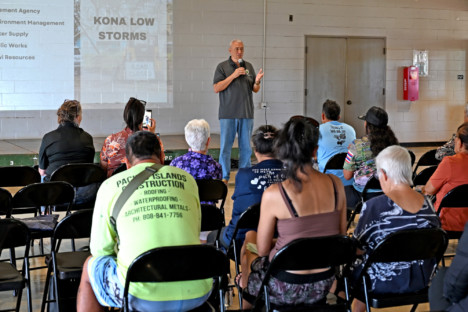
Mayor Richard Bissen Jr. brought a large delegation to Molokai last week to discuss disaster-related topics with the community. Photo by Léo Azambuja
By Léo Azambuja
Many Molokai residents are still dealing with the impacts of March’s Kona Low storms. Mayor Richard Bissen Jr. and several county officials visited the island to address disaster preparedness, response, relief and recovery in a community meeting held at Mitchel Pauole Center last week.
“We’re here to listen. We’re going to learn. Those are the two main reasons we’ve come here today,” Bissen told about 40 people attending the April 19 meeting. “We’re also going to provide you with information that we think you need and that you want.”
Some of the key points discussed included the importance of signing up for emergency alerts, the need for better communication and community cooperation during emergencies, planning for future evacuations, flooding, debris management, and maintenance of culverts and streams.
The meeting also highlighted the availability of disaster relief and resource programs.
Maui Emergency Management Agency Deputy Administrator Kono Davis described the many ways to notify residents of impending storms, such as sirens, a radio that can broadcast information, a system that pushes notifications over cell phone, a Genesys Protect app, MEMA alerts and press releases sent by the county through email and TV.
Director of Public Affairs Mahina Martin also emphasized the importance of communication between neighbors, which she said is the fastest way to spread information.
Davis said he understands Molokai “is feeling a little left out,” but the county administration is trying to make a closer connection with residents, and asked their help to achieve that.
Many in the audience were frustrated with the lack of maintenance of gulches, dry riverbeds and culverts. Most of all, there was widespread confusion on who bears responsibility for maintaining many of those features that have added to flooding during the Kona Low storms last month.
When a resident asked who was responsible for maintaining a 1950-built culvert at Seaside Place that floods whenever it rains, Deputy Director of Public Works Paul Berany said it was the county’s responsibility, and they are “out there quite often.”
Berany acknowledged that culvert was “undersized,” but added most of the coastal areas are in a flood zone, so residents should expect flooding. “That is just topography and geography, right?” he said.
“But yeah, we definitely can take a look at Seaside Place. We know that one quite well is a problem area,” Berany said.
Regarding concerns on whether the water was drinkable after the storm, Department of Water Supply Deputy Director James Landgraf said the water was tested and there is no contaminant in any of the systems. If there is a problem, he said, the county notifies residents through a press release.
East End resident Gandharva Mahina Hou Ross blamed part of the erosion that causes runoff toward the ocean during heavy rains to an east-to-west fence installed in the uplands to protect the watershed from axis deer.
The project led by The Nature Conservancy in partnership with other groups and a small support from the county has caused deer to migrate from west to east, resulting in widespread vegetation loss in the middle lands, “denuded by the deer,” he said.
“We all proposed some north-south fencing to follow ahupua’a-based management like our kupuna did. They said, ‘We only have money for east-west fence,’” Ross said.
Heavy storms cause sediments to wash on to the reef, negatively impacting fisheries.
“How do we listen more to the people and to the land and to the traditional research management practices of our island, instead of forcing things down our throat that doesn’t match our community?” Ross asked.
Residents were also concerned with evacuation centers. The National Guard Armory, which is on a hill leading to Molokai General Hospital, has been closed for a while. Mitchell Pauole Center, an evacuation site, is right next to the police station, and both are in a flood zone.
“If this is the evacuation point, we’re in big trouble,” a resident said. “We need to get everybody, the mayor, all the different entities, together, and let’s start planning for the future, because it’s going to be too late if we don’t come together as a community now, and not this nitpicking and grumbling.”
The county administration brought about 20 staff. Besides Davis, Berany, Landgraf and Martin, the delegation including other department leaders such as Office of Recovery Administrator John Smith, Department of Environmental Management Deputy Director Michael Peterson and Department of ʻŌiwi Resources Director Kaponoʻai Molitau.
The administration’s staff set up tables to help residents navigate through available resources from different agencies. They also announced Maui Economic Opportunity had $200 gasoline cards donated by Hawaii Community Foundation, which contributed with $10,000, and Aloha Petroleum, which contributed with $2,000.
Visit www.mauirecovers.org, the county’s official website for the latest information on disaster-recovery resources available for those impacted by the Kona Low storms.

 Add your comment


Don't have a Molokai Dispatch ID?
Sign up is easy. Sign up now
You must login to post a comment.
Lost Password