



Bill Proposing to Shift Kalawao to Maui County
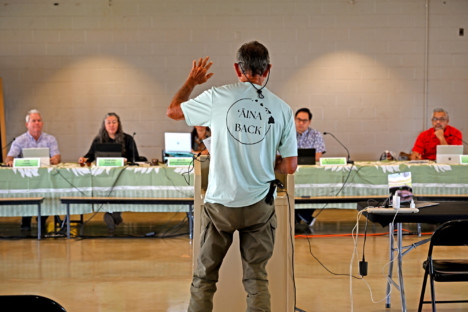
Hawaiian activist and cultural practitioner Walter Ritte told the County Council’s Aloha ‘Āina Committee he wants Kalawao to be part of a proposed Molokai County rather than being added to Maui County. Photo by Léo Azambuja
By Léo Azambuja
Members of the Maui County Council’s Aloha ‘Āina Committee visited Molokai last week to hear from local stakeholders their input on a proposal to transition Kalawao County, which encompasses the Kaulapapa Peninsula, to Maui County’s jurisdiction.
“The goal of today’s meeting is to bring everyone together to make clear the intention and expectations of the Kalawao County transition to Maui County,” committee chair Keani Rawlins-Fernandez said at the opening of a public meeting at Mitchell Pauole Center Jan. 29.
Currently, a pair of bills, SB 1432 and HB 1113, are making headway in the state Legislature. If one of them is approved, it will set forth the transition. Those bills were introduced in 2025, but were carried over to this year’s session to allow time to better understand the responsibilities and potential costs of the transition, according to Rawlins-Fernandez.
A good chunk of the public testimony called for transparency in the process and for Kalaupapa to be rather added to a proposed Molokai County, a long-term plan supported by some residents. Additionally, a few Hawaiian homestead beneficiaries questioned the future of roughly one-third of the peninsula that falls under the jurisdiction of the Department of Hawaiian Home Lands — exactly the area where most of the development is located.
“The State Department of Hawaiian Home Lands takes our kuleana for the trust lands in Kalaupapa very seriously. DHHL staff and administrators have been participating in multi-agency transition planning meetings since 2015,” DHHL planner Nancy McPherson testified at the meeting.
Based on discussions with the National Park Service, state Department of Land and Natural Resources, Hawaii Department of Health and the Mayor’s Office regarding the period after the DOH phases operations in Kalaupapa, McPherson said “DHHL anticipates that very little, if anything,” would change for the County from current responsibilities.
“NPS would continue to operate, maintain and upgrade the electrical, water, wastewater, telecommunications and transportation systems and facilities in the peninsula, and would assume all operations and maintenance responsibilities for structures and infrastructure upon the departure of the Department of Health,” she said.
McPherson, however, did not agree that under the proposed legislation, the county would extend its authority to Kalawao County for activity within the Special Management Area. The Hawaiian Homes Commission Act of 1920, she said, gives the Hawaiian Homes Commission exclusive control over land use and zoning on Hawaiian Home Lands.
NPS Superintendent Nancy Holman responded in a written communication to the committee that the lease between NPS and DHHL only applies to DHHL-owned lands. The remaining lands, roughly two-thirds of Kalaupapa, are state-owned lands with infrastructure that belong to DLNR and the state Department of Transportation. Additionally, there are facilities that belong to three religious organizations and a chunk of private land owned by R.W. Meyer, Ltd.
Hawaiian activist and cultural practitioner Walter Ritte said he doesn’t have “fond memories” of the park. He raised doubts on the plans of the current federal administration regarding national parks, and questioned how the park would be beneficial to Molokai residents.
“But I’m really supportive of the idea that this is Hawaiian Home Lands, and in the future, we need to be our own county, and homesteaders need to be down at Kalaupapa,” Ritte said.
Other testifiers also brought up their choice of Molokai becoming a county and bringing Kalawao County into its jurisdiction.
There was also the matter of access. Holman said NPS currently enforces entry without a permit, which is illegal, on behalf of the state, but the “big elephant in the room” is how access will be discussed in all its iterations — visitor, guests, residents, associations and individuals with customary Hawaiian practices.
“When I look at the General Management Plan, the Parks Service, that is what’s missing, quite frankly, and I feel like that’s the big conversation moving forward that I would like to start having,” Holman said.
Rawlins-Fernandez said she understands the intention of the Legislature is to pass SB 1432 during this session, but county costs and responsibilities need to be clear before the bill is approved.
“For everyone that testified today, we are not the decision makers on this. The Legislature is,” Rawlins-Fernandez said. “If you don’t want (Kalawao) to go under Maui County, then that is who you need to go and testify to, because they are the decision makers on this.”
As the county managing director explained, Rawlins-Fernandez said, Mayor Richard Bissen is open to taking on this kuleana. She added she understands the Council is also open to take on this kuleana.
“We just need the details of how that will look and what it would cost the county,” Rawlins-Fernandez said.

 Add your comment


Don't have a Molokai Dispatch ID?
Sign up is easy. Sign up now
You must login to post a comment.
Lost Password