



Berkeley Law Students, Faculty Learn from Molokai’s Energy Co-Op
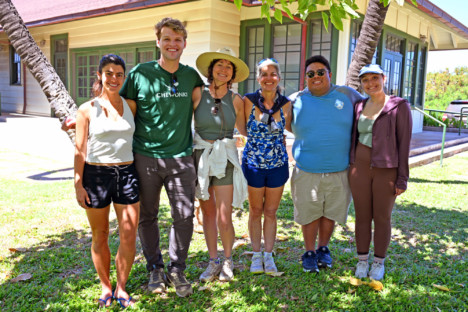
UC Berkeley Environmental Law Clinic students and faculty, left to right, students Dena Kleemeier and Mac Dickerson, supervising attorney Emily Griffith, law professor Claudia Polsky, and students Connor Tamor and Lucy Peterkin. Photo by Léo Azambuja
By Léo Azambuja
A small group of students and professors from the University of California, Berkeley visited Molokai last week to find out more about the island’s solar energy projects led by community initiatives, and potentially apply what they learned to different communities on the mainland.
“Our clinic does work for a number of different nonprofit groups and sometimes public agencies that are trying to advance solar and wind power and other noncarbon energy forms,” said Claudia Polsky, a law professor and director of the Environmental Law Clinic at UC Berkeley.
An ongoing series of projects at the Environmental Law Clinic, she said, relates to trying to get residential solar systems installed in a quicker, cheaper and more reliable manner to give homeowners and renters energy independence.
“Molokai was a very logical place to come to look at the work of the energy co-op here,” Polsky said of the Hoʻāhu Energy Cooperative Molokai, whose mission is to produce community-owned, affordable, renewable energy for the benefit of their members, community and the environment.
The co-op’s vision calls for “resilient, sustainable, equitable, culturally conscious energy for all.”
“As part of this project we’re working on, we’re looking at solar energy affordability, and because Hawaii has a lot of sun and is a great candidate for solar energy, we were specifically looking at the island of Kauai,” said Dena Kleemeier, who is pursuing a master’s degree in public policy.
However, as they were searching online for permitting, regulations and projects on different islands, they stumbled across Hoʻāhu and started reading more about them, Kleemeier said. The way Hoʻāhu framed what solar energy has been able to do for Molokai, and how it could support a community that has very high energy costs and wants to be off the grid, is a “really interesting” case study, she said.
“So, we wanted to talk to them in person and just learn more about the community specifically,” Kleemeier said, adding maybe they can help translate what is working so well on Molokai to other communities on the mainland with similar energy problems.
Law student Lucy Peterkin said it was exciting to hear about off-the-grid local families that were able to transition from predominantly using generators to using a solar system. She said Hoʻāhu Workforce Developer Liliana Napoleon and Board President Lori Buchanan shared with them how this transition brought “peace and quiet” to families.
“We’re also really excited about the idea of community solar, the bigger projects that they’re working on,” Peterkin said. “They shared with us they would be the first ones to have this sort of community solar. So, it would be a really big deal and a lot of people could learn from all of their efforts.”
Some of the challenges the students heard, according to law student Connor Tamor, include time-consuming communication with utility companies, county and state departments, and those in charge of permitting.
“Because things take time, things take a lot of money,” Tamor said.
But the conversations with Hoʻāhu helped them understand the importance of building a relationship with government officials to make interactions less adversarial, he said. This approach has helped the community to get projects off the ground and move them at a faster pace, Tamor said.
Law student Mac Dickerson said one of the things that stood out to him about Molokai was the community’s willingness to work together despite differences. That got him thinking on how to apply that to interactions with organizations and government officials to try to get everyone on the same page.
Dickerson also saw the positive impacts smaller off-the-grid systems can have in people’s daily lives. The same holds true, he said, for rural communities on the mainland where energy costs are high and often overlooked by environmentalists and conservationists. He would like to clearly articulate that message and motivate people to have a sense of urgency, targeting lower income areas with some of these projects.
Emily Griffith, supervising attorney at the Environmental Law Clinic, said these place-based learning opportunities drive home thematic goals of the course in helping students have a wider lens and perspective in community-driven and community-first solutions.
The state of Hawaii, she said, has aggressive 100% renewable energy goals within the next couple decades. But policy decisions often can be a mismatch from what the community actually wants or needs the most.
Griffith said if we start from a posture of listening, asking questions and having curiosity, we can drive solutions forward while supporting the community’s vision rather than making decisions for them based on theory or academic research.
“I think that’s a lesson that can really be clearly demonstrated here in Molokai, and is something that we hope that the students will take forward into a lot of decision making,” she said.
Polsky said she would like to maintain the relationship with Hoʻāhu, and think about how the Environmental Law Clinic can reciprocate for what they learned on Molokai.
“People have been educating us and have been incredibly warm and generous with their time and their experience, and we are trying to solve a national and a global problem of how to have affordable clean energy that gives everyone security and makes the planet more sustainable,” Polsky said.
Visit www.law.berkeley.edu/experiential/clinics/environmental-law-clinic/ and hoahuenergy.coop for more information.

 Add your comment


Don't have a Molokai Dispatch ID?
Sign up is easy. Sign up now
You must login to post a comment.
Lost Password