Author Archives:

Why I Am Not Voting for Neil Abercrombie

Wednesday, July 28th, 2010

In the early 70s, while on Oahu, I knew an individual doing government surveillance of a radical group known as the SDS (Students for a Democratic Society). In the spirit of adventure, when this individual lacked the usual companion, I volunteered to dress up in hippie garb and go to an SDS meeting.

This turned out to be an important meeting where a long term plan was set forth to 1) set up a task force to infiltrate the high schools in the state of Hawaii, 2) obtain an office/copy machines, etc from which to propagandize, 3) change from the radical hippie image to a clean cut suit and tie image and 4) put people who supported Marxist philosophy into positions of power. Two of the names I remember well were John Witeck and Neil Abercrombie.

Can Someone Step Up to the Plate?

Wednesday, July 28th, 2010

Agree or disagree: President Obama and Congress in less than two years put into law a 30-year debated health care reform, and in two months Wall Street and financial reform. Two years ago the Dow, the Jones and the Mary was 6,000 and the country was on the brink of financial depression – and today it’s over 10,000. The automobile industry and banks were on the verge of collapse, and have a better outlook today. There have been two wars and a very fragile economy to manage, etc., etc., etc.  Yes, one can walk and chew gum at the same time. 
 

County Deems Molokai’s Water Safe

Wednesday, July 28th, 2010

Molokai’s water supply meets all federal and state safety standards, according to the annual Water Quality Report released this month by the county Department of Water Supply (DWS).

Tests conducted last year show safe levels of containments and do not raise any concerns, said Cari Sumabat, DWS laboratory supervisor. DWS tested Molokai’s three water systems – Kalae, Kaunakakai and Ualapue.

Contaminants that were found in the water were well below allowable limits set by the Environmental Protection Agency (EPA). For example, the Kalae system’s water contained 0.39 parts per million (ppm) of nitrate, while the EPA’s allowable limit is 10 ppm.

Two Molokai Schools Make the Grade

Monday, July 26th, 2010

Even in the face of furloughs, two Molokai schools – Maunaloa and Kualapu`u Elementary – met adequate yearly progress (AYP) benchmarks in math and reading scores this year. Kaunakakai Elementary landed on the cusp, missing its goal by only 1 percent.

“All the schools worked really hard,” said Complex Area Superintendent Lindsay Ball. “It was nice to see some improvements made.”

Every year, public schools across the country are given assessments mandated by the federal No Child Left Behind Act to measure reading and math proficiency, graduation rates and other criteria. Schools must meet a higher standard each year to show they are making progress toward the goal of having 100 percent proficiency in reading and math by 2014.

Aunty’s Corner

Friday, July 23rd, 2010

Aloha `auinala! Bingo fever has hit Home Pumehana.  Keep an eye out for our bingo fundraiser that is just getting planned.  We are raising funds to take everyone out to dinner at the hotel for Christmas.

Healthy Keiki

Thursday, July 22nd, 2010

Healthy Keiki

It was nothing short of an eventful day for the island’s new and only pediatrician, Dr. Kawika Liu. Last Thursday marked his first full day at Molokai Community Health Center (MCHC), complete with stuffy noses, upset tummies and check ups.

Liu, a native Hawaiian himself, comes to Molokai with a can-do attitude and an esteemed career in pediatrics and internal medicine. He first ventured to the Friendly Isle in the 1990s and came back in 2006, where he practiced for a short time at the MCHC before moving back to Oahu. Liu said what brought him back was the island’s close-knit community.

“It’s a great place to be,” he said. “I hope to make a difference and improve the health of the people.”

needs,” he said.

As a health care provider, Liu said he believes in open access to the public when medical attention is needed, and same-day walk-in appointment availability. He also hopes to help boost MCHC’s vision of servicing Molokai by creating more jobs and career opportunities within the health care field.

“We want to serve as an engine to the community by coming up with new ideas and new ways of developing health care in the future,” he said.

Kili`ohu `A`ali`ikumakani Pulama`iaku`upualei Farm

Thursday, July 22nd, 2010

Kili`ohu `A`ali`ikumakani Pulama`iaku`upualei Farm

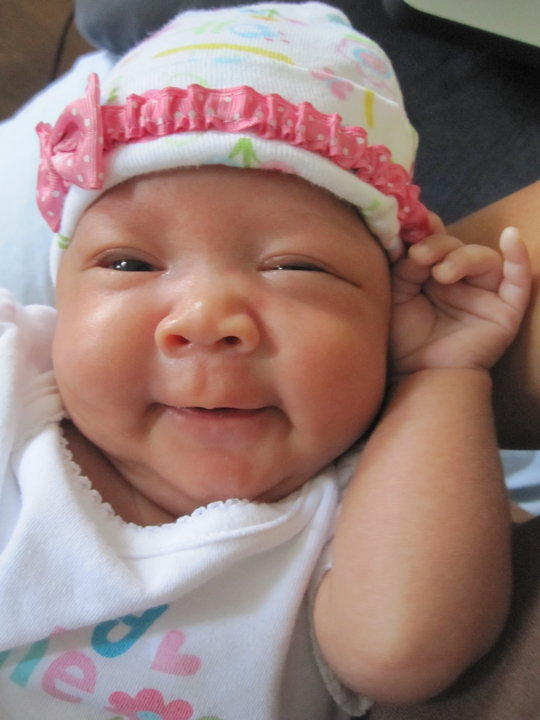
We are proud to announce the arrival of our little miss princess, Kili`ohu `A`ali`ikumakani Pulama`iaku`upualei Farm. She was born on May 27 at Kapiolani Women & Children’s Center.  She weighed 4 pounds 15 ounces and 17 inches long.  Her proud parents are Ale`a Arce and Keoni Farm residing in Wailuku, Maui.  Her paternal grandparents are Valeny and (the late) Kimo Farm of Kainalu.  Great grandparents are John and Marion Dudoit of Kapa`akea and Gladys and Charles Lennox of Haleiwa.  Her maternal grandparents are Kuulei and Andrew Arce of Ho`olehua, Molokai.  Great grandparents are Anita Arce of Ho`olehua, Thelma Shimaoka of Wailuku and John amd Maggie Duvauchelle of Kaunakakai.  She is showered with love from her many aunts, uncles and cousins, especially Hokuao, Kamalua and Kule`a.

Kalaupapa Finding its Future

Thursday, July 22nd, 2010

Kalaupapa’s breathtaking sea cliffs, Hansen’s disease patients living and passed, and historic Damien structures are just a few of the many facets of the peninsula’s rich and poignant culture deserving of preservation. Over the next two years, a new general management plan will take form to ensure the history is remembered and the future well-planned. A draft plan and several alternatives are now being compiled for public review.

Last year, the National Park Service (NPS), which serves as the main steward of Kalaupapa, conducted public scoping on five different islands. Nearly 1,500 people sounded off on the future of Kalaupapa.

The Pecking Order

Thursday, July 22nd, 2010

The Pecking Order

Opinion by Catherine Aki

In my first commentary on Molokai social structures, I described how local businesses choose to remain non-political in order to maintain healthy relationships with all customers. This week, I will try to explain pecking order.

The pecking order on Molokai is difficult for newcomers to understand. I am going to try to explain it in such a way that newbies can comfortably find their place within our community. However, remember, I did not make the rules; I am just trying to explain our community based on my observations. Locals, you folks know these things so this is for those who don’t.

The Metaphor
People rooted in Molokai from the beginning of Hawaiian time are an “endemic species”. They can only be found on Molokai. East End families are the biggest grouping of endemic Hawaiians. Land there has belonged to some families for many generations and is not considered a commodity. Land is instead a place where the bones of ancestors rest. This connectedness cannot be bought or sold. Endemic Hawaiians are very involved in day-to-day living and interacting with family. These values have and will continue for generations into the future.
 
“Indigenous” Molokai Hawaiians are found predominately in Ho`olehua and other homestead areas. Most, but not all, have been here for a few generations and originally come from other islands. They have family here and elsewhere and are therefore indigenous. They, too, focus on day-to-day living and close bonds with family and friends.
 
The next group, of which I am a part of, is “Polynesian-introduced.” I was brought to Molokai by a Hawaiian and remain connected through children and grandchildren. This group may not be fully integrated into the Hawaiian communities but we observe and celebrate the culture with family.
 
The next group could be called a “non-native species.” Non-natives include generations of Chinese, Japanese and Filipino who came when plantations started on other islands and later on Molokai. They have extensive networks and organizations within their own groups.
 
The aggressive nature of Westerners suggests that many people from the mainland fall into the category of “invasive species.” Sometimes we westerners don’t see ourselves the way others do. We see ourselves as entitled to our opinion without realizing we are entitled to keep them to ourselves as well. We often have no family here, only newly formed friendships. We mention the number of years we have lived here to establish seniority within our group.
 
So what does this metaphor mean in terms of Molokai? It means that if you have lived here for less than five years, most likely you lack the depth of relationships of people who have been here since the seventh century, or at least for several generations.

What Molokai’s pro-developer group does not seem to understand is that relationships are a key component to Molokai’s culture; relationship to families, the land, the ancestors, cousins, classmates and friends. Those relationships are the foundation which is creating the future. You suppose to know your place in order to be in the future of Molokai.


Metal Recycling to Resume

Wednesday, July 21st, 2010

After seven months with no metal recycler on Molokai to dispose of junk cars and appliances, the County of Maui has secured a new contractor to run the island’s facility.

Kitagawa Towing, a metals recycling company based on Maui, will oversee the disposal of metal scraps, appliances and junk cars with an event-based collections program on Molokai. The public can dispose of metal material for about two weeks during the collection events, which are expected to take place two to four times per year.

Patience Gaia, vehicles and metals administrator for the county’s Solid Waste Division, said the first Molokai collection event will be held within the next sixth months.