



Aligning our Piko: Kamākou to Mauna Kea
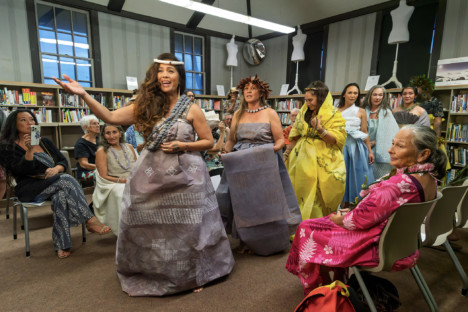
Kumu Kanoelani Davis leads the participants in the Kū ‘A’ahu Wearable Arts Show at Molokai Public Library Feb. 19. Photo by PF Bentley
By The Molokai Dispatch Staff
The Molokai Public Library recently became more than a place for books. For evening, it served as a gathering space for remembrance, reflection and renewed commitment to ʻāina through Aligning Our Piko: Kamākou to Mauna Kea, which brought together the 26th installation of the Kūkulu Exhibit and the Kū ʻAʻahu Wearable Arts Show.
The Kūkulu Exhibit, envisioned by Pua Case as part of ongoing Mauna Kea education and awareness efforts, is community-driven and has traveled across islands and beyond. Supported in part by the Molokai Public Library, Hoʻakā Mana and dedicated community volunteers, the exhibit reflects years of commitment to protecting Mauna Kea from the proposed Thirty Meter Telescope.
Photographs line the walls, familiar faces of Molokai ʻohana who stood as kiaʻi and aloha ʻāina advocates. Some images capture keiki who are now parents themselves. Others honor kūpuna whose presence is still deeply felt though they have since passed. Together, the collection preserves moments of ceremony, courage, resolve and unity in defense of sacred ground and natural resources.
Traditional elements anchor the exhibit. Kāhili stand in quiet dignity. A lele, of a traditional native Hawaiian place for offerings, rests with intention by ʻOhana Molokai. Artwork and collected memories curated over the years by Case honor voices from Hawaiʻi and around the world who answered the call to protect Mauna Kea. The installation reads not only as documentation, but as living archive, a testament to relationship between people and mountain, past and present.
What distinguishes Molokai’s installation from the 25 before it is Kū ʻAʻahu.
Kumu Kanoelani Davis drew from her extensive knowledge of hula and traditional healing arts to guide a small hui of participants through an immersive creative process. While no hula was performed, her foundation informed the structure and intention of the work. Each member selected and studied an element and akua associated with Mauna Kea, observing natural phenomena, exploring moʻolelo, and reflecting on ‘Ike kupuna. From that study emerged design.
Using bamboo stamps known as kāpala, participants carved patterns representing their chosen element. These designs were carefully printed onto ʻaʻahu, garments that came to embody wind, mist, snow or celestial expanse. Each finished piece was more than wearable art; it was an expression of interconnection, a reminder that the elements are not separate from the people who honor them. Davis reminds the listeners that as a culture the first part of control is disconnecting the people from their land and natural resources and that Kū ʻAʻahu reminds us of the connection and why we protect as Aloha ʻĀina. It’s because it is who they are.
The wearable arts show transformed the library into ceremonial space. With Hāwane Paʻa Makekau on the pahu, chants welcomed the gathering. Oli honoring Mauna Kea filled the room as participants entered adorned in their creations, carrying themselves with humility and the ʻike gained through process.
Lei were presented to kūpuna in attendance, a gesture of gratitude for foundations laid and pathways cleared. It was a visible acknowledgment of kuleana passed from one generation to the next.
Many in the audience sat in stillness. Some wiped away tears. Others watched with widened eyes as tradition and contemporary expression moved together seamlessly.
Participants later described the experience as life-changing. Several expressed interest in continuing the work, sharing that the process deepened their understanding of identity and strengthened their connection not only to culture, but to ʻāina itself. For some, it reaffirmed genealogy and responsibility. For others, it sparked new commitment.
Aligning Our Piko: Kamākou to Mauna Kea served as a reminder that the protection of sacred places is not confined to a single moment in time. Through images, memory, chant and cloth, the Molokai community demonstrated that culture is not static; it is practiced, studied, worn and carried forward.
In aligning piko, spiritual and genealogical centers the gathering affirmed what many here understand: caring for Mauna Kea is inseparable from caring for one another.

 Add your comment


Don't have a Molokai Dispatch ID?
Sign up is easy. Sign up now
You must login to post a comment.
Lost Password