



Mauna Kea Authority Collecting Public Input
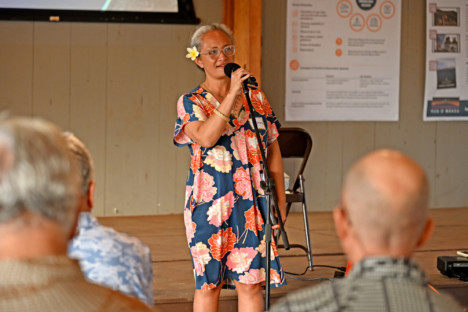
Facilitator Mahina Paishon is seen here at the Mauna Kea Stewardship and Oversight Authority meeting last week. Photo by Léo Azambuja
By Léo Azambuja
Mauna Kea Stewardship and Oversight Authority officials came to Molokai last week as part of a statewide tour to gather public input toward a new management plan being crafted for when they take over the lease of Mauna Kea’s summit on Hawaii Island in a couple of years.
“I really urge you to just share your deepest naʻau, your manaʻo about Mauna Kea, about the ways that properly mālama our very important wahi pana and help us develop the management plan that we think is the best management plan we can possibly come up with in order to make sure that the Mauna is there for generations,” MKSOA board member Noe Noe Wong-Wilson said through a video conference from Hilo on the slopes of Mauna Kea.
The authority, comprising community members, lineal descendants and educators, aims to create a management plan before they take over the lease management and land use at Mauna Kea’s summit from the state Board of Land and Natural Resources and the University of Hawaii by July 1, 2028, as established by the state Legislature through Act 255 in 2022.
About 20 people attended the public meeting at Kulana ʻOiwi on the evening of Jan. 29. The meeting focused on community input regarding several issues.
Some of the key points brought up at the meeting included the need for a permitting system to manage recreational use, ensuring cultural compatibility, and addressing social justice issues.
Participants emphasized the importance of education, enforcement and traditional knowledge to protect the sacred site. They discussed the impact of modern recreational activities, such as ATVs and snowboarding, and the need for strict biosecurity controls.
The conversation also highlighted the necessity of involving frontline activists and homesteaders in decision-making processes.
A video presentation by Dr. Pualani Kanakaʻole Kanahele explained Kānāwai, one of four core values that MKSOA is using to craft the Strategic Framework and Management Plan for Mauna Kea.
Kānāwai, according to Kanahele, is observing the four laws of nature that govern the relationship to the ʻāina, and are meant to ensure its health will continue to nurture all life forms. These natural laws include the orders of continuum, emergency, boundaries and regeneration.
MKSOA’s guiding principles are a commitment to community engagement, land use controls, protection of Native Hawaiian rights, restoration of natural resources, the significance of Mauna Kea and a support for astronomy.
The construction of the Thirty Meter Telescope — an optical-infrared, next-generation telescope with a 30-meter aperture — was scheduled to begin in 2014, after the BLNR approved a sublease on Mauna Kea’s summit in July of that year. UH was a key player in the TMT, acting as a lessor for the site where the multi-country project was planned.
However, legal challenges and protests were already brewing in 2014. Hawaiians consider Mauna Kea a sacred site, and were already opposed to the existing 11 telescopes and associated facilities operated by observatories from 11 countries at Mauna Kea’s summit.
The movement “We Are Mauna Kea” gained momentum in 2019, when protests against the TMT escalated. Dozens of protestors, including kūpuna, were arrested during a siege of Mauna Kea, which halted construction for extended periods.
The persistence of the activists paid off; the state Legislature established MKSOA in 2022 to take over the lease management of Mauna Kea’s summit in 2028.
Although the TMT still has an active permit on Mauna Kea, their plans and timeline are currently uncertain, according to MKSOA.
“We’re not talking about telescopes yet, although we can certainly talk about astronomy, we’re not afraid to talk about that subject. But our belief is, you got to have the vision and the plan first before you talk about any of the human behaviors,” MKSOA board member Neil Hannahs said. “Unless you know what that vision is, and strategic framework is, you cannot regulate astronomy.”
Besides the meeting on Molokai, MKSOA has already held two public meetings on Oahu, and meetings on Maui and Kauai. They will now hold meetings throughout Big Island on Feb. 4, 5, 11, 18 and 19.
Visit kuaowakea.org for more information.

 Add your comment


Don't have a Molokai Dispatch ID?
Sign up is easy. Sign up now
You must login to post a comment.
Lost Password